Invoice Builder keeps the accounting file in your hands
Invoice Builder is aimed at freelancers and small businesses that want to make invoices without opening another cloud account. The desktop app stores records in a SQLite file chosen by the user. A web deployment can use the same database style or connect to PostgreSQL. There is no subscription layer in the project itself, and the MIT license permits broad use and modification. That is a clean proposition for a solo operator.
The document model covers invoices and quotes, with payment states, partial payments, discounts, shipping, taxes, multiple currencies, and reusable business records. A document captures snapshots of its business, bank, style, client, item, and currency data. Later edits to those source records do not silently rewrite old invoices. That historical behavior matters more than a long feature list once documents have been sent to customers.
PDF control is extensive, while compliance still needs checking
PDF output can use A4 or Letter pages, preset layouts, bundled fonts, brand colors, logos, signatures, attachments, watermarks, custom labels, reordered columns, and payment QR codes. Live preview makes this practical for users who care about presentation. The README also lists 4 interface languages: French, German, English, and Lithuanian, with a separate language choice for each invoice or quote.
Electronic exports include UBL 2.1, Peppol BIS Billing 3.0, and XRechnung. The project describes these outputs as compliant, but an invoice's legal adequacy can depend on jurisdiction, buyer rules, tax handling, and the validation or delivery network used. Before replacing an existing billing system, run representative documents through the official validator and receiving process your customers require. A repository claim should begin that check, not end it.
What happened when we ran it
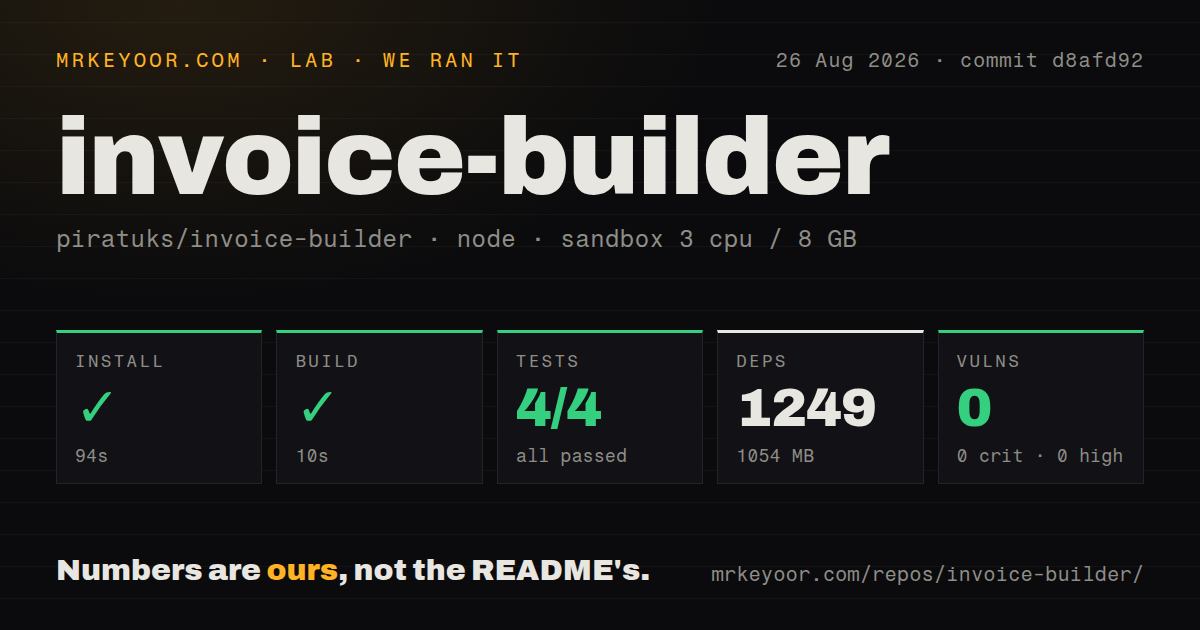
Our sandbox installed 1,249 npm packages in 94 seconds and occupied 1,054 MB. The build succeeded in 10 seconds. Npm audit reported 0 known vulnerabilities at critical, high, moderate, or low severity. The measured commit was d8afd92 in a fresh, unprivileged Node 22 Debian container with 3 CPUs and 8 GB of RAM.
Tests exited with code 1 after 10 seconds. Vitest reported 4 tests passed and 0 failed, but one of 2 test files could not load. The sqlite3 native module requested GLIBC_2.38, which was unavailable in the container's libm.so.6. That is a test-process failure even though every executed assertion passed. The log does not show whether rebuilding the module or changing the host is the project's preferred remedy.
The checkout held 739 files, about 40,390 source lines, and 53.3 MB before dependencies. It had 3 CI workflow files, a Dockerfile, and a Compose file. There was no top-level tests directory, while tests existed under source paths and Vitest found them. The 1,054 MB installed footprint is large beside the README's approximate 550 MB application figure, though those numbers describe different artifacts and should not be equated.
Desktop use avoids the web deployment's shared-state questions
For one person, the flow is direct: install the application, create or open a database, add a business, currency, client, bank, and item, then build a document. Full database backup, JSON export and import, and XLSX transfer for many entities provide several ways out. Invoices and quotes are export-only through the structured import path to preserve their history. Restore testing is still the user's job.
The Docker route runs backend and frontend containers, or combines both with a standalone Compose file. PostgreSQL is described as the choice for concurrent, multi-device use. Issue 215 reports a serious edge in the recommended 2-container setup with separate local database files: when a second user selected a database, the first user's refreshed view showed the second database. Teams should use PostgreSQL and test session separation before exposing the web app to multiple people.
Unsigned macOS packages demand an explicit trust decision
Windows 10 or newer, modern Debian-family Linux distributions, and macOS 11 or newer on Apple Silicon are listed as supported. The macOS package is unsigned. The README explains that Gatekeeper may label it damaged or unidentified, then instructs users to remove the quarantine attribute from the installed app with a sudo command. That is transparent documentation, but managed Macs may forbid the workaround for good reason.
Linux distribution is through a DEB package rather than an AppImage or distribution repository. Issue 203 asks for an AppImage. For organizations, packaging policy may decide the purchase before invoice features do. A Docker deployment can avoid desktop packaging, while adding server patching, database backup, authentication review, TLS termination, and multi-user verification to the owner's responsibilities.
Active releases sit beside a single-maintainer handoff risk
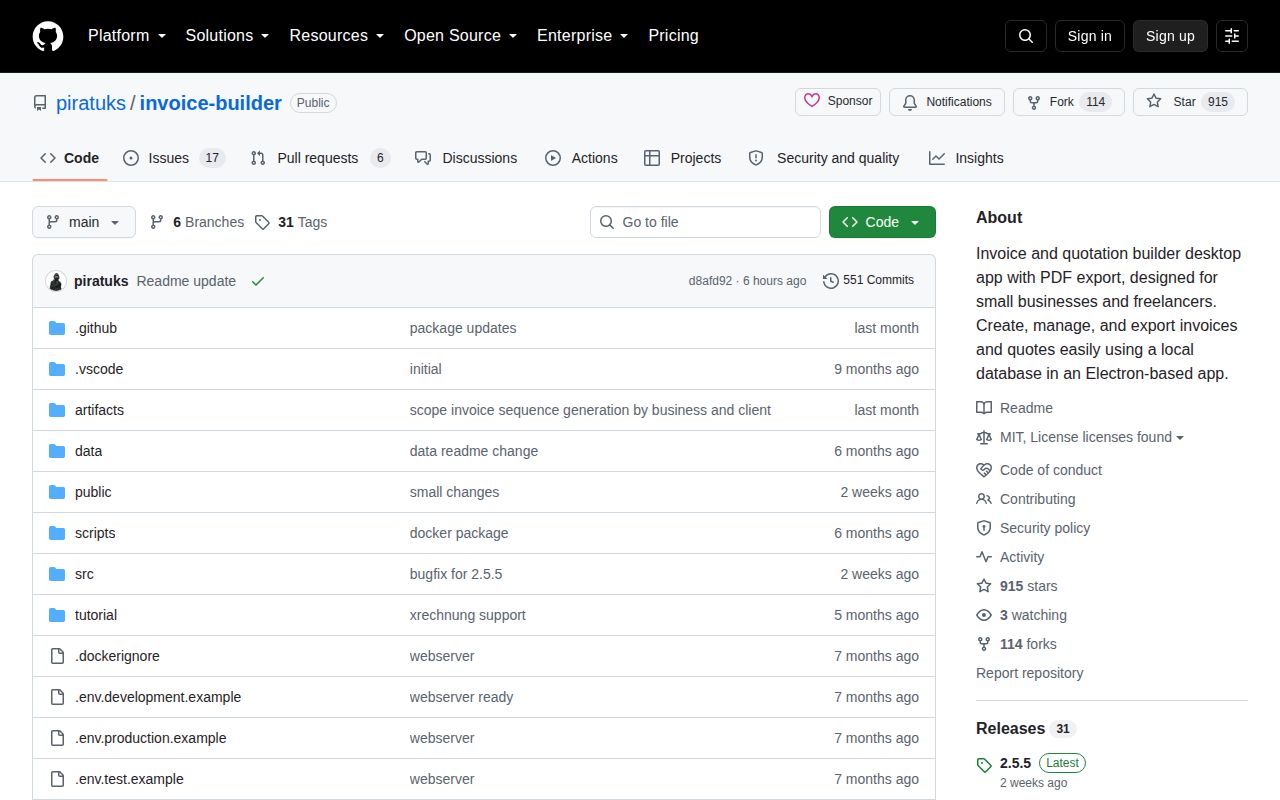
Release 2.5.5 shipped on August 10, 2026, fixing invoice-number uniqueness per business and client. GitHub recorded another push on August 26. The project had 915 stars and 23 combined open issues and pull requests when fetched. Current commits and same-month release activity show maintenance today, even with a modest community size.
The README also states that one developer maintains Invoice Builder and the project is open for asset-only acquisition. That does not make it unusable. It does change the risk calculation for a business whose invoicing process may last years. Keep database exports current, document the installed release, and confirm that another engineer can build the app before depending on the current maintainer's availability.
It is best as a private tool for one business
Invoice Builder's offline file, document snapshots, PDF controls, and import and export options form a coherent product for a freelancer. Our 10-second build suggests the source is approachable after its large install, while the GLIBC test failure warns that native dependencies need a matched build environment. The lack of mandatory accounts is a real advantage for private financial records.
A larger organization should test PostgreSQL concurrency, user separation, backups, signed deployment, and every required e-invoice case. Invoice Ninja or Akaunting makes more sense when the invoice sits inside a broader accounting or client workflow. For one operator who wants local ownership and verified backups, Invoice Builder is unusually capable.