Repeated search states are the problem it addresses
An arithmetic search can reach the same remaining numbers through different sequences of operations. Interference Search keeps explicit states, combines repeats, and advances a group of promising branches together. Its Countdown environment performs the arithmetic while a trained judge ranks the remaining choices. The useful distinction is where work happens: the environment executes moves, and the search controls which possibilities receive attention. A developer considering it needs a problem that can be represented that way.
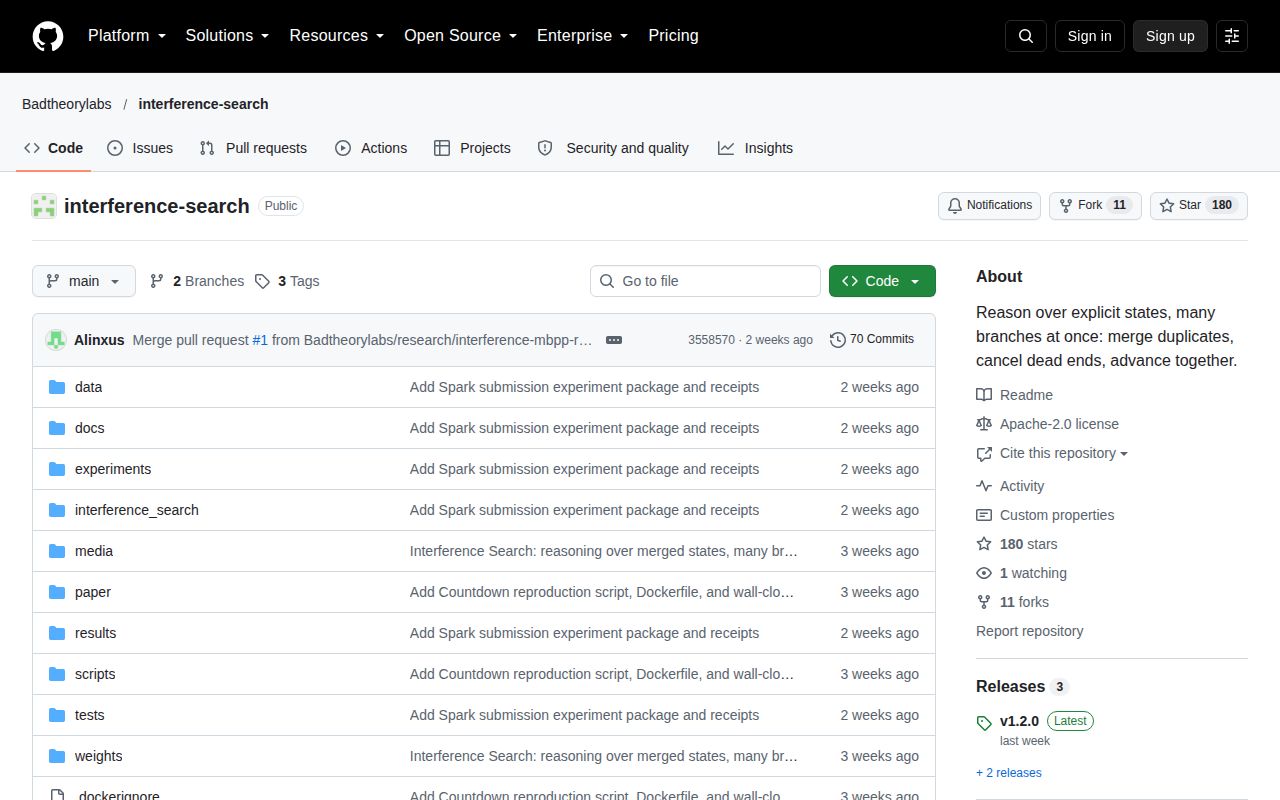
Our clone contained 432 files and about 18,303 source lines, with a 108 MB checkout before dependencies. Alongside the library are model weights, raw experiment results, and research notes. That gives a researcher more to inspect than a diagram of the idea. It also makes this a repository to read and adapt, rather than an assistant you install and immediately ask to fix a production application.
What happened when we ran it
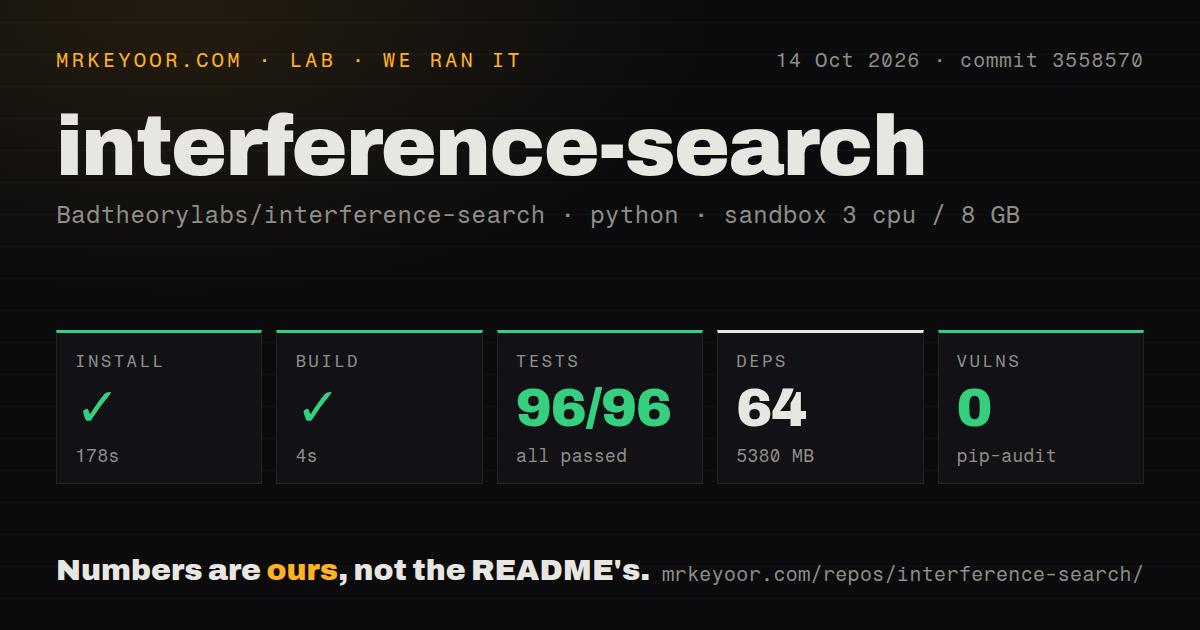
Our sandbox installed commit 3558570 in 178 seconds, pulling 64 packages and occupying 5,380 MB, then built successfully in 4 seconds. The October 14, 2026 run used an unprivileged Debian container with 3 CPUs, 8 GB of RAM, the uv Python 3.12 Bookworm image, and no secrets. Installation and packaging worked in that environment. The footprint is worth budgeting before keeping several experiment environments on the same machine.
The test command succeeded in 109 seconds. The supplied pytest record reports 96 passed, 0 failed, and 5 skipped, but also labels the total as 96. Those figures don't reconcile, so we retain the reported outcomes without calculating a pass percentage. Pip-audit found 0 known vulnerabilities. Our scan found a tests directory and a Dockerfile, with 0 CI workflow files. None of these results measures search quality on a new task.
A custom domain must define what counts as the same state
The search-loop source asks a domain to supply its starting state, proposals, merge key, judge, and goal or dead-end decisions. These are the substantive parts of an integration. In Countdown, remaining arithmetic possibilities provide a clear state. In a browser or coding task, apparently similar situations may still permit different actions. An incorrect merge key can discard a branch that had a distinct route to success.
The 5,380 MB environment buys you working components, not a ready-made definition of equivalence for your product. The newer frontier selector explicitly separates exact repeats from behavior signatures. Matching visible outputs can help keep a diverse set of candidates, but it does not prove programs will behave identically on unseen inputs. That care makes the source worth studying. You still have to decide which properties survive later revisions and which observations only describe a particular evaluation set.
The arithmetic result does not establish a coding-agent advantage
The README's results discussion says the experiments use a single seed and calls the coding comparison within noise. Its Countdown search uses a small trained judge and environment-generated moves rather than running the language model for every choice. That changes the interpretation of any speed comparison. The project is forthright about the systems differing, which is more useful than treating the result as proof that all model reasoning should be replaced.
Our 109-second test step confirms an available developer check completed. It cannot settle the research claim. The repository also records approaches that did not help, including prompting the model about previous failures and using a prompted judge. Those negative findings are a reason to read the research log before copying a technique. For adoption, I would require a task-specific comparison against a simpler search using the same proposals, budget, and evaluation conditions.
Linux covers the basic search, while MLX experiments need Apple Silicon
The documented arithmetic search and judge run wherever PyTorch does. The language-model experiments use MLX and require Apple Silicon, with Linux explicitly excluded from that documented path. A Linux developer can therefore inspect the algorithm and reproduce the arithmetic workflow without being able to follow every experiment unchanged. Choose the part of the project you actually need before assuming the optional language-model dependencies provide a portable execution route.
Our build took 4 seconds on Linux, which says nothing about the Apple-only experiments. Generated-code execution has another boundary: the newer isolated Python runner calls system sudo, prlimit, and bubblewrap, runs as nobody, and removes network access. Those requirements are visible in the source. The older program-domain runner uses a subprocess with timeouts. Check which runner your experiment invokes before assuming identical isolation or host prerequisites.
October activity supports research use with a narrow recommendation
GitHub recorded a last push on October 3, 2026, with release v1.2.0 on the same day, 180 stars, and no open items in its combined issues and PRs count. The visible issue history includes a closed research pull request. This shows recent work, but little public discussion from which to judge support under unfamiliar workloads. Apache-2.0 covers the project code, while the README separately identifies the sanitized MBPP data's license.
Tree of Thoughts is the more direct comparison for prompt-based branching research. LangGraph fits persistent agent workflows with human intervention. Interference Search deserves a trial when repeated states are wasting effort and you can define them accurately. Keep the 64-package local setup separate from the scientific decision: the useful experiment is whether your state definition preserves good solutions while spending less effort on duplicates.