This is the product source, not an IDE download
IntelliJ Community contains the open-source code behind JetBrains IDEs and the IntelliJ Platform. It is useful for changing platform behavior, contributing language and tooling features, or tracing how a public API works internally. Someone who only wants to write Java or install a normal plugin should download IntelliJ IDEA instead. The source tree exists for platform work.
Scale changes every part of that work. Our checkout had 276,721 files, about 12,425,622 source lines, and occupied 999.3 MB before build outputs. A shallow clone can omit history, as the README suggests, but it does not make the current tree small. Clone performance, filesystem limits, IDE indexing, and target selection all matter before a contributor changes code.
Bazel is required while the migration is still incomplete
The README says the project is moving to Bazel and that building through only the IDE's built-in facilities is no longer supported. Contributors need IntelliJ IDEA 2026.1 or newer and the Bazel plugin, then open the repository's .bazelproject. If required plugins such as Kotlin are missing or old, the IDE asks for installation or an update before the project is usable.
The migration has an explicit gap: some tests cannot yet run with Bazel. JetBrains points those cases to tests.cmd, a script that accepts test configurations or class patterns. Full community builds use bazel-build-all-community.cmd; running the IDE uses ./bazel.cmd run //build:idea_community; installer production has another command. This is clear documentation for a changing system, though it leaves contributors with two test routes during the transition.
IntelliJ IDEA also requires Android modules from separate repositories. The supplied script fetches them, and the README warns that the main and Android repositories must stay on matching branches or tags. That is a concrete source-sync obligation. A clone of the main repository alone does not contain everything needed for the IDEA product build.
What happened when we ran it
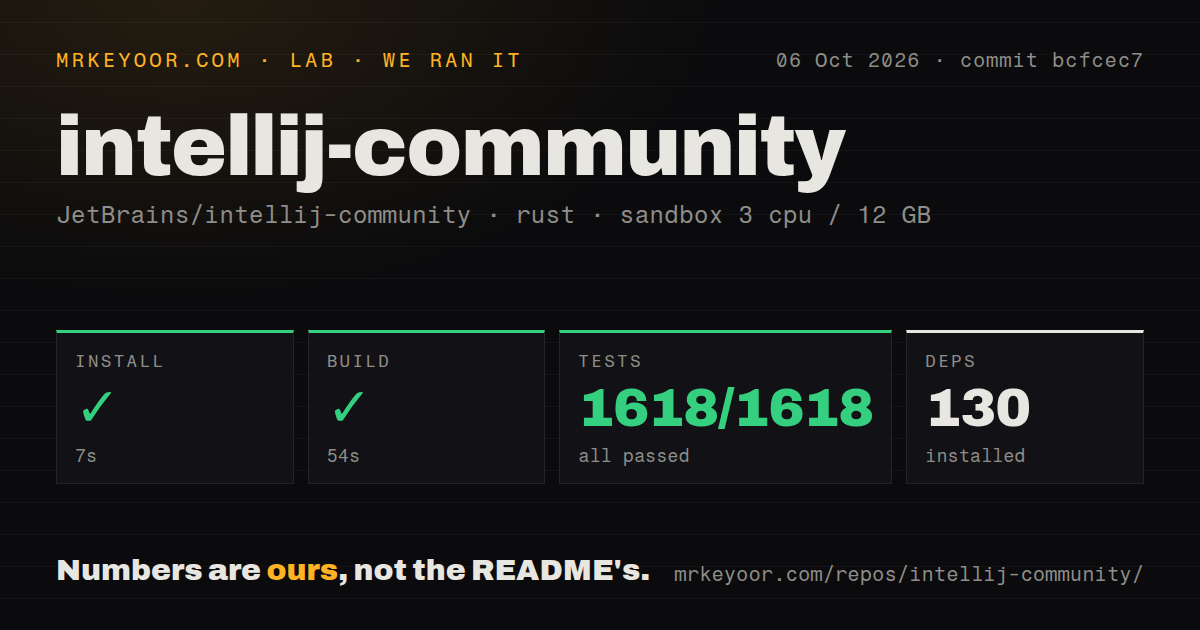
Our harness selected build/content-module-packer, a Go component inside the much larger repository. It installed 5 Go packages in 23 seconds and built that component in 16 seconds. Its test run then passed all 12 tests in 6 seconds, with 0 failures. These results are useful for that packer and no broader.
The measured path is a tiny fraction of roughly 12,425,622 source lines. It did not build IntelliJ IDEA, fetch the separate Android modules, run the Bazel community target, create installers, or execute the platform's Java and Kotlin suites. Calling the entire repository verified from 12 Go tests would misrepresent what our sandbox did.
We used commit 7f484d2 in a fresh Go 1.24 Debian container with 3 CPUs, 8 GB of RAM, no secrets, and no elevated privileges. The repository had 6 CI workflow files and a tests directory but no Dockerfile detected by the harness. The README does document a Dockerized installer-build environment, including a host-user mapping to prevent root-owned outputs.
The documented paths are precise but aimed at contributors
Windows users receive Git settings for long paths and line endings before cloning. Unix and Windows scripts are named separately where needed, while the *.cmd build scripts are documented as working on both systems. The README also shows how to pass installer properties, attach a debugger on port 5005, set JUnit working directories, and run one CI test pattern. These details reflect real contributor needs.
What it does not do is shrink the domain. IntelliJ Platform code spans editor infrastructure, project models, indexing, VCS integration, languages, build tooling, and desktop UI. A first contribution still requires finding the correct module and its tests. The contribution guide is the appropriate next document; the root README mainly gets a prepared developer into the source and onto the supported commands.
Licensing also needs file-level attention. GitHub reports no single SPDX license for the repository, and the README carefully calls this the open-source part of the JetBrains IDE codebase. A company building a fork should inspect the notices and module licenses it redistributes instead of assuming every JetBrains product component is present or covered identically.
Current pull requests show active platform work
GitHub recorded the last push on August 25, 2026. Recent pull requests that day covered the Jewel UI library, Compose, GitHub integration, Kotlin behavior, Linux file watching, and Python type information. GitHub Issues are disabled on this repository, so the reported 155 open items are pull requests, not a combined defect queue. JetBrains directs product reports through its own tracker.
The latest GitHub release is pycharm/2026.2.1, published August 12, 2026, with notes linked to YouTrack. That tag illustrates the repository's shared-product role: releases are named for an IDE built from parts of the tree, rather than one simple library artifact. Contributors must match branches and build numbers to the platform version they target.
Clone it only when the platform itself is the work
IntelliJ Community is the right source when a bug or feature belongs upstream, an internal platform behavior must be understood, or a substantial fork is intentional. The active JetBrains development, detailed build commands, and 12 passing packer tests are reassuring within their proper scope. None removes the cost of a million-line product family.
For a normal plugin, the published IntelliJ Platform SDK and plugin template keep the dependency boundary smaller. For IDE users, the packaged distribution is the answer. The 999.3 MB checkout earns its place only when access to the implementation is the point of the task.