The repository is for Ink developers, while Nextra has its own starter
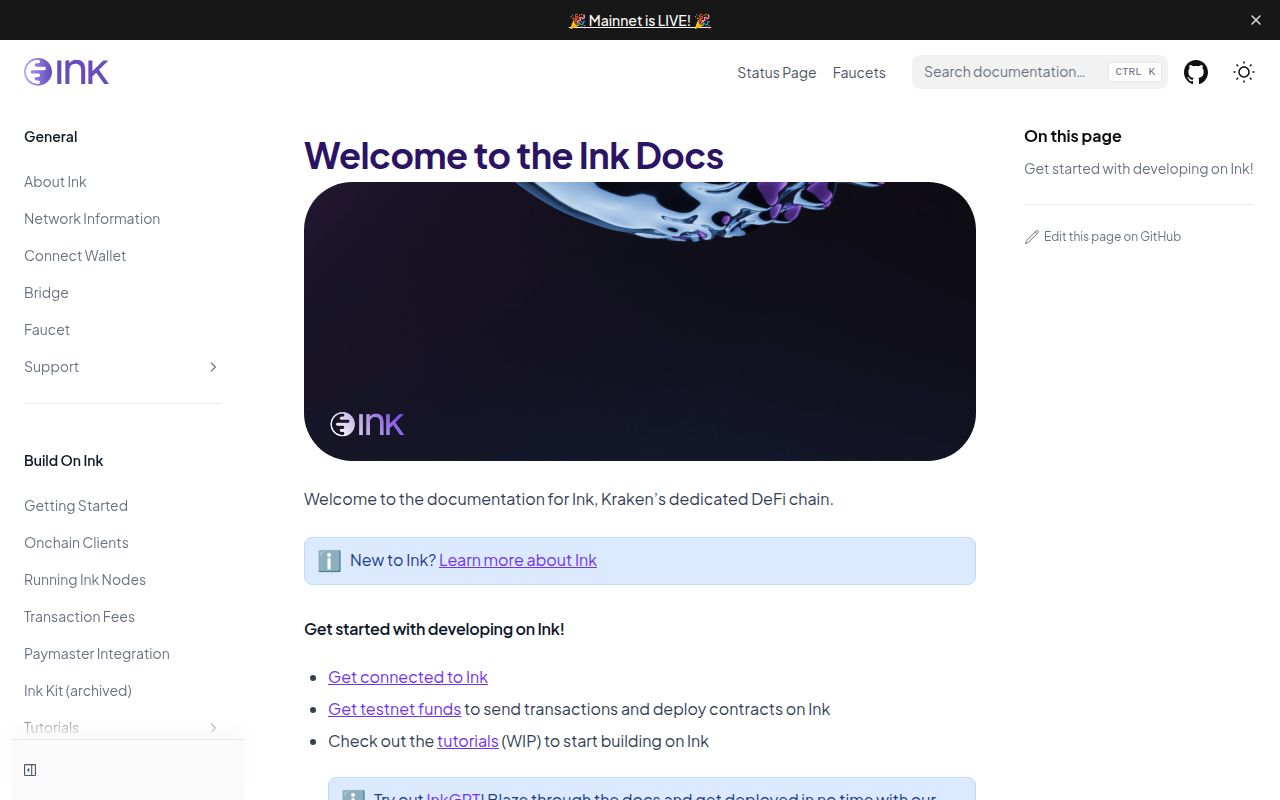
Ink Docs publishes the official working material for mainnet chain ID 57073 and Ink Sepolia chain ID 763373. Its MDX pages cover adding the networks to a wallet, obtaining test funds, choosing an RPC provider, deploying contracts, checking fees, and finding bridges or explorers. Ink itself is an OP Stack layer 2 in the Superchain, backed by Kraken and aimed at decentralized finance applications.
That makes the repository useful in two direct ways. Developers can read the source behind a guide when rendered text is unclear, and contributors can propose a correction next to the component that displays it. The getting-started page recommends Foundry or Hardhat, links a Remix path, and suggests holding at least 0.01 ETH for standard deployments. Those are Ink-specific instructions, not neutral examples for a new documentation site.
Next 15.5.24 and Nextra 3.3.1 keep content close to code
The application uses Next.js 15.5.24, Nextra 3.3.1, React 18.3.1, and the Pages Router. MDX files live under src/pages, while React components handle copy buttons, network controls, navigation, and page metadata. A contributor edits prose and interface code in one repository, then runs JavaScript linting, MDX linting, formatting, spell checking, and the production build through pnpm scripts.
The Pages Router choice is deliberate according to the README, which says compatibility has held back an App Router move. That is fine for this site. It is less attractive as the base for a new project where you want current Next.js conventions and control over future migrations. Nextra's own repository is the cleaner starting point for that job; Ink's code arrives with chain content, brand assets, custom components, and deployment assumptions attached.
What happened when we ran it
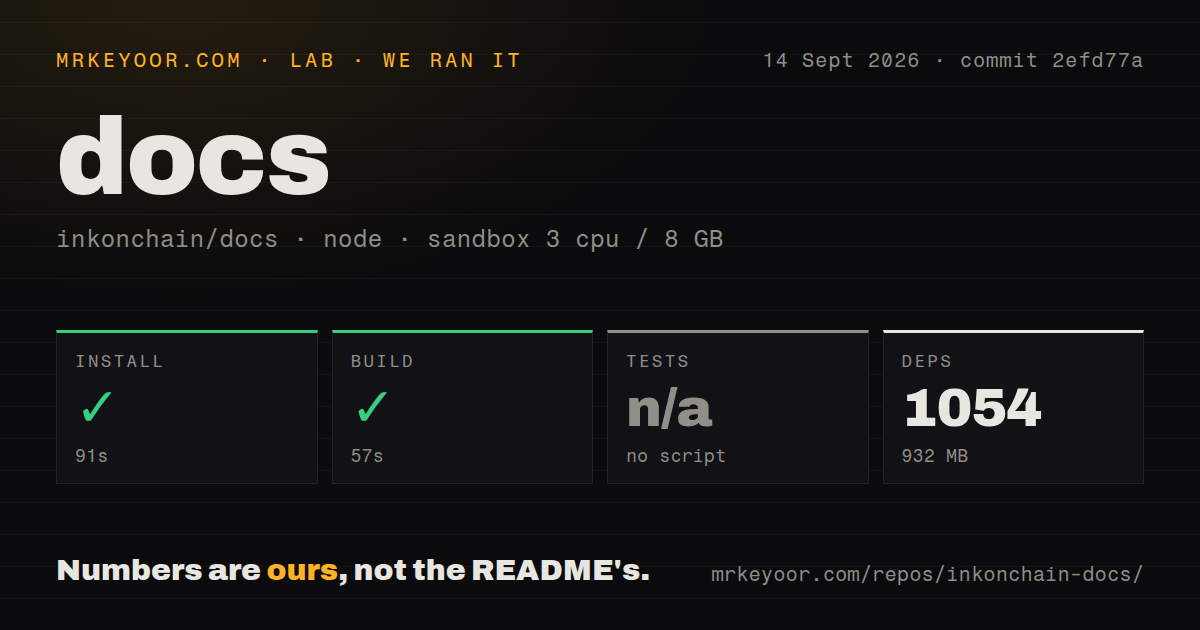
Our sandbox cloned commit 2efd77a into a fresh unprivileged container with 3 CPUs and 8 GB of RAM. The pnpm install succeeded in 91 seconds, adding 1,054 packages and occupying 932 MB. The production build passed in 57 seconds. That is a working build, though the installed tree is substantial beside a 21.6 MB checkout with 152 files and about 1,380 source lines.
There was no test script or target, so we skipped tests rather than turning a missing command into a pass. The scan also found 2 CI workflow files, no Dockerfile, and no tests directory. Build success proves that the documentation application compiled in our stated environment. It does not test wallet switching, copied network values, outbound links, heading anchors, or the instructions inside each code example.
The README's Docker and hosting paths no longer match the repository
The README's first production command is docker build -t docs ., yet commit 2efd77a had no Dockerfile. The current root listing still has none. A new contributor who follows that path reaches a dead end before the application starts. The working local route is pnpm, and the package configuration pins Node 22.14.0 with pnpm 9.12.3 even though the README lists Node 20.11 or newer.
Deployment instructions have drifted too. The README says pull requests and the main branch deploy through AWS Amplify. The current CI file uses Vercel for both, with previews limited to branches inside the repository because forked pull requests cannot access the token. This changed on September 14, 2026, when pull request 670 moved deployment to Vercel. The source now explains production better than the front door does.
Missing license terms make reuse a separate decision
GitHub reports no detected license for the repository, and the root contains no license file. You can read the public source and submit a patch through GitHub. Copying the theme, components, or a large body of text into another product raises a different question because the repository does not state reuse terms. Organizations that need clear permission should get that clarification before treating Ink Docs as a template.
The absence is easy to miss because the project looks like a normal public web repository. It has a lockfile, 2 workflows, lint scripts, and public contribution activity. None of those grants a software license. Nextra has its own upstream repository for teams choosing a docs framework; Ink Docs is best approached as the maintained source for this particular publication.
Thirty open issues point to content and interface gaps
On September 15, 2026, GitHub search returned 30 open issues and 59 open pull requests. Issue 669 identifies an onchain-clients section that promises a block-number example but contains no snippet. Other current proposals address a wallet-network race, duplicate heading IDs, broken edit links, stale explorer entries, and social-image dimensions. These are specific faults readers can encounter, even though our 57-second build stays green.
The homepage also labels its tutorials as WIP. The About page says sub-second blocks are coming, which is an aspiration rather than current behavior. Read chain IDs and RPC addresses from the maintained network page, then verify any operational value before putting funds or production traffic behind it. Documentation for a live chain changes with the chain and its provider list.
September 14 activity outweighs the lack of release tags
The last push was September 14, 2026, when the repository removed a Kraken Verify page. Two other pull requests that day changed hosting and removed old hosting material. GitHub showed 36,504 stars, while the latest-release endpoint returned no published release. For a continuously deployed documentation site, missing release tags do not establish neglect; recent merges and the open queue show active work.
Ink developers should keep the site bookmarked and use the repository when a page needs correction. Maintainers should fix the README before inviting more outside contributions, add behavior checks for the interactive pieces, and declare reuse terms. Until then, the 57-second build is the reassuring part, while the missing test target, Dockerfile, and license are the details that decide how far you should take the code.