A field manual, not a scanner
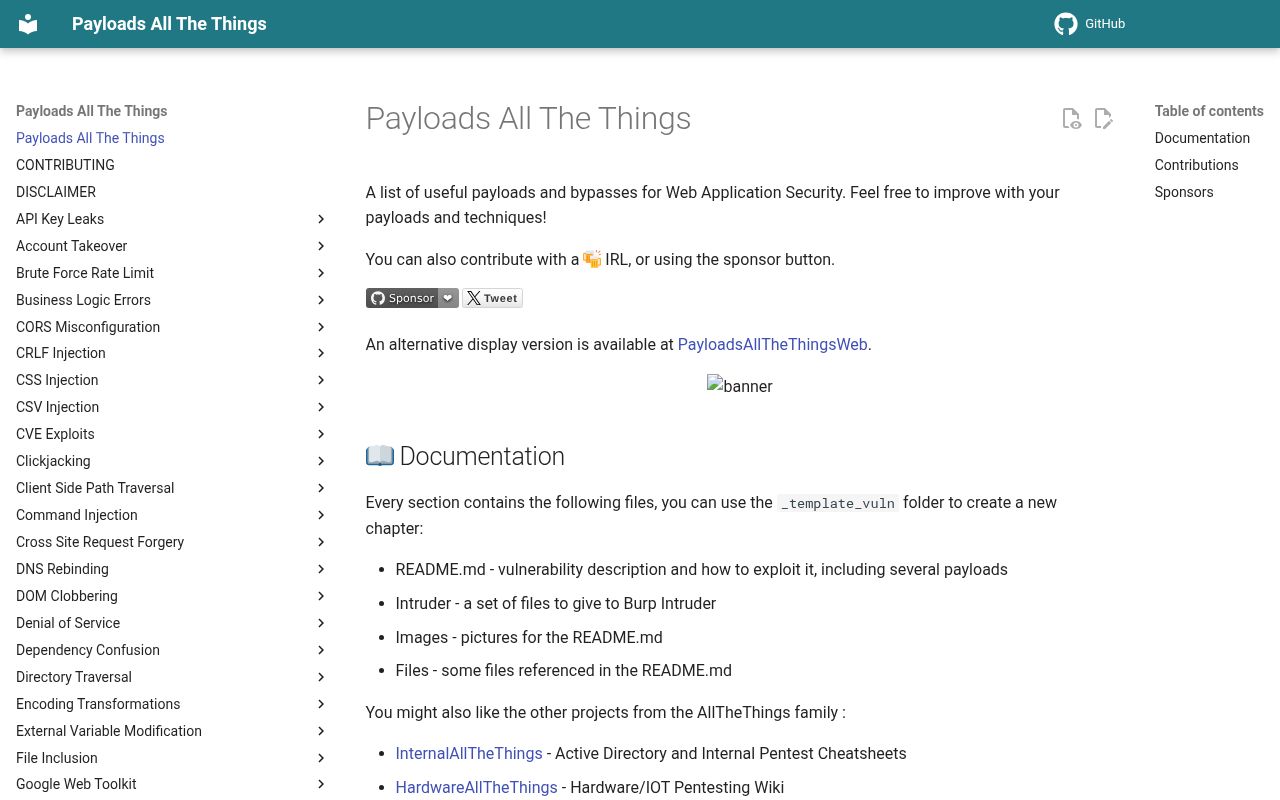
PayloadsAllTheThings organizes offensive web security knowledge by vulnerability class. A chapter usually explains the flaw, links relevant tools, lays out a testing method, provides payloads, points to labs, and cites further reading. The repository also carries files meant for Burp Intruder, images, and artifacts used by individual techniques. A hosted MkDocs version makes the same material easier to browse.
Its value appears after a tester has a hypothesis. If an application behaves like it may be vulnerable to SQL injection, the corresponding chapter separates database-specific checks, error behavior, timing tests, authentication bypasses, WAF evasions, tools, and practice targets. That is much more useful than a flat dump of strings. The tester can understand why an input exists before adapting it to the application.
This is not an automated assessment. It will not discover attack surface, maintain session state, prove exploitability, or decide whether a response is a true finding. Those tasks stay with the tester and their tools. The repository supplies raw material and working notes, which is exactly why it is useful and why careless use is dangerous.
What happened when we ran it
There are no lab install, build, or test results for commit 3bff425. The harness classified the repository as Python but found no supported ecosystem entry point and no Dockerfile. The checkout is documentation-led rather than an application described by a package manifest and runnable command sequence.
That finding changes how to read setup claims. The main README invites readers to use the Markdown or hosted site; it does not promise a local security tool. Individual chapters may reference sqlmap, Burp Intruder files, callback domains, databases, or vulnerable labs. We did not execute those techniques, and a chapter's presence should never be read as a successful reproduction against a current target.
The contribution guide does document one optional Docker command for markdownlint. It also requires contributors to sanitize examples with placeholder domains, private test IP addresses, generic account names, and sample passwords. Those rules reduce the chance of publishing live targets or secrets. They do not make an offensive payload safe to fire at an arbitrary endpoint.
Why the organization works
The topic map is broad without being a single endless page. Dedicated areas cover SQL and NoSQL injection, XSS, SSRF, request smuggling, deserialization, OAuth mistakes, race conditions, prototype pollution, prompt injection, reverse proxy configuration, and many other web security problems. Technology-specific material lives below those headings, so a tester can narrow the search after fingerprinting the target.
Chapters often include the missing middle between a definition and a payload. The SQL injection material, for example, describes entry-point checks, database identification, several exploitation families, and the behavior that makes each check informative. It also warns that a common always-true authentication payload can interact with endpoints that delete sessions, files, configuration, or data. That warning is the right tone for a collection people may use under time pressure.
References are part of the contribution format rather than an afterthought. Submissions must include an author, title, link, and date, with archived copies for dead sources. External material can still become stale, and a citation does not verify a technique on today's target. It does give readers a path to the original research instead of forcing them to trust an isolated snippet.
Where it can mislead
A large payload collection encourages cargo-cult testing. Context decides whether quotation marks, encodings, callbacks, or timing delays mean anything. Copying a string without understanding the parser, database, framework, and response path can produce false negatives or unintended writes. Payloads also outlive the product versions and mitigations that made them useful. Reproduce each technique in a disposable environment before relying on it in a customer engagement.
The material is weighted toward finding and exploiting weaknesses. Developers who need to fix a bug should pair it with the affected product's security guidance and a defensive source such as the OWASP Cheat Sheet Series. SecLists is a better input when a fuzzer needs large wordlists. HackTricks reaches further into hosts, cloud systems, and privilege escalation when the engagement is broader than web applications.
The legal boundary is explicit. The disclaimer permits educational and research use only within applicable law and on systems where the user has permission. A useful internal process should be stricter: written scope, named targets, allowed techniques, time windows, data-handling rules, and an emergency contact. The repository cannot supply authorization merely because its content is public.
Maintenance and the decision
The last push was August 9, 2026. Open work in July and August included email-based SSRF, Zip Slip, upload tooling, and real-world examples. GitHub listed 34 open issues and pull requests, and the most recently updated items were largely proposed content changes. That activity shows ongoing maintenance even though the latest tagged release, 4.2, dates to July 26, 2025. A year-old release tag alone does not make a documentation repository stale.
Release 4.2 added reverse proxy misconfigurations and external variable modification, expanded several established sections, repaired links, and added automated Markdown linting. The master branch has continued moving since then, so readers who need the newest material should browse current documentation rather than treating the tag as the complete current edition.
Use PayloadsAllTheThings as a searchable notebook during authorized web testing. Its mix of explanation and ready inputs is better than a bare wordlist, while its topic structure is faster than reconstructing each technique from scattered posts. It does not replace judgment, a testing methodology, or defensive remediation guidance. That boundary is the difference between a useful reference and reckless copy-paste.