One desktop app combines a library, downloader, and social profile
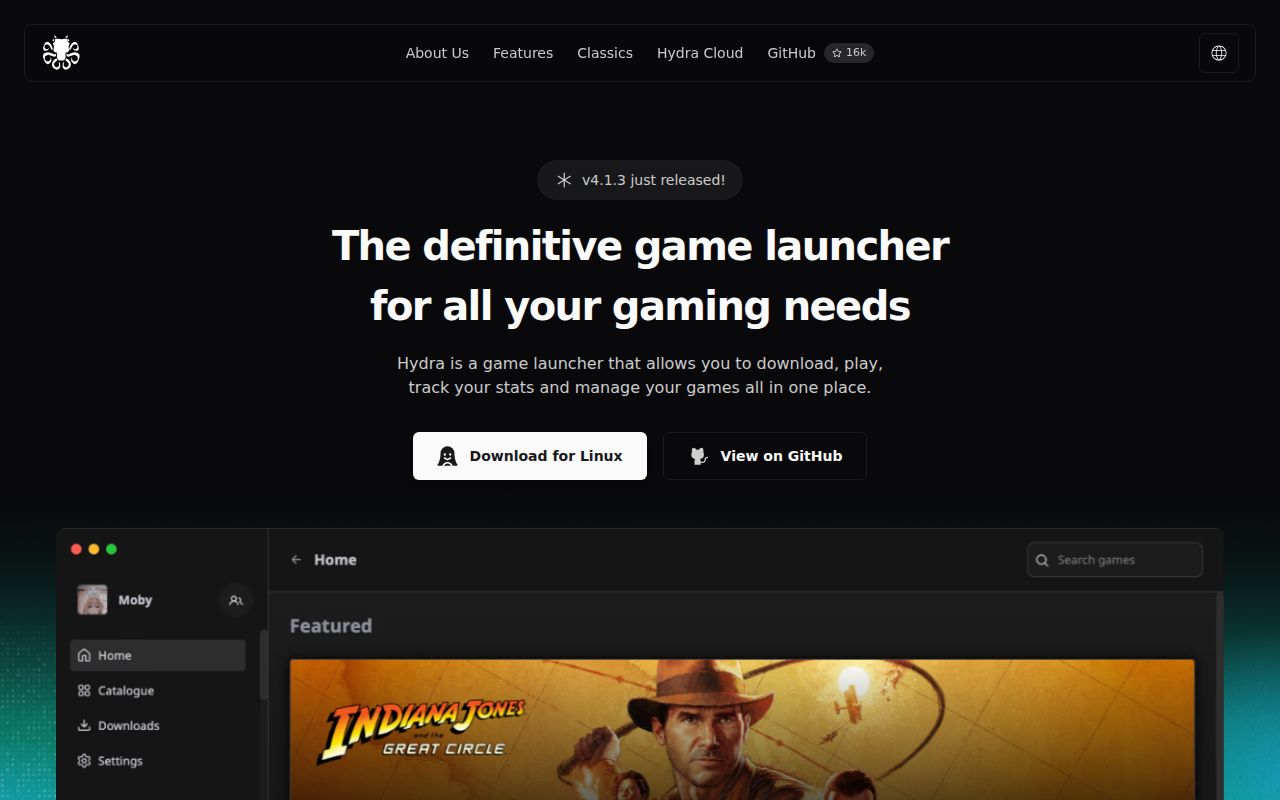
Hydra puts 1 local game library beside catalog search, recommendations, achievements, profiles, friends, and downloads. Users can add games they already own, browse titles, track what they play, and launch installed entries. Version 4.1.3 also added PPSSPP and Dolphin support, extending the Classics area beyond ordinary PC executables. Big Picture components in the source provide a controller-oriented interface.
The result is broader than a thin launcher. Electron and React handle the desktop UI, Python runs a downloader RPC, and Rust supplies the native addon and cloud-save machinery. Hydra accounts connect social and paid cloud features to the local app. Some players will value that integration; others will see an account service and remote catalog added to a job that a local shortcut manager can already do.
Two torrent responsibilities stay with the user
Hydra's terms place 2 decisions on the user: whether a downloaded game is legally acquired and whether the file is safe to run. The platform manages downloads through BitTorrent, but its terms say it cannot verify authenticity and does not guarantee files are secure, virus-free, or suitable. Anyone adding a source should understand where its links come from and scan the resulting files before execution.
Peer-to-peer privacy is a separate concern. The same terms warn that an IP address and other information may be visible to other BitTorrent users. A debrid service changes parts of the transfer path, yet third-party availability and policy still apply. Hydra is a convenient client, not a legal opinion, malware scanner, or privacy shield. Heroic is the cleaner alternative when games come from an owned Epic, GOG, or Amazon library.
What happened when we ran it
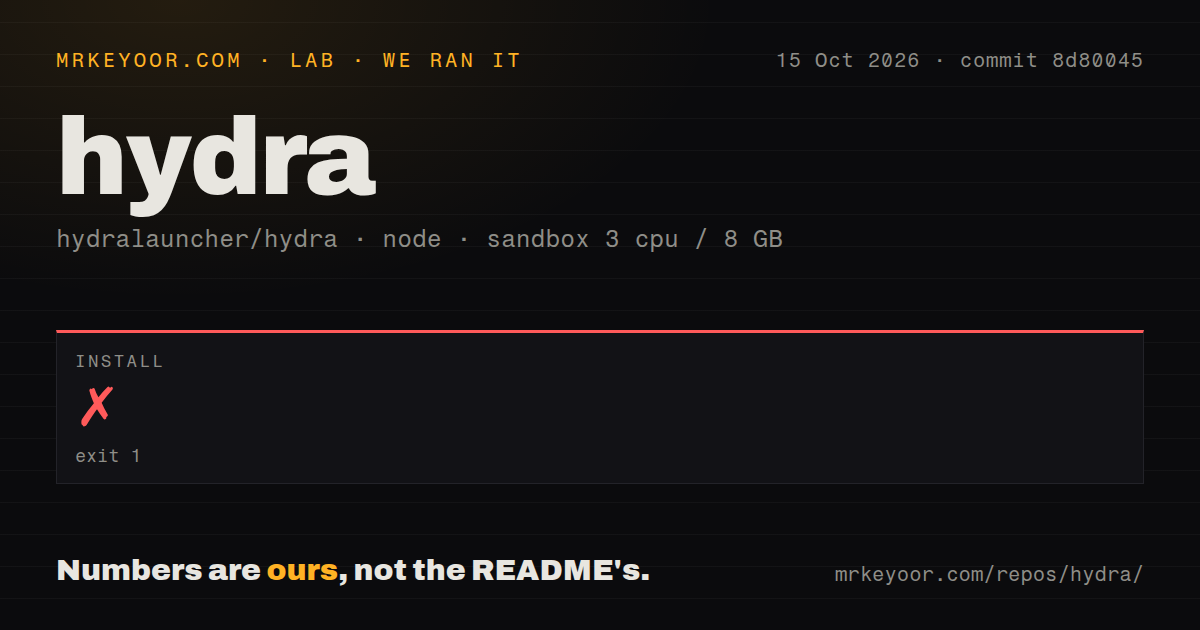
Our measurement setup installed 1,771 Yarn packages in 719 seconds and occupied 1,325 MB. The build completed successfully in 112 seconds. The Node test run then finished in 108 seconds with 508 passed and 0 failed. commit 5ec943b cleared all three lab steps in an unprivileged Debian container with 3 CPUs, 8 GB of RAM, and no secrets.
The checkout itself was 32.5 MB, with 1,862 files and about 236,769 source lines. Our scan found 7 CI workflow files, no Dockerfile, and no top-level tests directory. The passing node:test result still counts even though the cases live elsewhere in the tree. These measurements cover dependency installation, build completion, and tests; they do not measure torrent speed, game compatibility, cloud restore quality, or desktop startup time.
Three language toolchains make source builds expensive
Local development needs 3 language environments: Node.js with Yarn, Python 3.9 or newer, and Rust. The postinstall script builds hydra-native.node automatically, while packaging commands also build the Python RPC. That explains why a seemingly familiar Electron app occupied 1,325 MB after installation in our sandbox. Contributors should budget for native compilation and platform packaging alongside TypeScript editing.
The source bundles 7-Zip helpers, an umu-run path for Linux game execution, Ludusavi configuration, the Python torrent downloader, and Rust cloud-save code. Those pieces touch archives, executables, save folders, network transfers, and platform process state. A change that passes the renderer build can still fail in a packaged desktop, a Wine environment, or a native save restore. Cross-platform testing belongs in the contribution cost.
Two cloud backups per game can include unrelated files
The published subscription terms allow 2 backups per game, each up to 500 MB, for Hydra Cloud. They also say cloud saving stores contents from system-mapped folders without distinguishing unrelated files. That is an unusually important sentence: inspect every resolved save path before enabling uploads, especially when a game stores data beside screenshots, mods, configuration, or personal files.
Cloud services also change the durability question. The terms do not guarantee backup files are error-free or undamaged and make users responsible for verifying integrity. Keep a separate local backup for a save you care about, then test one restore before assuming the subscription is your recovery system. Profiles and achievements can remain useful without treating cloud storage as the only copy.
Three open reports cover startup, shutdown, and RPM conflicts
Issue 2749 reports version 4.1.2 waiting on an unbounded top-level network request before showing its window; the reporter measured a much shorter start after forcing that request to fail immediately. Issue 2722 describes version 4.1.1 leaving Windows processes and the profile lock behind after the visible window closed. Both reports explain the observed mechanism while leaving their initial trigger or network condition bounded.
Linux packaging has its own edges. Issue 2729 says the 4.1.2 RPM conflicted with Blockbench-owned build-ID files on Nobara. Issue 2335 reports that the 4.0.0 AppImage could not mount on Fedora Atomic 44 after FUSE 2 support was removed. These version-specific reports do not condemn every current package, but Fedora users should trial the exact v4.1.3 artifact before migrating a library.
Version 4.1.3 shipped alongside September issue activity
Release v4.1.3 was published September 4, 2026, the same date GitHub records for the last push. GitHub showed 16,840 stars and 114 combined open issues and pull requests; new user reports arrived on September 6. The release added emulator support and several catalog, localization, shortcut, achievement, and review fixes. That is active maintenance with a sizable support queue, not a quiet finished utility.
Hydra earns a trial because all 508 tests passed and its feature set can replace several smaller tools. Its cost is equally concrete: 1,771 dependencies, 1,325 MB after install, three build toolchains, source judgment, and platform-specific bugs. Start by importing owned games, keep cloud saves secondary to local backups, and add download sources only after you know their legal and security implications.