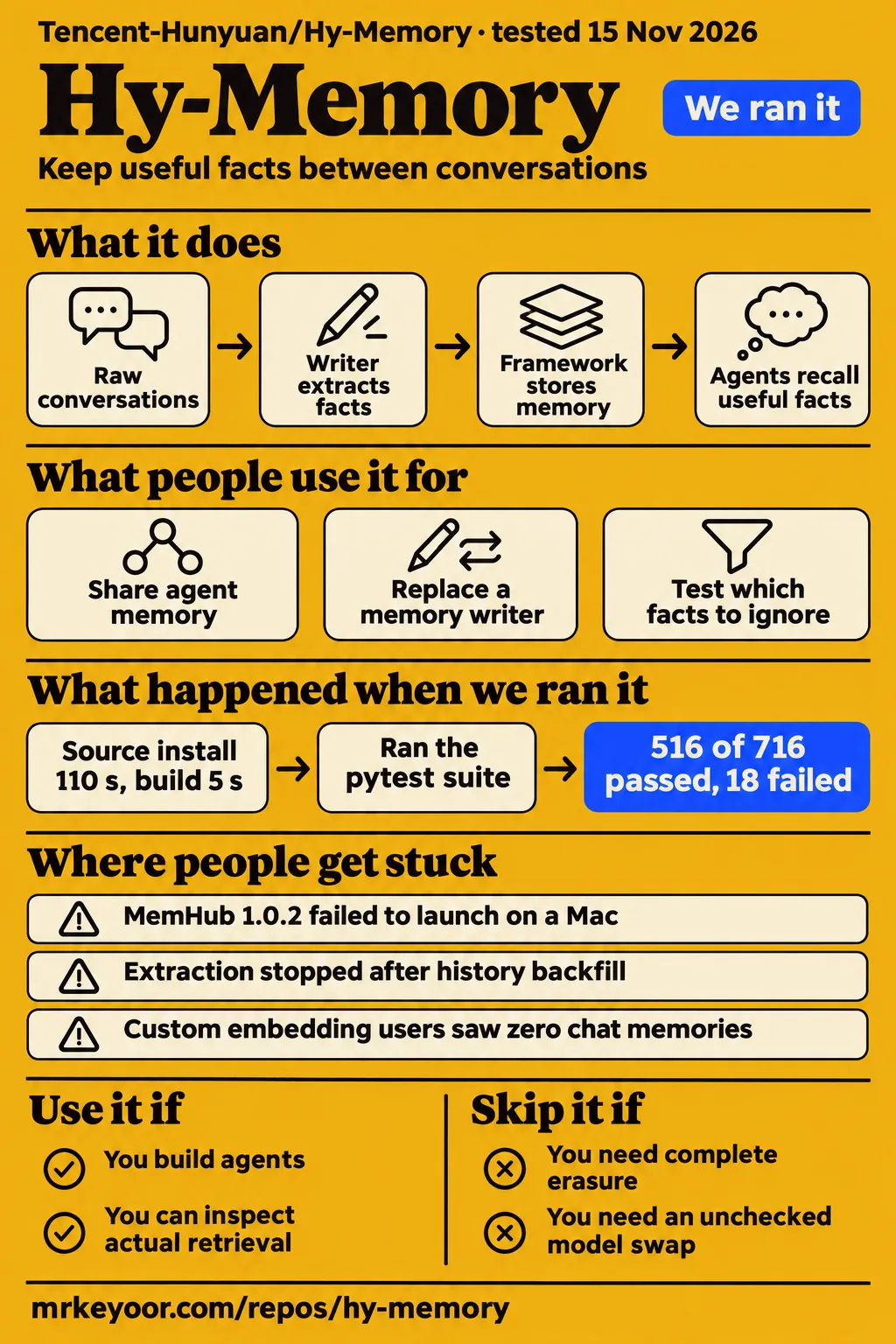
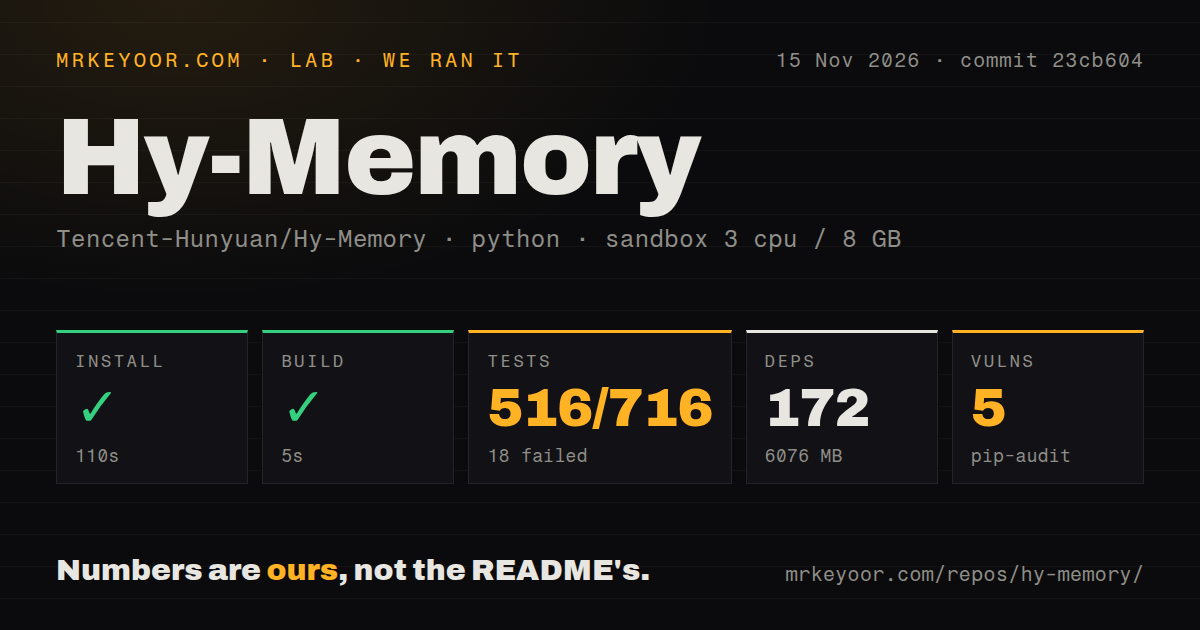
Our sandbox installed Hy-Memory in 110 seconds and built it in 5 seconds, but the test command failed with 18 failures and 182 collection/setup errors. Use it if you build agents and can inspect what their memory pipeline stores and retrieves. Skip it if you need a writer you can swap into an existing application without checking its output contract, or if deleting a visible fact must erase every retained copy.
What people use Hy-Memory for
People have used Hy-Memory to share agent memory, replace an application's memory writer and test which facts a local model should ignore. Those uses expose different parts of the system, which is why one person's successful deployment can coexist with another person's failed model swap.
| Who used it | What they tried | What they reported |
|---|---|---|
| Countlesshrs on r/hermesagent | Moved five Hermes agents from Mnemosyne to Hy-Memory | Better recall and roughly 10,000 fewer initialization-context tokens per turn. This August account predates the October open-source 2.0 release. Hermes migration report |
| DistanceAlert5706 on r/LocalLLaMA | Replaced the writer in an observational-memory application similar to a Pi extension | Unreliable identifiers, noisy extraction and output 3.5 times larger than Qwen3.6-35B. The simple model swap was unsuccessful. Application test |
| stevyhacker, building LokalBot | Tested useful extraction alongside instructions to ignore ineligible facts | Official Q4_K_M captured all 52 eligible English memories but failed all 44 empty-output cases and proposed 76 unwanted memories. Recall-versus-restraint test |
| Tencent's iWiki team | Built CTX so multiple agents could share memory | Tencent reports answer accuracy of 36.7 with memory alone versus 24.7 with full raw history on 251 questions, using the same model and prompts. Vendor deployment evaluation |
Countlesshrs' account is especially useful because replies asked about the baseline. The author says Mnemosyne had extraction and consolidation enabled, and both systems used Qwen 3 Embedding 8B with 4096 dimensions. That makes the report more informative than a comparison against raw storage alone. It remains one person's older deployment, with their prompts and tool configuration, rather than a controlled comparison of today's releases. Baseline clarification
What happened when we ran it
Our November 15 sandbox run at commit 23cb604 completed installation in 110 seconds and the build in 5 seconds; tests exited 1 after 85 seconds. The separate hands-on deployment attempt stopped at its safety check because the required Compose file was absent. Its generic run record nevertheless says it deployed with Docker Compose, so the two records conflict. The concrete failed step supports a blocked deployment, not a successful memory workload. Safety failure Conflicting run record
| Sandbox check | Recorded result | What it tells you |
|---|---|---|
| Installation | Succeeded in 110 seconds, 172 dependencies, 6,076 MB on disk | This developer environment installed successfully and had a substantial disk footprint. |
| Build | Succeeded in 5 seconds | The recorded build step completed. |
| Tests | Exit 1 in 85 seconds; 516 passed, 18 failed, 27 skipped, 182 collection/setup errors | The suite did not pass. The tail also lists 45 deselected cases and pytest's own duration of 80.57 seconds. |
| Dependency audit | pip-audit reported 5 known vulnerabilities | The supplied summary gives a count, without package names or severity. |
| Repository scan | 1,877 files, about 616,096 source lines, 46.9 MB checked out | This describes the checkout, not model-weight size. |
| Automation signals | Four CI workflow files, a tests directory, no Dockerfile detected | The scan found test infrastructure; it gives no CI pass result. |
The configured sandbox had 3 CPUs and 8 GB RAM, with image label ghcr.io/astral-sh/uv:python3.12-bookworm. That label identifies the configured image. Actual Python and operating-system versions require the raw toolchain logs. The 85-second outer test step and pytest's 80.57-second summary describe different scopes, so neither should replace the other.
The test tail contains OSError: [Errno 24] Too many open files in an edit-failure test. Several coding-store migration and writer tests then show pyo3_runtime.PanicException with operating-system error code 24. The log supports an open-file error in these cases. It supplies no basis for blaming a particular Python release, package incompatibility or storage backend. Nor does the passing build turn those failed tests into a passing check.
The hands-on runner's rule required one of compose.yaml, compose.yml, docker-compose.yaml or docker-compose.yml. None existed, and the runner called the repository unsafe under that rule. This is a deployment-method restriction, not a finding that the SDK itself is unsafe. Teardown recorded ok. There are no question-answer results or screenshots accompanying this blocked attempt. Failed safety step Teardown
Hy-Memory 2.0 separates the writer, framework and app
Hy-Memory 2.0 comprises a specialized memory writer, a Python memory framework and the MemHub application, and Tencent says each layer can work separately. The writer decides what to retain or update. The framework manages storage and recall. MemHub imports authorized application histories and connects memory back to those tools. Official product explanation
For a developer, that separation changes the migration decision. You can evaluate Hy-Memory-30B-A3B inside an existing memory system without immediately moving its database, retrieval logic and host integrations. Tencent's paper trains the writer across Mem0, MemOS and Hy-Memory, then evaluates transfer to held-out EverMemOS. That is a useful reason to test the writer independently of the desktop app. Writer paper
The framework's README distinguishes chat, working and coding scenes. Chat organizes memory from raw conversations through facts and higher layers. Working memory extracts session facts and reusable experiences from tool traces. Coding adds version-evolution chains. Its modes also differ: lite stores and searches raw memory without LLM extraction, pro adds extraction and reconciliation, and ultra adds further graph-based evolution. Choosing lite while expecting the specialized writer to run would test the wrong configuration. Framework scenes and modes
Tencent's benchmark lead concerns memory writing
Tencent reports a 55.49% macro average for Hy-Memory-30B-A3B versus 54.62% for Claude Opus 5 on fixed 20% benchmark subsamples. These are vendor results across memory-system harnesses, not our measurements and not a general chat or coding comparison. Technical report
The distinction matters because a writer is only one stage. A later answer depends on what was stored, which records retrieval returns and how the reader uses them. A small aggregate lead gives you a candidate to evaluate. It doesn't tell you whether the model will preserve your application's identifiers or obey your policy for excluding salaries, quoted speech or repeated facts.
LokalBot's test makes that concern concrete. stevyhacker used one shared application prompt, native chat templates, an enforced JSON schema and a single pass without model-specific prompt tuning. Hy-Memory's perfect eligible-memory recall came with failure on every empty-output case. The Qwen models missed more useful facts but were more selective. For a memory system, storing a statement that should have been ignored is a quality failure even when the model remembers everything else. Test method and results
Where people get stuck: fixes depend on the MemHub version
MemHub's issue history contains both confirmed release fixes and reports whose resolution stops at a patch or partial retest. Use the version and the exact symptom to choose a response, rather than treating every closed issue as proof that every related problem has disappeared.
| Reported problem | Evidence of resolution | Practical reading |
|---|---|---|
| MemHub 1.0.2 would not launch on an Apple Silicon Mac | The reporter in issue #37 confirmed that 1.0.4 build 13 launched and ran on the same Mac. | A user retest supports this specific startup fix. The initial missing-file explanation was corrected. |
| Extraction stopped after interruption or history backfill | A maintainer in issue #24 points to PR #27 for release 1.0.3. | This is a maintainer-reported fix; the supplied follow-up has no completed upgrade retest. |
| Reconciliation silently added duplicates after permission-wrapper argument errors | A maintainer in issue #26 points to PR #20 for release 1.0.3. | Watch whether updates and merges occur, rather than counting successful additions alone. |
| Custom embedding users saw zero chat memories in 1.0.5 | A maintainer in issue #242 confirms the read-profile fix in 1.0.6. | The report says data remained on disk. Empty search results were not evidence of data loss. |
| DeepSeek Harness profiles installed but real tool calls lacked authorization | The reporter in issue #69 confirmed profile-ID acceptance in 1.0.5, then moved the remaining authorization problem to #230. | Discovery, installation and authorized recall are separate acceptance checks. |
Issue #242 is the failure I'd use to design a smoke test. Writes used the chosen embedding profile while reads used the built-in 512-dimensional profile. The library appeared empty although the stored memories still existed. A model-configuration probe could succeed and still miss the broken read path. After connecting a host, ask for a distinctive fact from a new conversation through that host's actual recall tool. A green configuration screen isn't the result you need. Embedding-profile report
Backfill can spend money without adding usable memory
The author of MemHub issue #72 reports post-write authority failures and repeated token spending after initially successful batches in version 1.0.4. The maintainer confirmed the failure signature and advised pausing extraction to stop new model dispatches. PR #78 prepared scope restrictions and prevention of repeated model calls for authority-invalid failures. Confirmed backfill problem
That report changes how I'd budget an import. Conversation count alone is a poor purchasing unit when extraction, reconciliation and retries can all call a model. Record provider spending alongside completed tasks and retrievable facts. If calls continue while useful memory stops growing, stop the import and inspect the error class before increasing the budget. This is an operating recommendation drawn from the failure report, not a general cost estimate for Hy-Memory.
Countlesshrs reported about $0.037 per day after comparing 12 extraction-model configurations and selecting deepseek-v4-pro with thinking off. Their workload and older deployment make that a personal spending report, not a price promise. Issue #72 shows why an inexpensive extraction model alone cannot bound a backfill bill: repeated work still costs money. Model-selection account Retry failure
Local storage leaves processing and erasure decisions to you
The SDK supports separately configured LLM and embedding endpoints, so local storage does not guarantee that conversation processing stays on your machine. The README's configuration examples include hosted providers. Audit both endpoints before importing company histories, and include the embedding service in that decision. Provider configuration
AnchorTerminal's storage assessment reports that deleting a chat memory leaves the source conversation, deleted text in history storage and extraction prompts in cache storage, and can reactivate a superseded fact. That makes a visible delete unsuitable as a promise of complete erasure. A team handling deletion requests needs an inventory covering raw records, memory versions, history and caches, together with its own backup policy. Retention assessment
The same reviewer describes the bundled SDK HTTP server at commit b58e95f as listening on loopback without authentication and with permissive CORS. That observation concerns the bundled server, not proof that every MemHub interface shares the same boundary. Keep the component distinction when reviewing access controls: an in-process SDK, its optional HTTP wrapper and a desktop runtime are different surfaces. Dated server assessment
English support improved after the early Chinese-only app
MemHub 1.0.6 release notes list eleven interface languages, including English, and the repository supplies an English README. The earlier Chinese-only interface report should therefore be read as version history. Language request and follow-up Versioned README
In issue #80, the requester described being able to read the documentation but being unable to use the memory-review interface without translation. A later reply points to localization on main. The release record supplies the next useful boundary: 1.0.5 described Chinese, English and Spanish, followed by eleven languages in 1.0.6. This matters for a product whose job includes letting you review and correct remembered facts. An untranslated governance screen affects the work, not just the appearance. Localization history Released language support
Hy-Memory vs Mem0, MemOS and Qwen memory writers
Mem0 and MemOS can host the Hy-Memory writer, so choosing the model need not mean replacing your existing memory framework. Separate the writer comparison from the storage-and-retrieval migration. Tencent's cross-framework paper supports that distinction; application tests tell you where to look for incompatibilities. Cross-framework evaluation
| Candidate | Reason to consider it | Decision boundary |
|---|---|---|
| Mem0 or MemOS with Hy-Memory as writer | Keep the existing framework while evaluating the specialized model. | Test framework-specific write operations and downstream answers. The paper evaluates multiple memory harnesses. Paper |
| Qwen3.6-35B as observational writer | DistanceAlert5706's existing Qwen setup produced less noisy output than the attempted Hy-Memory swap. | Their reported 3.5-fold output increase and identifier failures concern one application's unchanged prompts and parser. User comparison |
| Qwen3.5 4B or 9B | LokalBot's shared-prompt test found greater restraint than Hy-Memory. | Choose according to the cost of missed facts versus unwanted memories, then retest your policy. Contrast-pair test |
| Memory MCP reference server | AnchorTerminal recommends it for a small, inspectable local fact store. | Its comparison describes Hy-Memory's broader layered chat and tool-trace memory. The reviewer's readiness grades are assessments, not task-success benchmarks. Architecture comparison |
For an existing observational-memory application, I'd start with the writer comparison and leave retrieval unchanged. Preserve the actual UUIDs, schema and negative examples your application uses. If Hy-Memory produces better future answers but breaks tool identifiers, the swap still fails. Rewriting the application to accommodate the model is a larger project and deserves a separate decision.
What the other reviews get wrong
ReviewRamble's claim that no quantized versions exist is stale: the project lists official FP8 and GGUF releases, and Tencent's October 20 X announcement describes an 18 GB option. That makes the model more accessible, without turning the checkpoint size into a measured total-memory requirement. Official quantized releases Tencent announcement
ReviewRamble also says there was no launch post, while Tencent's site dates the open-source launch to October 16. The older Hermes issue saying no public repository existed belongs to the pre-release period. Neither statement describes the public GitHub project we reviewed. Official launch Historical Hermes issue
MindStudio's benchmark summary mixes model names and counts. Tencent's published table lists seven models, gives 50.37 to Qwen3.6-35B-A3B and 44.37 to Qwen3-30B-A3B. Broad claims of an Opus win also need the paper's fixed-subsample qualification and individual results, rather than an implication that every metric favors Hy-Memory. Vendor results table Evaluation scope
The companion to the video “Hy-Memory 30B: Memory for Local AI Agents” explicitly calls it a narrated explainer rather than a filmed installation. Its run commands are useful starting material, but its own disclosure rules out treating the video as a reproduced deployment. Likewise, the guide's suggestion that a deleted row disappears needs the retention distinction above. Video companion and disclosure Video transcript Storage assessment
Questions people ask
Hy-Memory is Tencent Hunyuan's memory stack for AI agents, with a separate writer model, Python framework and MemHub app. The choice of layer determines whether you're evaluating model output, memory retrieval or integration with your existing tools. Official overview
What is Hy-Memory, and how do its model, framework and MemHub app differ?
Hy-Memory-30B-A3B writes memory operations, the framework manages memory, and MemHub brings it into authorized applications. You can use the layers separately. Start with the writer if your application already has satisfactory storage and retrieval. Three-layer explanation
Where is the official Hy-Memory GitHub repository?
The official repository is Tencent-Hunyuan/Hy-Memory. Tencent's technical report links that exact repository alongside the model weights. Older posts about the absence of public source predate this release. Paper's repository link
What changed in Hy-Memory 2.0?
Tencent describes upgraded chat memory plus working and coding memory in Hy-Memory 2.0. The launch covers the model, framework and MemHub app. This is broader than the older shared-memory plugin described in some integrations. Version 2.0 overview
Does Hy-Memory actually beat Claude Opus 5, and on which memory tasks?
Tencent reports a higher aggregate across four memory harnesses on fixed 20% benchmark subsamples. The comparison measures memory-writing outcomes through those systems. It doesn't make Hy-Memory a stronger general assistant, and Opus leads some individual metrics, including Mem0 LoCoMo. Detailed result discussion
Can Hy-Memory run in a home lab or on a 24GB GPU?
Official GGUF and FP8 weights exist, and Tencent advertises an 18 GB option. That supports investigating a home-lab setup. It is not a guarantee that a 24 GB GPU can handle your chosen context and serving backend. Quantization announcement Official weight options
How much RAM and VRAM does a 30B-total, 3B-active model really need?
The 3B-active label is not a RAM or VRAM requirement. The companion guide puts Q4_K_M weights around 18.2 GB and discusses additional KV-cache headroom. Treat its 24 GB GPU or 32 GB Mac advice as guide estimates, rather than our measured minimums. Hardware discussion and scope
Does Hy-Memory replace Mem0, or can I use its writer inside my existing framework?
The writer can be evaluated inside Mem0 or MemOS without adopting the whole Hy-Memory framework. Tencent's paper explicitly studies that arrangement. Keep the application's write protocol in the evaluation, since a model swap changes behavior even when its API remains compatible. Training and evaluation frameworks
Can a local memory model retain useful facts while obeying rules about what to ignore?
LokalBot's shared-prompt test found a tradeoff: Hy-Memory retained all eligible English facts but failed every empty-output case. Qwen was more selective and missed more eligible facts. Use both positive and negative cases when scoring a candidate writer. Recall and restraint results
Can Hy-Memory reliably produce the UUIDs and tool calls my observational-memory system requires?
DistanceAlert5706 reported unreliable UUID reproduction and malformed tool calls in a direct model swap. The author left parser and prompting explanations uncertain. Run your own identifiers through the unchanged application before accepting compatibility. Integration report
Was extraction and consolidation enabled in the Mnemosyne comparison, and which embedding model was used?
Countlesshrs says both were enabled in the previous Mnemosyne setup. The author reports Qwen 3 Embedding 8B with 4096 dimensions for both systems. Those details describe that user's comparison, not a default Hy-Memory configuration. Author's replies
Is Hy-Memory tied to SiliconFlow embeddings, or can I choose another provider?
You can configure another embedding endpoint. The SDK README exposes separate embedding settings, and Countlesshrs reports using Qwen embeddings through OpenRouter. Keep the configured dimensionality consistent with the selected model and read path. SDK configuration User configuration
Is Hy-Memory safe for company data, and what leaves the machine?
Company-data suitability depends on configured processing endpoints, access controls and retention. Local files alone don't answer that question. Review the selected LLM and embedding providers and the component serving memory, alongside the raw, history and cache records described in the storage assessment. Provider configuration Security and retention assessment
What we have not tested yet
Our evidence stops at a successful developer install/build and a failed test suite, plus a blocked hands-on deployment attempt. We have not tested end-to-end recall, host authorization, application answer quality, GPU serving, latency, throughput or model memory use. The conflicting generic deployment record needs correction or supporting logs before it can count as a successful run. No known-answer task was recorded, so there is no recall score to report from our lab.
The five audit findings need package names, affected versions and advisory details before we can judge their deployment relevance. The test tail cannot settle whether file-descriptor exhaustion came from the harness limits, cleanup behavior or another condition. Raw runtime logs, full failure traces and a controlled rerun would be needed for that diagnosis.
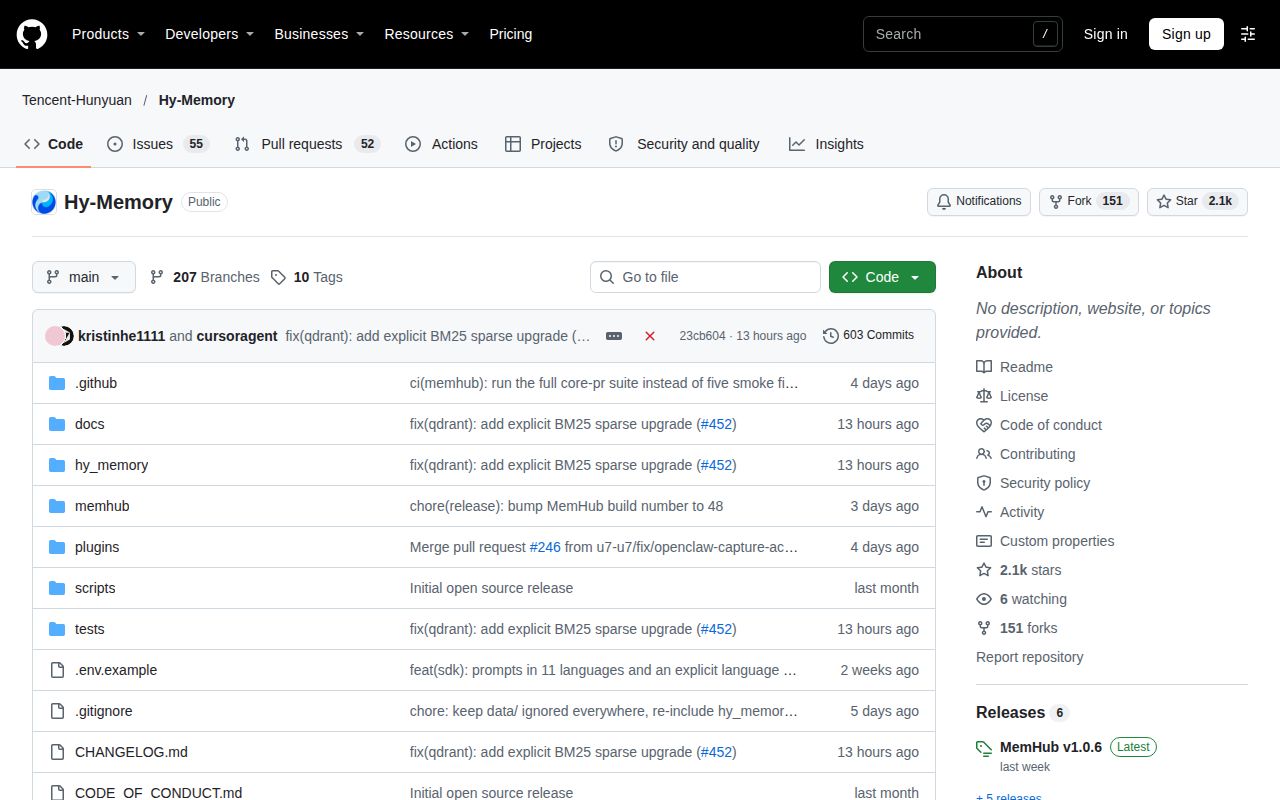
The issue map distinguishes a user's startup retest, maintainer-reported release fixes and partially resolved integrations. We have not reproduced those fixes. Issue #72's supplied thread does not identify a release containing the complete repair. The current README advertises 1.0.7 while the public latest-release endpoint returned 1.0.6 during this review; choosing a release requires checking its actual assets and SDK pin. A recent push and active issue replies support ongoing development, not a blanket reliability claim.
We have not reproduced Tencent's full benchmarks or measured each quantization on the same hardware. LokalBot's single shared-prompt pass and the observational-memory swap are useful failure reports, not universal rankings. The supplied video transcript is incomplete and carries no channel identity, so we attribute its companion by title and make no claim of a creator-run deployment.
A useful acceptance test should follow one distinctive fact from capture through extraction into retrieval from the target application. Add an update that supersedes it, a quoted statement that must be ignored and an explicit deletion request. Record provider calls and retained copies at each stage. The adoption decision should depend on whether the application gets those cases right, not on whether its memory counter increases.