One readable command replaces a pile of curl flags
HTTPie turns common request parts into compact shell tokens. A field written as name=John becomes JSON data, while headers, query parameters, files, forms, and authentication use related operators. Responses arrive with syntax highlighting, indentation, status and headers suited to a terminal. That makes it faster to inspect an unfamiliar API than a command whose important result is buried between transfer statistics and an unformatted body. The value is human reading and ad hoc work, not a new HTTP capability.
The tool still covers serious daily tasks. It can send arbitrary methods and headers, upload files, follow redirects, use proxies and certificates, stream responses, resume downloads, and print a request without sending it. Named sessions persist selected headers, authentication, cookies, and other defaults across calls. Plugins can add authentication schemes, transports, converters, and formatters. For an engineer diagnosing a staging endpoint, that combination often reaches the answer before a GUI project has finished opening.
Version 3.2.4 has a two-year merge gap
Release 3.2.4 was published on 2024-11-01, and GitHub reports the default branch was last pushed on 2024-12-17. By 2026-08-25, the repository held 187 open issues and 145 open pull requests. Recent pull requests address certificate fallback, URL-encoded credentials, Windows man-page behavior, Python 3.14 tests, and invalid format-option errors. The issue tracker is active, but that work has not produced a new default-branch push or release visible through GitHub's repository data.
That is different from abandonment. Contributors and users are still discussing bugs and submitting fixes in August 2026. It does mean an installer cannot assume a recent-looking pull request is present in the published package. Windows users have a current report that Chocolatey is out of date, and basic WebSocket support remains a feature request. Teams should evaluate the actual 3.2.4 artifact they plan to deploy, rather than reading an open fix and mentally treating it as shipped.
What happened when we ran it
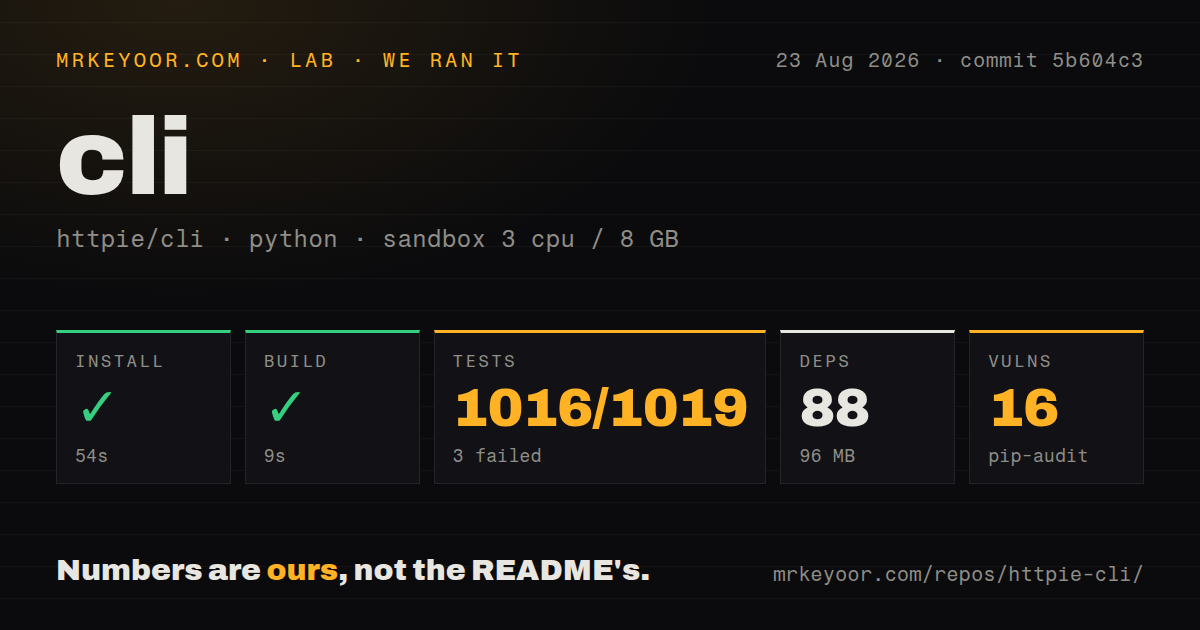
Our sandbox installed commit 5b604c3 in 54 seconds. The Python environment contained 88 packages and took 96 MB on disk; the source checkout had 265 files and about 19,308 lines. Building the package succeeded in 9 seconds. The repository included a tests directory and 15 CI workflow files, but no Dockerfile. A dependency audit found 16 known vulnerabilities, the largest negative result in this review. The supplied audit count does not state severity or exploitability.
Pytest ran for 148 seconds and exited with code 1. It reported 1,016 passed, 3 failed, and 5 skipped out of 1,019 tests, plus 4 expected failures and 138 warnings. One failure compares the help text for an invalid --pretty choice, where quoting differs. The other 2 involve Big5 charset detection for terminal request and response output. Those named differences are all the log establishes; the tail does not prove whether the container locale, a dependency, or HTTPie itself caused them.
Sixteen audit findings change the install decision
The 16 known vulnerabilities came from the environment produced by our installation, so they belong in the buying decision even though HTTPie's own code may not be the affected component. Dependency scanners can include development and transitive packages, and a count alone does not show severity. A security-conscious team should reproduce the audit against the exact installation method, identify each affected package and path, then decide whether isolation, upgrading, or replacement is appropriate. Ignoring the count because most tests passed would confuse correctness checks with dependency risk.
Installation choice matters here. HTTPie's docs cover PyPI, Homebrew, MacPorts, Chocolatey, several Linux packages, and FreeBSD. System package versions may lag PyPI, while Python environments can resolve different transitive versions. pipx or another isolated application environment keeps HTTPie's packages out of a project's dependency graph. Persistent sessions deserve similar care because saved cookies, authentication, and headers can become credentials on disk. Use restricted file permissions and avoid committing HTTPie configuration with a project.
curl wins automation; HTTPie wins inspection
HTTPie's expressive operators are easiest for a person composing a request at a prompt. They can be awkward inside scripts where shell quoting, version stability, and ubiquitous availability matter more than colored output. curl is installed almost everywhere, supports many more protocols, and has libcurl for embedding. HTTPie's offline mode and explicit output controls help with scripting, but a production job should pin the executable and disable presentation features that could change parsing.
For interactive HTTP and JSON work, the trade remains favorable. The documentation is thorough, examples are close to copyable, and 1,016 passing tests show substantial exercised behavior in our run. The stale published line and dependency audit stop us from recommending an unexamined global install. Put HTTPie in an isolated environment, inspect the 16 findings, and keep curl available for scripts that must survive machines and years.