A downloaded error page can still mean success to curl
An API request can return an error page while curl reports a successful transfer. Its default success condition concerns moving the data, so your script must decide which HTTP responses count as failure. That distinction is why I would choose curl for deliberate automation: you can specify the request and its handling precisely. It is also why a copied command deserves a closer look before it becomes a deployment check. For an API script, --fail-with-body preserves the error response while returning a failure exit code, as the curl command manual explains.
Our source install failed after 6 seconds, before we had a working installation to evaluate. That result matters if you intend to maintain your own executable or modify libcurl. A developer who only needs to send requests has a different decision: choose a suitable packaged executable and learn its options. The repository contains both the terminal tool and the library behind it. Cloning their source is a separate commitment from using the command.
What happened when we ran it
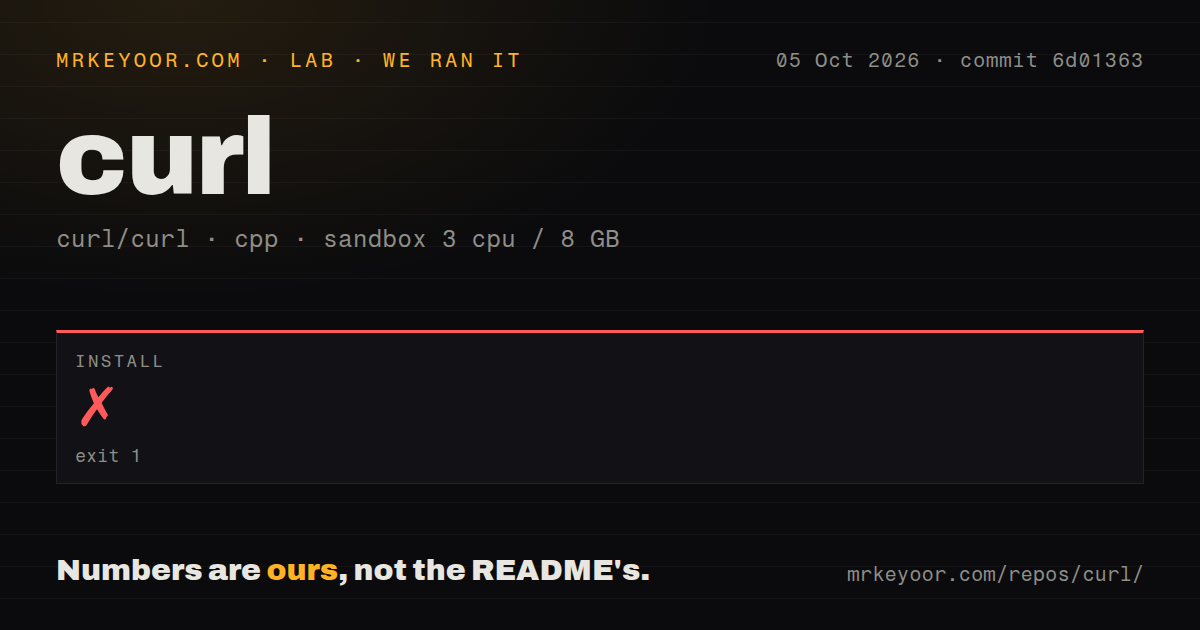
Our sandbox install of commit 6d01363 failed with exit 1 after 6 seconds on 2026-10-05. We ran it in a fresh, unprivileged Debian container with 3 CPUs and 8 GB of RAM, using image lab-cpp:1 and no secrets. The log ended during CMake configuration. Our run establishes that this source setup did not complete in that environment. We have no successful build, test result, or transfer-speed measurement to report.
CMake 3.25 reported that it could not find Libpsl, specifically LIBPSL_INCLUDE_DIR and LIBPSL_LIBRARY, and marked configuration incomplete. The tail also names missing Zstd, NGHTTP2, and Libidn2. Libpsl is the fatal error shown. The log does not establish that the other missing libraries independently caused the failure, or that adding Libpsl alone would complete the install. For a fresh container, finding the required headers and libraries is concrete work left to do.
The README points source users to separate instructions
The project README gives a clone command, then sends installation questions to a separate document. Usage has another route through the command manual and the Everything curl book, while libcurl has its own API reference. This is sensible documentation for different audiences, though the short README cannot stand alone as a source-setup guide. Someone embedding the library should follow the library reference rather than treating a terminal example as an application design.
Our checkout contained 4,551 files and roughly 318,574 lines of source. The checked-out source occupied 18.5 MB, so that figure says nothing about the final executable or installed environment. The practical question is whether you need to work on those files. For a shell job that fetches a URL, maintaining a source checkout adds work without an obvious benefit. For a libcurl change, the configuration failure belongs on your task list.
Credentials and proxy settings belong to the destination
Curl needs no vendor account to make an ordinary public request. Authentication depends on the service you contact, and a private endpoint may require credentials or a client certificate. Corporate networks can require explicit proxy settings. Keep those choices with the job that uses them. Curl's trace options can record the transferred data, which helps diagnose a request but also means a trace should be inspected before you share it.
The 3 CPUs and 8 GB of RAM in our sandbox describe the measurement environment, not a recommended machine size or demonstrated capacity. We have no throughput result to turn into a sizing claim. Before adopting a command for production, inspect what curl --version reports for the actual executable and consult its matching documentation. A source repository's protocol list does not establish the capabilities available in the executable on your server.
Recent pushes show maintenance, while timing reports need care
Curl's last push was 2026-10-10, and the GitHub API listed 70 open issues and PRs together. The latest release returned by GitHub's release endpoint was curl-8_22_0, published on 2026-09-02. Issue activity is current too: issue 23325, opened on October 9, reports transfer timers being populated even when a request was never sent. That is an upstream report, not a timing defect reproduced in our sandbox.
Our scan found 15 CI workflow files, a Dockerfile, and a tests directory. Their presence gives a contributor places to inspect upstream checks, but none supplies a passing result for our failed install. The active issue queue and recent push support calling curl maintained. They also suggest a specific adoption habit: if you use curl's timing fields for monitoring, examine the failed-request behavior described in that issue before interpreting those fields as completed network stages.
JavaScript pages and recursive archives need another tool
The curl FAQ says curl does not execute JavaScript and has no recursive fetching code. That rules it out for browser-dependent scraping and makes it an awkward starting point for website archives. PAC proxy files hit the same JavaScript boundary. HTTPie CLI is a better candidate for interactive API exploration when readable JSON and sessions dominate the work. Wget fits recursive retrieval, while aria2 fits download management with torrents or Metalink.
The 6-second configuration failure makes me cautious about recommending a source checkout as someone's first curl experience. It does not answer whether their existing executable fits the task. Choose curl when you need explicit transfer controls, then define failure handling and timeout policy in the command you keep. If the job requires rendering a page or following its links, choose that tool before you start wrapping curl in extra machinery.