mrkeyoor.com_
Thu 01 Oct 08:12 UTC
AI Toolsevaluationupdated 01 Oct 2026

holo-card review

Holo Card is a Codex skill that turns supplied artwork into an interactive layered card with tilt, depth, flip, moving background, and contour glow. It guides image generation and repair, then assembles the approved layers into self-contained HTML and a ZIP; an optional local API covers agents without native image tools.

Verdict

Our optional-API run installed 7 packages in 7 seconds and passed its tests in 14 seconds, but those tests use a mock provider and cannot judge the generated card. Use Holo Card when you want a disciplined Codex-assisted layer workflow and will inspect every asset before delivery. Skip it for one-click conversion, exact hidden-pixel recovery, or production automation that cannot pause for visual approval.

We ran it

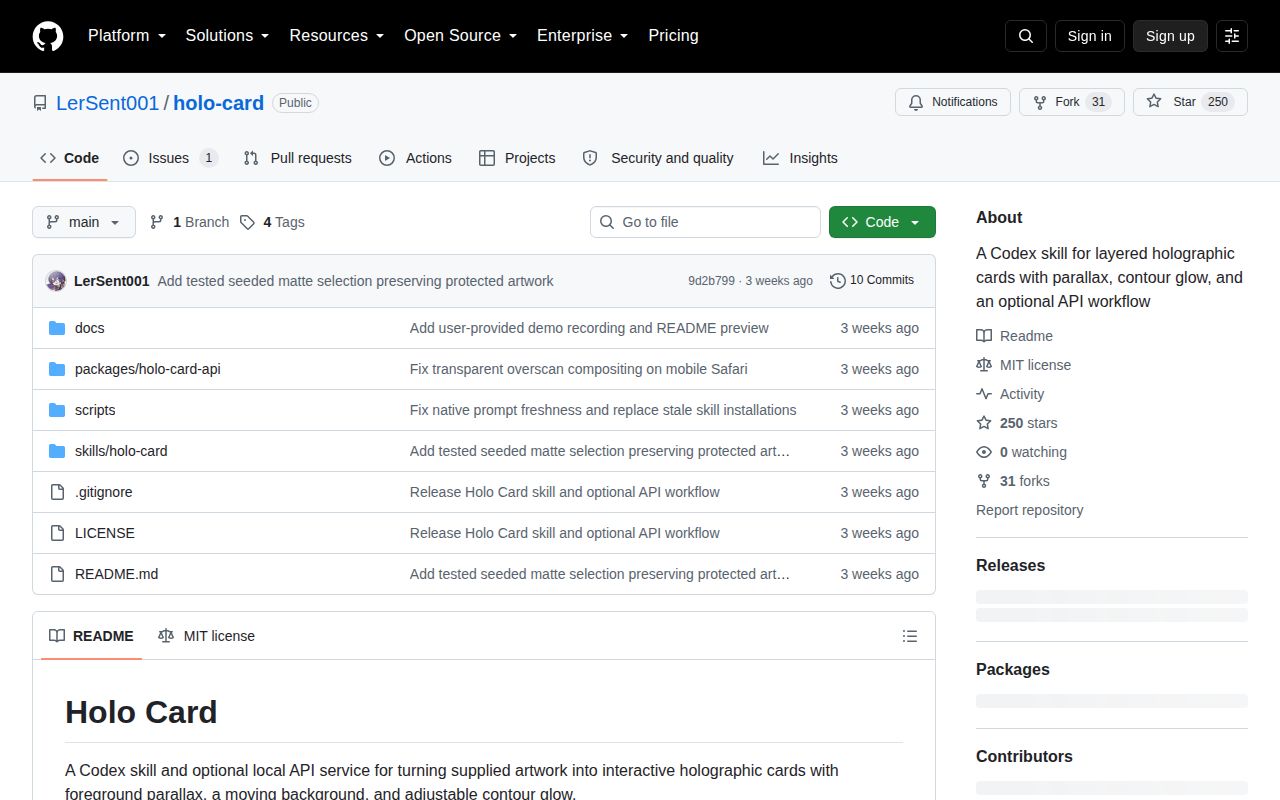
Lab card: what happened when we ran holo-cardScreenshot of holo-card (github.com/LerSent001/holo-card)
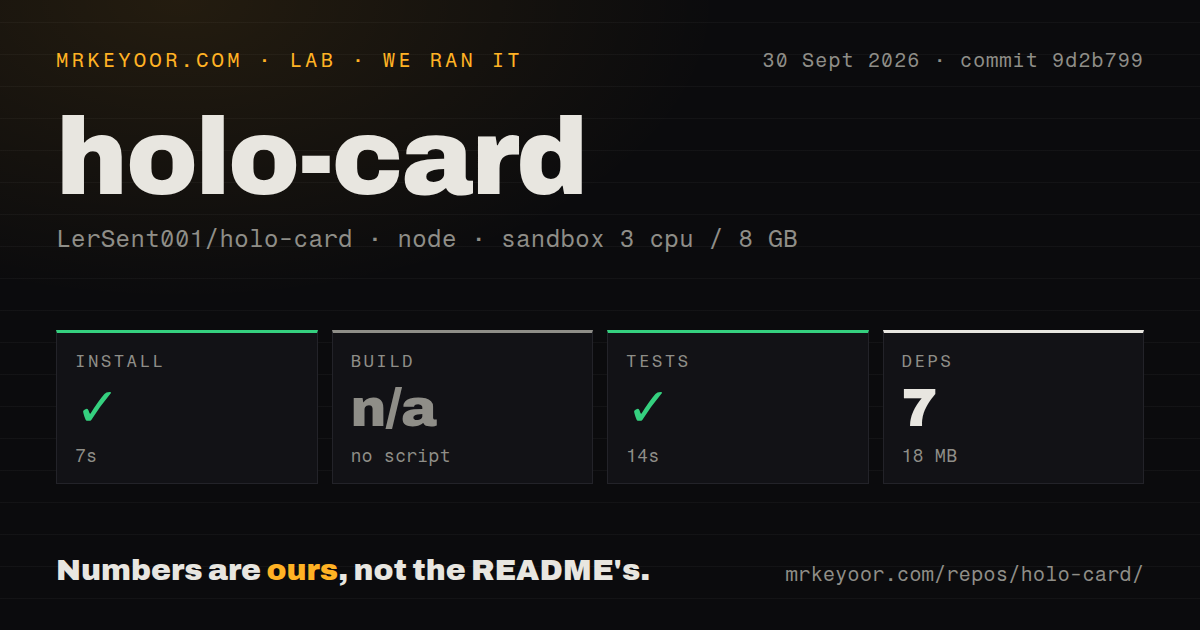
Install✓ · 7s7 packages · 18 MB
Buildn/ano build script
Tests✓ · 14sran, no count parsed
Repo53 files~3,522 lines of source · 9.5 MB · 0 CI workflows · tests dir

Answers from our run

Does holo-card build from source?

Dependencies installed in 7 seconds (7 packages), and the project has no separate build step. We cloned commit 9d2b799 into a clean Debian container with 3 CPUs and no project-specific setup.

Do holo-card's tests pass?

The test command failed in our container, and its output did not report a pass or fail count.

Who should not use holo-card?

Anyone expecting a one-click filter: the README requires separate layer generation, matte repair, alignment checks, and visual inspection.

What are the alternatives to holo-card?

Vanilla Tilt, Parallax.js, three.js. Our optional-API run installed 7 packages in 7 seconds and passed its tests in 14 seconds, but those tests use a mock provider and cannot judge the generated card.

Setup3/5Tiny API install; the full card workflow needs careful manual checks
Docs5/5Detailed layer, repair, API, safety, and preview instructions
Community2/5250 stars and one feedback issue in a very young project
Maturity2/5v1.0.3 exists, but CI, containers, and live provider tests do not

Who it’s for

Codex users who want a repeatable workflow for interactive card artwork.
Designers willing to inspect foreground, background, typography, alpha edges, and contours separately.
Developers who want an offline HTML deliverable instead of a hosted editor.
Teams that can keep optional API credentials local and approve paid generation calls explicitly.

Who it’s NOT for

Anyone expecting a one-click filter: the README requires separate layer generation, matte repair, alignment checks, and visual inspection.
Projects that need exact recovery of artwork hidden behind text or a subject: the documentation says those pixels are inpainted approximations.
Teams seeking reconstructed 3D geometry: this is a layered 2D parallax renderer.
Node 22 deployments: the optional API requires Node 24 or newer, pnpm, a provider key, and explicit paid-call authorization.
Buyers treating the API tests as proof of provider quality: they use a mock provider and do not test live billing, availability, or visual fidelity.

Setup reality

Our sandbox installed commit 9d2b799 from packages/holo-card-api in 7 seconds, adding 7 packages and 18 MB. The package has no build script, so build was skipped. Its tests passed in 14 seconds.

The main Codex path instead needs the installed skill, a supplied image, native image generation, Python with Pillow, filesystem access, and a browser preview. The optional API needs Node 24 or newer, pnpm, a provider key, local token files, and approval before paid generation.

The 53-file monorepo had about 3,522 source lines and a tests directory, but no CI workflow or Dockerfile. Passing mocked API tests proves local request and job mechanics, not layer accuracy or live provider behavior.

Four layers turn one image into a moving card

Holo Card splits a supplied image into a foreground character, a complete background, a combined text-and-frame layer, and structural contours. The generated viewer moves those pieces at different rates as you drag or tilt, then adds foil lighting and contour glow. It can flip to a card back, respond to a keyboard, and run from a self-contained HTML file. The result is a portable web artifact rather than a video or flattened image.

The split is also where most of the work lives. Text may cover the subject, the subject may cover scenery, and generated checkerboards may be baked into RGB pixels instead of real transparency. The skill asks Codex to generate colored replacements, repair concealed regions, prepare masks, and compare the composite with glow turned off. Depth ranges from -3 to +3, but a slider cannot repair a misplaced letter or a second figure left in the background.

Assembly succeeds before visual quality is proven

The local Python helper saves the source, imports layers, tracks provenance, and assembles the viewer. It does not generate or segment images by itself. The README repeats a useful warning: successful assembly is not proof of visual fidelity. You still have to inspect the subject edge, reconstructed scenery, typography, frame, and contour registration. Bloom can make a bad edge look dramatic while leaving the underlying extraction wrong.

Hidden pixels are another hard boundary. If a title covers a face or a character covers the scene, the missing artwork cannot be recovered exactly from the input. Image generation can infer a plausible fill. It cannot retrieve pixels that were never present. Holo Card records that distinction and tells the operator to reject alignment drift, duplicate subjects, checkerboard residue, and changed geometry rather than quietly shipping them.

What happened when we ran it

Our sandbox tested commit 9d2b799 inside packages/holo-card-api, the pnpm workspace that contains the optional service. Installation finished in 7 seconds, adding 7 packages and 18 MB on disk. The container used Node 22, 3 CPUs, 8 GB of RAM, no secrets, and no elevated privileges. There was no build script or target, so the build step was skipped.

The available tests passed in 14 seconds. The repository had 53 files, about 3,522 lines of source, 9.5 MB checked out, and a tests directory. Our scan found no CI workflow and no Dockerfile. Those results show that the local API mechanics can be installed and checked cheaply. They do not measure image-generation latency, provider cost, segmentation accuracy, alpha quality, or browser rendering on a phone.

The API documentation makes the boundary explicit: its tests use an in-process mock provider. They cover authentication, uploads, job deduplication, recovery, extracted files, ZIP output, and scoped previews. No live provider call occurs. A green 14-second run therefore supports confidence in request handling, not the claim that a particular card will look correct.

The native skill and API do not produce the same layers

Codex users are directed to the native path, which uses built-in image generation and colored layers with repaired scenery. The optional API exists for agents without that capability. It requires Node 24 or newer, pnpm, a provider key, and an explicit authorization step before paid generation. It binds to 127.0.0.1:8787 by default, stores jobs in SQLite, and does not create a hosted endpoint.

The API still uses a legacy four-mask extraction route. Its own README says it does not implement the native colored-layer inpainting workflow. That means the two paths should not be treated as interchangeable fallbacks. API outputs need the same visual review, and a safety refusal on the native path is not permission to switch providers. Uncertain paid submissions are retained for status checks rather than automatically retried.

Version 1.0.3 fixes matte selection, not geometry drift

Release v1.0.3 added a Pillow-only helper for selecting explicit matte regions while protecting artwork outside them. The release notes still list geometry drift, fine text, contour registration, and an all-effects-off inspection control as unresolved. That candor helps because those are exactly the defects a bright holographic treatment can conceal during a quick preview.

GitHub showed 250 stars, 1 open issue, and a last push on September 8, 2026. The sole issue is feedback from an outside agent platform rather than a bug report, and it was updated through September 19. This is a young project with a detailed process, not a long maintenance record. Use artwork you have rights to process, keep the four layer checks in the approval path, and judge the exported card with glow disabled before accepting the flashy version.

Alternatives

ProjectWhat it isPick it when
Vanilla TiltA small JavaScript library for adding a 3D tilt effect to existing DOM elements.pick this instead when you already have finished artwork and only need pointer-driven tilt.
Parallax.jsA browser parallax engine driven by cursor or device orientation.pick this instead when you want to arrange and animate your own layers without an AI asset workflow.
three.js gh↗A general JavaScript 3D rendering library for custom browser scenes.pick this instead when the card needs real 3D geometry, custom materials, or a larger interactive scene.

What people are saying

  1. [velocity-scout] LerSent001/holo-card
  2. [velocity-scout] EverettFish/holo-card-studio

Sources

  1. Holo Card repository and README
  2. Holo Card API documentation
  3. Holo Card v1.0.3 release notes
  4. Measured commit 9d2b799
  5. AutoClaw feedback issue 1

More ai tools reviews

unigit-ecosystem · handraw-style · souchastnik · dlssg_for_sm86 · glm-flash-offline-client · cyber-resume-reviewer-skill · the whole board →