mrkeyoor.com_
Tue 01 Sept 17:45 UTC
Dataevaluationupdated 26 Aug 2026

hiring-without-whiteboards review

Hiring Without Whiteboards is a community-maintained directory of companies that say their technical interviews resemble day-to-day engineering work. It helps job seekers find employers using work samples, pair programming, design discussions, or take-home exercises instead of trivia puzzles.

+181stars / 7d
Verdict

Our run installed 243 packages in 11 seconds and passed the available tests in 6 seconds, so the repository is easy to check locally and useful as a starting list. Use it to discover employers, then verify each interview process before investing time in an application. Its opinion about work-like interviews is sound; its company claims are leads, not warranties.

We ran it

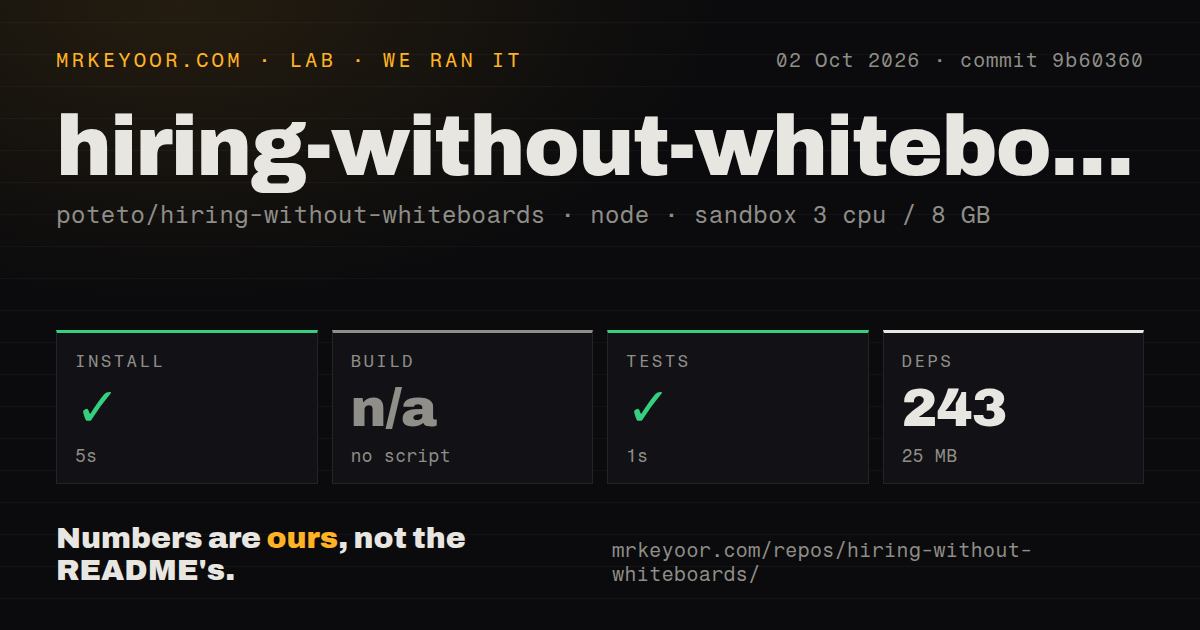
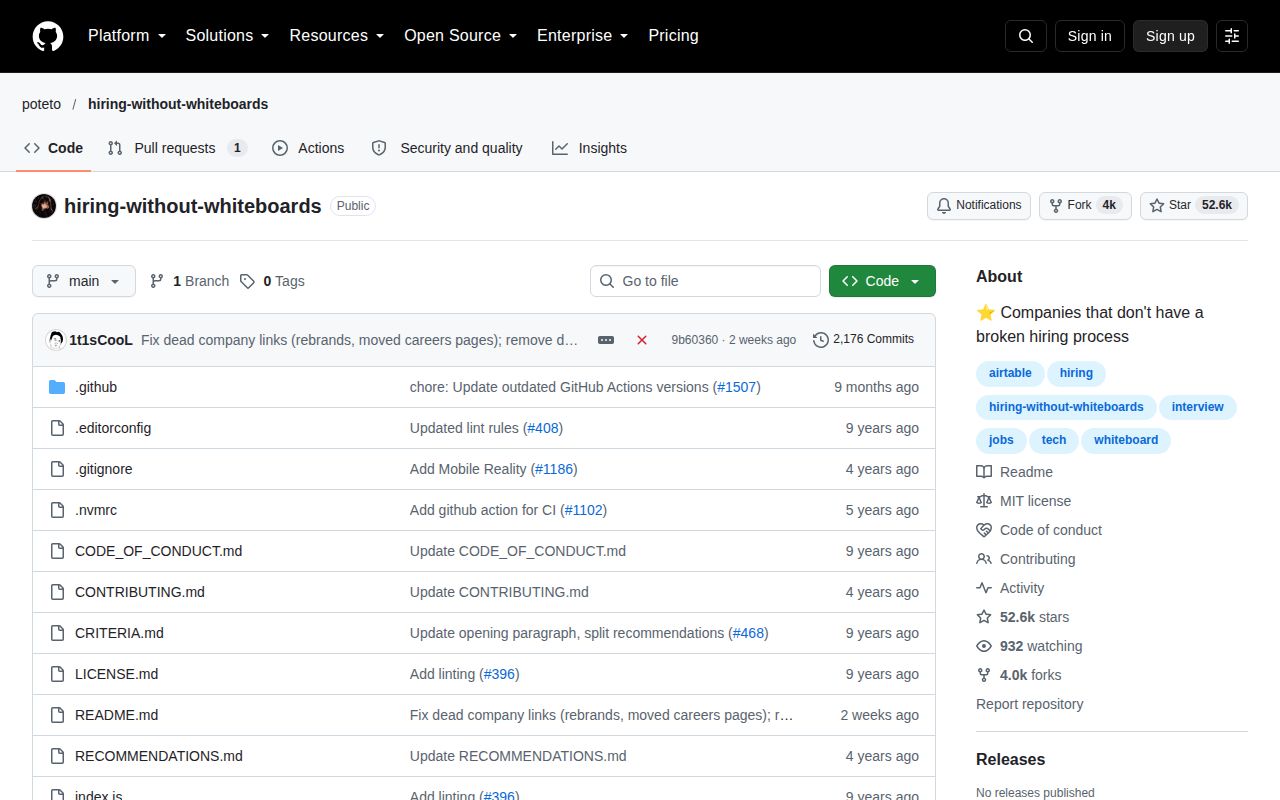
Lab card: what happened when we ran hiring-without-whiteboardsScreenshot of hiring-without-whiteboards (github.com/poteto/hiring-without-whiteboards)
Install✓ · 11s243 packages · 25 MB
Buildn/ano build script
Tests✓ · 6sran, no count parsed
Repo15 files~1 lines of source · 0.2 MB · 1 CI workflows

Answers from our run

Does hiring-without-whiteboards build from source?

Dependencies installed in 11 seconds (243 packages), and the project has no separate build step. We cloned commit b96912c into a clean Debian container with 3 CPUs and no project-specific setup.

Do hiring-without-whiteboards's tests pass?

The test command failed in our container, and its output did not report a pass or fail count.

Who should not use hiring-without-whiteboards?

Candidates who need a guarantee about their next interview: the README says experiences that contradict an entry should be reported as a dud, so processes can change before the list catches up.

What are the alternatives to hiring-without-whiteboards?

Tech Interview Handbook, Coding Interview University, Awesome Interview Questions. Our run installed 243 packages in 11 seconds and passed the available tests in 6 seconds, so the repository is easy to check locally and useful as a starting list.

Setup5/5243 packages installed in 11 seconds; tests passed in 6 seconds
Docs4/5Purpose, contribution route, and interview advice are plain
Community4/5Pushed in August 2026 with recent company-entry updates
Maturity4/5A long-running list, though every employer claim can age

Discussed on

  1. hnHiring Without Whiteboards481 points
  2. hnHiring without whiteboards423 points
  3. hnA listing of companies that don't do whiteboard job interviews369 points
  4. hnShow HN: Hiring Without Whiteboards4 points
  5. hnList of companies hiring without whiteboards3 points

Who it’s for

Developers choosing where to apply and willing to verify the current process with a recruiter.
Hiring managers looking for concrete alternatives to algorithm trivia.
Researchers comparing how engineering teams describe practical interviews.
Contributors with recent first-hand evidence that an entry is right or stale.

Who it’s NOT for

Candidates who need a guarantee about their next interview: the README says experiences that contradict an entry should be reported as a dud, so processes can change before the list catches up.
People treating every take-home assignment as candidate-friendly: the project recommends payment, a time box under 4 hours, and an exercise related to the actual job, but directory entries do not all promise those safeguards.
Applicants who reject every whiteboard on principle: the README objects to trivia, riddles, and unrelated puzzles, and explicitly accepts discussing a real work problem on a whiteboard.
Anyone expecting live vacancies or application tracking: many entries point to general careers pages, and the repository is a Markdown catalogue rather than a job board.

Setup reality

Our sandbox installed 243 Yarn packages in 11 seconds and used 25 MB on disk. The available tests passed in 6 seconds. The repository had 15 files, about 1 line classified as source, and a 0.2 MB checkout; there was no build target to run.

Using the list needs no account, API key, database, or service. Open the README, search by company or location, then confirm the role and interview steps on the employer's current careers page or with its recruiter.

Contributors need Node and Yarn for the repository checks. Our scan found 1 CI workflow, no Dockerfile, and no tests directory, which fits a Markdown catalogue rather than a deployable service.

The directory records practical interviews, not zero whiteboards

Hiring Without Whiteboards makes a narrower argument than its name suggests. The README does not condemn a marker and a board. It rejects computer-science trivia, riddles, brainteasers, and unrelated algorithm puzzles as proxies for engineering ability. Discussing a real design problem on a board is acceptable. So are pair programming, reviewing existing code, and a job-related take-home exercise. That distinction makes the catalogue more useful than a blanket list of companies that promise no live coding.

The main README is an alphabetical directory. Each row can include a careers link, locations, remote status, and a short description of the interview. Some entries describe a single conversation. Others spell out several stages, including paid trial work, code review, system design, or pairing. The format is quick to search and easy to scan, but it is not normalized data. A location separator or phrase such as "take home" may vary between contributors.

A company entry is a lead, not a current promise

The project tells candidates what to do when reality disagrees with the directory: open a pull request to remove the company as a dud. That is an honest correction mechanism, and also the clearest warning on the page. Interview loops change by team, seniority, country, hiring manager, and quarter. A row written after one candidate's experience cannot guarantee what another candidate will receive.

Use the list near the start of a job search. Find employers whose stated process suits you, open the linked careers page, and ask the recruiter what the current technical stages are for the exact role. Ask whether an exercise is timed, paid, and reviewed with an engineer. A directory answer can save discovery time. Only the employer can confirm the process attached to today's vacancy.

GitHub reported 10 open issues and pull requests combined when we checked. The default branch was pushed on 2026-08-24, and recent merged pull requests updated Betterment and added Plivo. That combination matters more than the lack of a release tag. This catalogue changes through small content edits, so a tagged software release would add little. Current entry work shows that maintainers are still processing corrections.

What happened when we ran it

Our run at commit b96912c installed 243 Yarn packages in 11 seconds, consuming 25 MB on disk. The available test command succeeded in 6 seconds. There was no build script or target, so we skipped that step instead of inventing one. The fresh Debian container had 3 CPUs, 8 GB of RAM, no secrets, and Node 22.

The checkout itself was tiny: 15 files, about 1 line identified as source by the lab classifier, and 0.2 MB on disk. Most of the value lives in Markdown content, which explains why a source-line count says almost nothing about the directory's size. Our scan found 1 CI workflow file, no Dockerfile, and no tests directory. Those signals match a maintained document with automated checks, not an application.

Passing tests do not validate every employer claim. They show that the repository's available checks completed on the measured commit. Our sandbox did not call company recruiters, apply for jobs, or test the links as a candidate. Treat the 6-second result as evidence about repository hygiene only. Freshness still depends on contributors reporting changed processes and maintainers merging the correction.

The hiring advice sets a better bar than many entries prove

The separate recommendations document is the strongest part for hiring teams. It says screening questions should resemble the role. Take-home work should be paid, limited to under 4 hours, restricted to the standard library where appropriate, and based on the sort of task the candidate would perform. It also recommends an alternative for people who cannot spare take-home time, such as a shorter pairing exercise on their own laptop.

That advice is more demanding than the directory's inclusion threshold. A company may appear because it uses a take-home project, while its row says nothing about payment or a time limit. Some entries describe long interview sequences, and a non-trivia process can still consume too much unpaid time. Candidates should compare each row with the project's own recommendations instead of reading inclusion as an endorsement of every detail.

The README also allows candidate choice. Someone may prefer a whiteboard for discussing a problem, and the recommendation says to let them use it. This is a practical position: the problem is an assessment detached from the work, not one particular surface or interview setting. Hiring managers can borrow that principle without copying any listed company's full process.

Search works, but structured filtering does not

A browser find is enough if you know a company name or city. It is less helpful for questions such as which remote employers pay for exercises, which processes avoid take-homes, or which entries were verified within 6 months. The Markdown rows do not carry consistent dates, evidence levels, or fields. There is no API, vacancy feed, or guarantee that every careers URL leads to an open engineering role.

Turning the repository into a database would create another maintenance problem. The simple pull-request model lets a candidate correct one line without learning a schema or running a service. For personal research, copy a shortlist into your own spreadsheet and add the date you confirmed each process. The upstream list remains useful precisely because contribution is cheap, while your private notes can carry the stricter evidence a job decision needs.

Active edits make the list useful, not authoritative

Hiring Without Whiteboards is best used as a filter for where to investigate, not proof that an employer runs a humane process. The 2026-08-24 push shows it is still maintained, though it cannot prove older rows remain correct. Its definition of a good technical interview is specific enough to challenge recruiters with useful questions. The directory gets you names. Verification, compensation for exercises, and a role-specific explanation still have to come from the company.

Alternatives

ProjectWhat it isPick it when
Tech Interview Handbook gh↗A practical guide to preparing for coding, system design, and behavioral interviews.pick this instead when you need interview preparation rather than a list of employers with practical processes.
Coding Interview UniversityA long self-study curriculum for computer science and coding interviews.pick this instead when you have decided to prepare for algorithm-heavy interviews rather than avoid them.
Awesome Interview QuestionsA language-by-language collection of technical interview questions.pick this instead when you want question banks for practice or for designing an interview.

What people are saying

  1. [github-trending] poteto/hiring-without-whiteboards

Sources

  1. Hiring Without Whiteboards README
  2. Recommendations for practical interviews
  3. Recent issues and pull requests

More data reviews

turso · TrackersListCollection · dash · getcontact-cli · awesome-zhuiju-free · iggy · the whole board →