Read the English edition before cloning anything
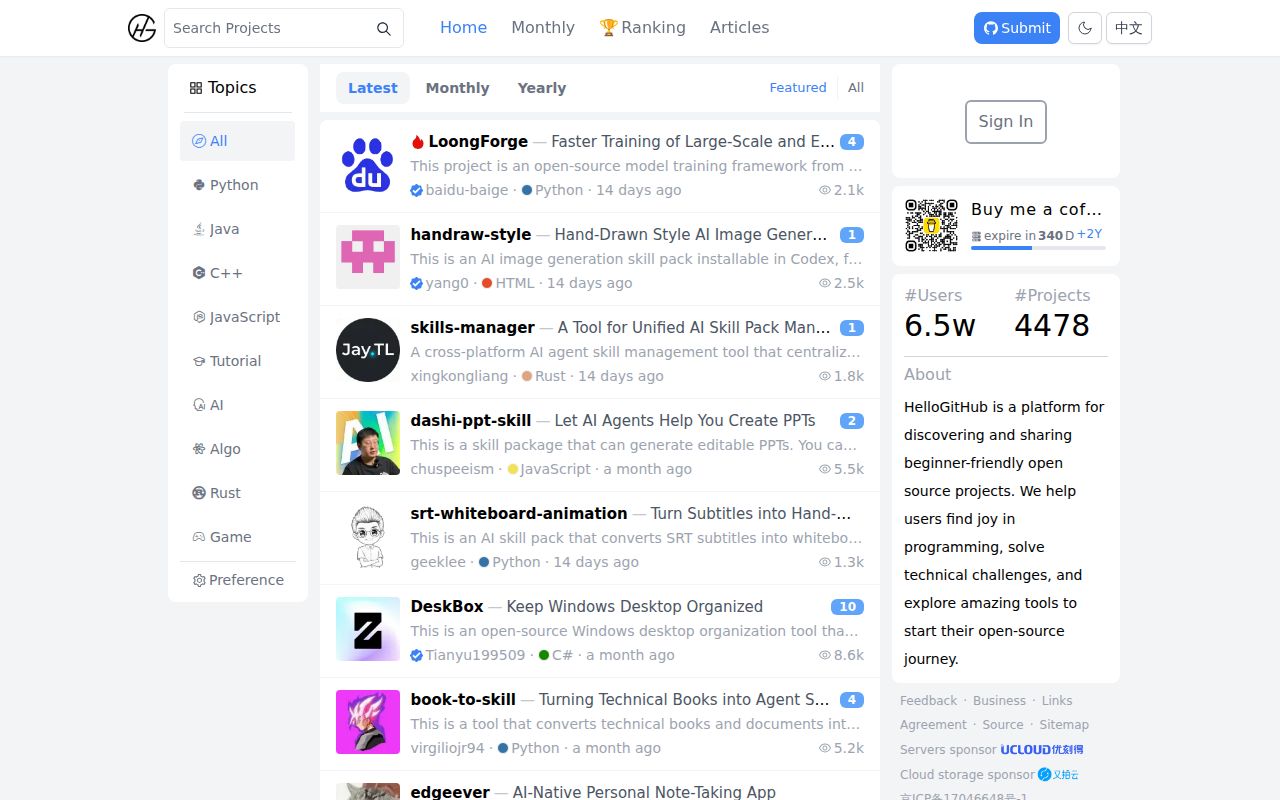
Open HelloGitHub's English volume 126 and you can move directly from a screenshot tool to a Python app framework or a small robot. Entries group projects by language or subject, give a short description, and often include an image. That makes the magazine useful when you want something interesting to try but haven't chosen a category yet. I'd read it with a specific afternoon project in mind, rather than collect another folder of bookmarks.
Our checkout occupied 5.6 MB across 266 files, with roughly 315 lines of source. Most of what you came for is readable content. You can browse the Markdown editions on GitHub or follow the English website link without configuring the Python scripts. The repository's Python language label is easy to misread here: installing its support code is optional for someone who just wants project recommendations.
English articles exist, while the script guides remain Chinese
The main README is Chinese, and an English README links directly to English monthly editions. The latest English issue includes descriptions of Flameshot and Flet, alongside projects in other languages and hardware categories. You don't need to translate the Chinese introduction to use that edition. The dated issue format also helps you place a recommendation in context before following its link to a project's current documentation.
The support code is a different experience. Both script READMEs are Chinese, including the account and mail configuration instructions. Our lab identified script/github_bot/ as the Python project within a checkout containing about 315 source lines. That distinction matters if you intend to adapt the collector: English magazine content doesn't amount to an English operator guide. Readers can skip those scripts entirely, while maintainers need to inspect them before putting credentials into a configuration.
What happened when we ran it
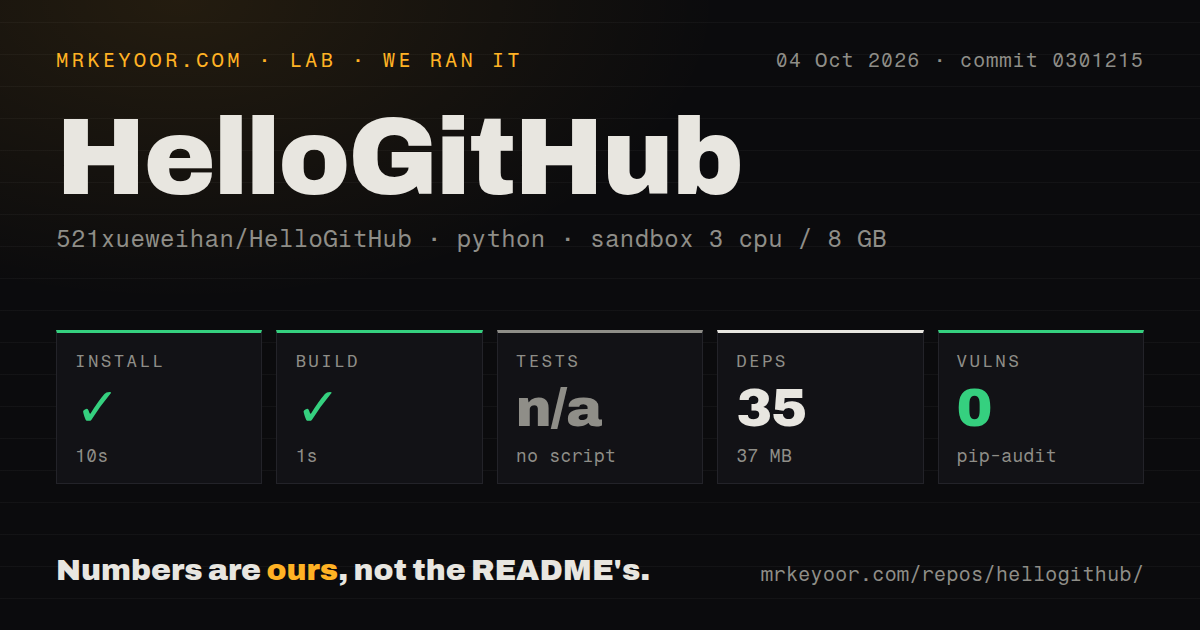
Our run installed HelloGitHub commit 0301215 in 10 seconds, adding 35 packages and occupying 37 MB on disk. The build succeeded in 1 second. We cloned it on October 4, 2026, into an unprivileged Debian container with 3 CPUs, 8 GB of RAM, and the ghcr.io/astral-sh/uv:python3.12-bookworm image. The container held no secrets, and the Python project lived in script/github_bot/. Those are useful setup results for the support code.
Tests were skipped because the lab found no test script or target. Pip-audit reported 0 known vulnerabilities, and the scan found 0 CI workflow files, no Dockerfile, and no tests directory. The 37 MB environment was straightforward to prepare, but the supplied results contain no authenticated collection or delivered-email outcome. They also say nothing about the reliability of projects featured in the magazine. Each recommendation still needs its own evaluation.
The collector needs account and mail settings edited in source
The bot configuration guide tells you to fill in ACCOUNT, MAIL, and RECEIVERS before running github_bot.py. The source requests received GitHub events, selects starring activity, looks up repository popularity, and sends an HTML table through SMTP. Its default mail host is smtp.qq.com. This is useful source material for a personal digest, provided you're willing to own the authentication, mail configuration, and operational behavior rather than expect a finished newsletter service.
The successful 10-second install doesn't remove that work. The script stores its configuration in Python dictionaries and writes warnings to bot_log.txt beside the source. Its date filter also adds an explicit timezone offset before comparing events with the machine's local clock, which deserves attention on a server outside the author's timezone. No secrets were present in our sandbox, so we'd inspect and adapt this path before trusting unattended delivery. Browsing the monthly archive avoids the credential requirement altogether.
The README's reuse license deserves a separate check
HelloGitHub's English README names CC BY-NC-ND 4.0 for the work. GitHub's repository metadata returned no recognized license value, so the README is the place to read the stated terms. If you want to republish the magazine commercially or distribute edited versions, resolve that license question before building a content pipeline around the archive. The license of a project linked from an issue is a separate question, answered in that project's own repository.
Pip-audit's 0 known vulnerabilities applies to the dependency audit in our sandbox, not permission to reuse the articles or a security assessment of the recommendations. The English volume's short descriptions can help you select a trial, but they don't supply deployment evidence for every linked tool. For an infrastructure decision, follow the repository link and check its actual configuration requirements and maintenance. A screenshot of a working interface is a reason to investigate, not enough evidence to operate it.
September publication and October submissions show continuing activity
HelloGitHub's last push was September 28, 2026, and release vol.126 appeared that day, matching the README's monthly publication schedule. GitHub listed 181,437 stars and 956 open issues and PRs. Recent entries included project submissions opened on October 12, such as issue 3931 for OpenConnector. The publication and incoming recommendations show continuing activity. The combined open count should not be read as a list of unresolved defects in the magazine or its scripts.
For a category search, I'd choose sindresorhus's Awesome index, which organizes links to topic-specific lists. For instructions that walk you through building an application, Project Based Learning is closer to the job. HelloGitHub earns its place when you want a varied monthly selection and readable introductions. Our 266-file checkout won't make the featured projects ready for your machine. Open an English entry that interests you, follow its repository link, and check whether its setup matches the time you actually have.