The repository teaches SDD through one 741-line example
Hello SDD is a Spanish course repository, and there is no English README or translated set of course notes. Its subject is spec-driven development: agree on what software must do, turn that agreement into a plan and small tasks, then let an agent implement against those artifacts. The repository contains templates under samples/ and a completed Python habit tracker under habits-cli/. That split makes the lesson inspectable instead of leaving viewers with slides alone.
The example is deliberately narrow. Our checkout contained 26 files, about 741 lines of source, and 0.5 MB before installation. The habit tracker can add a named habit, mark it complete for today, and list current streaks. Data stays in one readable JSON file. Editing, deletion, reminders, synchronization, statistics, and a terminal UI are all outside the MVP, so readers can follow the specification without first learning a large domain.
Eleven requirements connect the specification to the tests
The example specification contains 11 numbered functional requirements written in EARS notation. They cover normal actions and awkward cases such as duplicate names, empty input, a repeated completion on the same day, missing habits, streak gaps, and corrupt JSON. The plan maps those requirements to modules, data, command behavior, and tests. The task list then breaks implementation into short checked items with a visible definition of done.
That chain is the best part of the repository. The validation prompt asks the agent to walk from RF-1 through RF-11, identify the test covering each requirement, run the suite, and state whether the specification is met. Our run found 36 tests, all passing. A developer can therefore compare the written promise with executable evidence rather than accepting a polished generated answer.
What happened when we ran it
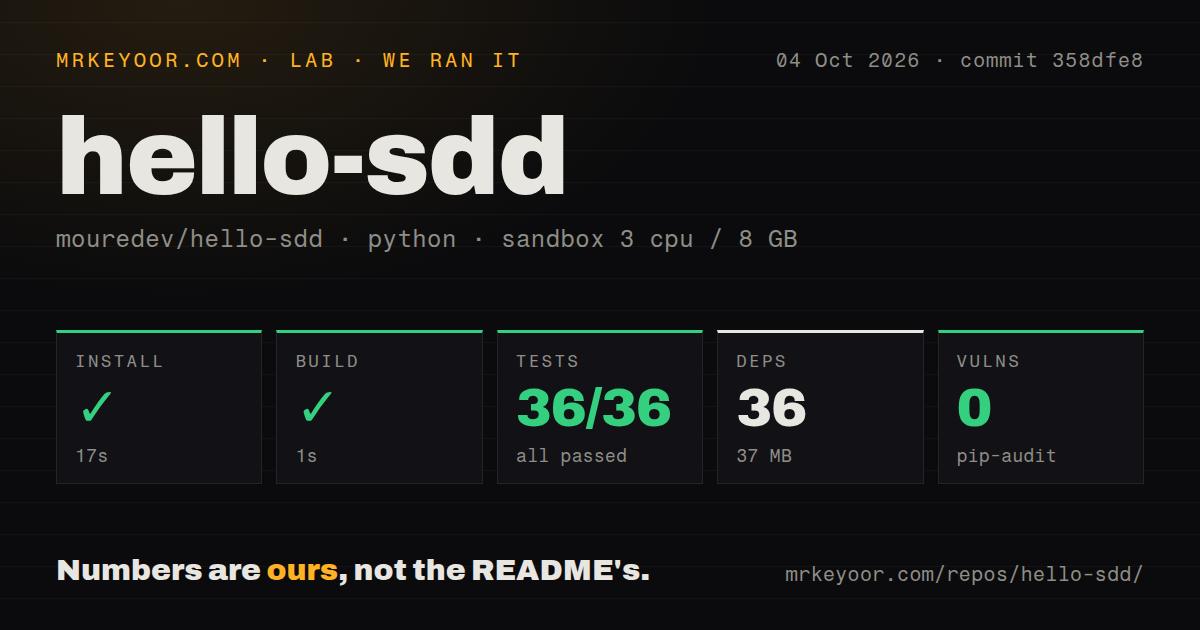
Our sandbox installed the habits-cli/ project in 19 seconds. The install added 36 packages and occupied 37 MB on disk. A separate build step completed in 2 seconds. The clean checkout was only 0.5 MB, so the environment remained modest even after the development dependencies arrived. Pip-audit reported 0 known vulnerabilities in the installed packages.
Pytest finished in 3 seconds with 36 passed and 0 failed out of 36. Those results came from commit 358dfe8 in an unprivileged Debian container with 3 CPUs and 8 GB of RAM. The repository has a tests directory, but our scan found 0 CI workflow files and no Dockerfile. Local verification is convincing; automatic verification on each proposed change is left to whoever adopts the material.
The Claude Code skill asks before it writes
The included spec-generator skill is more useful than a blank spec template because it controls the conversation. It reads a project constitution and prior specifications, asks requirements questions one at a time, allows at most 6 questions, and marks unresolved gaps instead of filling them silently. It also requires explicit approval before moving from the specification to planning or code. An OpenCode link points to the same skill material.
The rules keep implementation details out of the specification. Stack choices, file names, schemas, algorithms, and function signatures belong in the later plan. The skill also requires an out-of-scope section and rejects adjectives that cannot be tested. This is a sensible guard against an agent producing a detailed document that has quietly decided the architecture before the user has agreed on the behavior.
The Spanish video is part of the setup
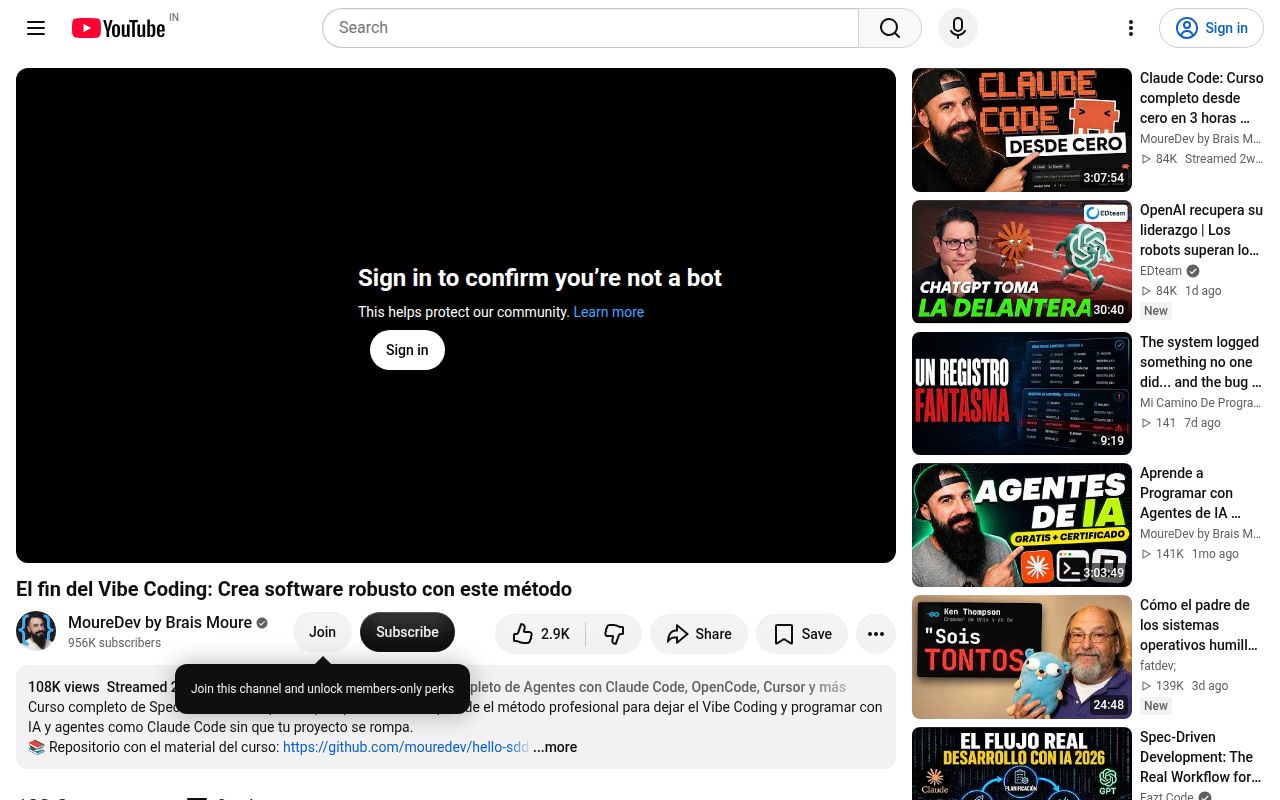
The main README says watching the linked course is indispensable for understanding the repository. That matters more than the 19-second install because the files do not form a guided application on their own. Prompts and artifacts are available as text, but their sequencing and explanation are part of a Spanish-language video. An English-only team would need to translate both the teaching and the project conventions before it could adopt them responsibly.
Runtime setup is simpler. Enter habits-cli/, create a Python environment, install pytest, and run the module. The application needs no account, API key, hosted database, or external service. It writes habits.json in the project root and refuses to overwrite a corrupt file. That last behavior comes directly from RF-11 and gives the lesson a concrete example of a requirement protecting user data.
Three commits and no release define its maturity
GitHub recorded 3 commits, all dated August 27, 2026, with the last push that day. The repository had 320 stars and 0 combined open issues and pull requests when fetched. It had no GitHub release. Those facts describe a new course drop with early attention, not a maintained framework with a history of releases, upgrades, and issue resolution.
Apache-2.0 licensing makes the templates and code easy to adapt, but adopters still have to supply their own automation and team process. There are 0 CI workflows and no container recipe to demonstrate how changes are checked outside a developer machine. For a small educational repository, that omission is understandable. For a company standard, it means the strongest pieces are the written workflow and traceability example, not the surrounding engineering system.
Use it as a lesson, not as your whole process
Hello SDD earns a place in a Spanish-speaking developer's study folder because the 741-line project keeps every stage visible. The constitution constrains the work, the specification states 11 requirements, the plan makes technical decisions, tasks limit agent scope, and 36 passing tests close the loop. Few tutorials leave enough artifacts behind to audit what the agent was asked to do.
The boundary is equally clear. This repository does not manage proposals across a large codebase, coordinate reviewers, run checks in CI, or provide a maintained command suite. Teams that need those capabilities should compare Spec Kit, OpenSpec, or cc-sdd. Use Hello SDD to teach why agreed requirements and traceable tests matter, then carry that habit into a tool and process suited to the size of your codebase.