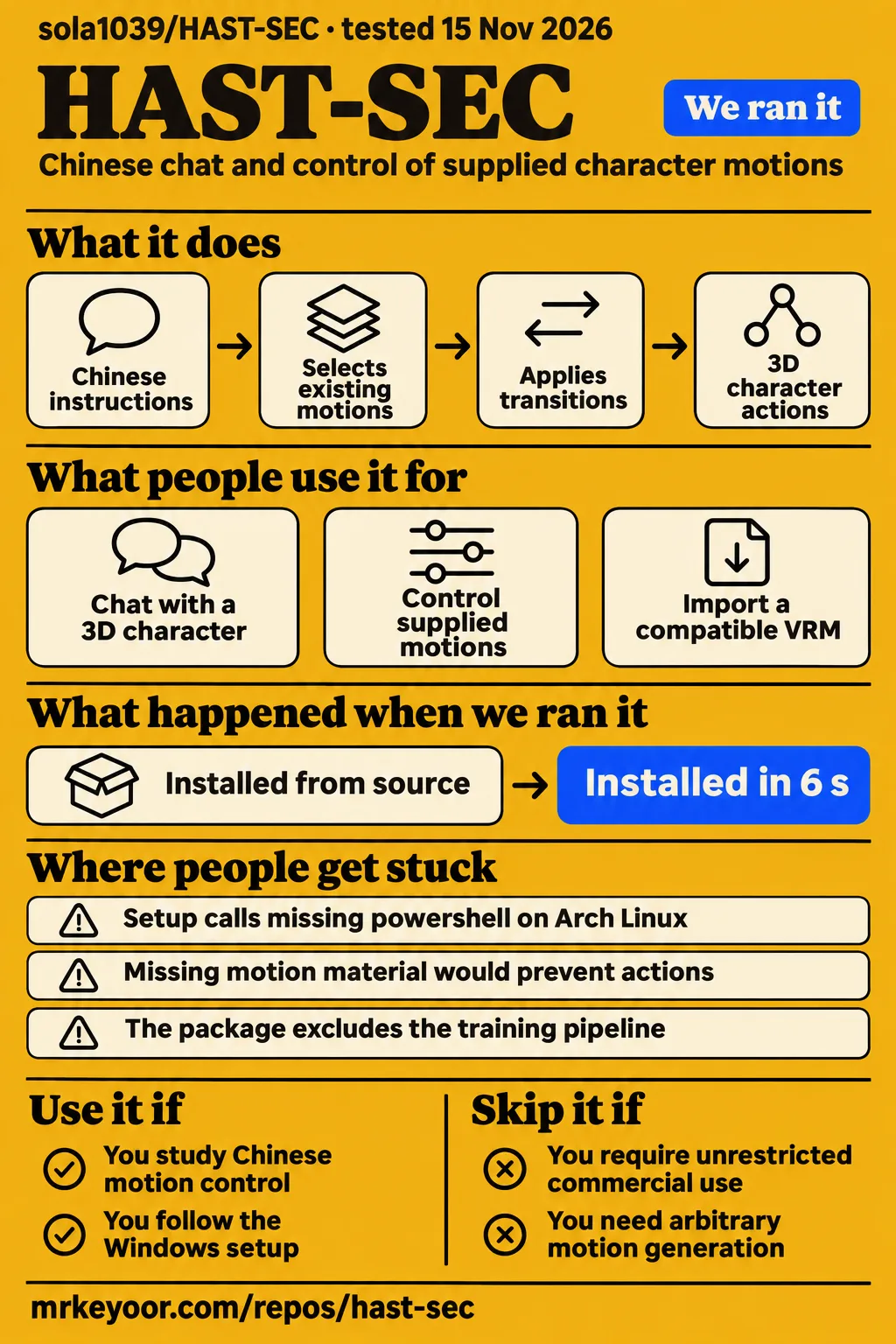
HAST-SEC is a local research demonstration for Chinese chat and control of supplied character motions. Our npm dependency installation took 6 seconds. The separate hands-on runner stopped at a missing-Compose check. Use it to study the documented character-control workflow for noncommercial research; skip it if your project requires unrestricted commercial permission, a complete supplied training pipeline or demonstrated arbitrary motion generation. The useful decision is whether its supported-action workflow matches your experiment.
What people use HAST-SEC for
HAST-SEC's model card describes Chinese control of supplied motions and continuous character display. The README adds chat, expressions, local VRM import and motion charts. Together, these describe an interactive character demonstration with specific inputs to try: a greeting, waving the left hand, raising the right hand and lifting the right leg. Those documented requests give a researcher a concrete starting sequence. HAST-SEC model card, HAST-SEC README.
| Who | What they tried | Recorded outcome |
|---|---|---|
| Project author 流明_Lumen_ | Chinese instructions controlling a 3D character | Published a demonstration advertised as using a 0.8B model for real-time actions. 0.8B demonstration listing. |
| GitHub user furina707, with shell account furina | Running npm run setup on Arch Linux | The command called powershell and failed; pwsh was available. Issue #2 setup transcript. |
| Project author 流明_Lumen_ | Goal-driven motion generation and control | Published a demonstration labeled 0.9B and Hast-Sec V0.2. V0.2 demonstration listing. |
These records cover author demonstrations and a user's installation attempt. The two video labels belong to separate demonstrations: the first advertises 0.8B parameters, and the second advertises 0.9B and V0.2. Keeping each label attached to its record helps readers follow the project without silently substituting a video architecture for the public resources described by the model card. The Linux attempt supplies a different kind of useful detail: the exact command that stopped setup.
What happened when we ran it
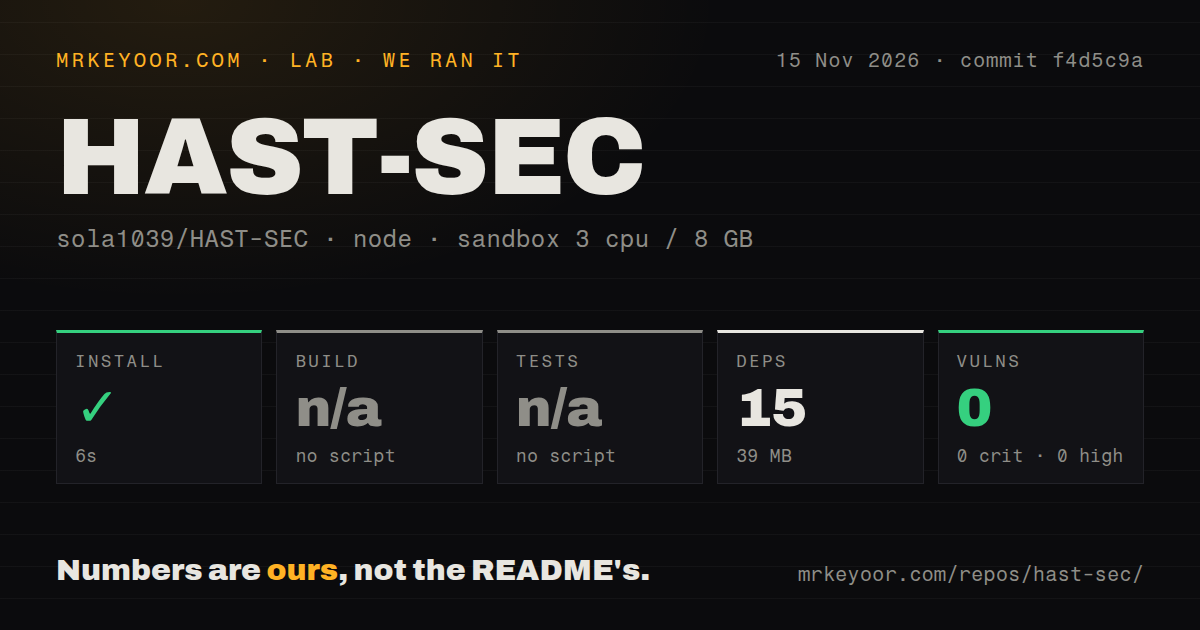
Our run installed npm dependencies in 6 seconds at commit f4d5c9a on 15 November 2026. The sandbox configuration recorded 3 CPUs, 8 GB RAM and image label lab-node:22. The separate hands-on runner failed its Compose-file requirement. These are two recorded stages with different outcomes: dependency installation completed, while the runner's prerequisite check stopped the application attempt before character interaction.
| Repository check | Our recorded result |
|---|---|
| npm dependency install | Succeeded in 6 seconds |
| Dependency record | 15 dependencies, 39 MB on disk |
| Build | Skipped: no build script or target |
| Tests | Skipped: no tests script or target |
| npm audit | 0 known vulnerabilities: 0 critical, 0 high, 0 moderate, 0 low |
| Repository scan | 291 files, approximately 2,887 source lines, 25.9 MB checked out |
| Automation and packaging signals | 0 CI workflow files, no Dockerfile, no tests directory |
The dependency step recorded 39 MB on disk; the README specifies approximately 2 GB of initial free space for installation. Its resource script separately obtains fixed-version language weights, an inference runtime and a public example character, then checks the files. GPU acceleration requires more space according to the same instructions. That separation explains why the dependency footprint and the documented installation requirement differ. README installation requirements.
The hands-on safety record says none of compose.yaml, compose.yml, docker-compose.yaml or docker-compose.yml existed. Its wording, "unsafe repo", identifies the runner's Compose requirement. The run summary contradicts that failed step by claiming deployment with the repository's own Docker Compose, with every port bound to 127.0.0.1. Teardown records "ok". We retain the failed step as the application attempt's outcome.
Where people get stuck: the setup command expects powershell
GitHub user furina707 reported npm run setup calling powershell on Arch Linux and failing because that command was missing. The same transcript shows pwsh --version returning PowerShell 7.6.9. The distinction is the executable name: the setup command requests powershell, while this user's installed command is pwsh. The issue asks for a Bash setup script. Issue #2 setup failure.
| Symptom | What the evidence identifies | Documented next step or status |
|---|---|---|
| powershell command not found on Arch Linux | npm calls powershell; the reporter has pwsh | Bash script requested in issue #2 |
| Windows PowerShell blocks npm scripts | README includes this symptom | README suggests npm.cmd forms of the commands |
| Resource download fails or checksum check fails | README includes interrupted downloads and validation errors | Check the connection and rerun setup; validated resources are skipped |
| Character loads with distorted movement | README points to skeleton compatibility | Use a compatible VRM with the required bones and check its licensing |
The README recommends Windows 10 or 11, Node.js 22 or later and a modern WebGL browser. Its troubleshooting table also covers occupied ports, a closed startup terminal and slow initial Chinese responses. These are upstream instructions, whereas the Arch Linux transcript is a user's recorded failure. Keeping those labels explicit makes the table useful without turning every documented symptom into something our sandbox encountered. README troubleshooting instructions.
Chinese instructions and a paused character are the starting workflow
The README says the character starts paused and the first interaction loads and warms the language model. After starting or resuming the character, the user enters a message in the bottom chat box. The instructions recommend waiting for interpretation and the action to finish before continuing. This sequence gives a first-time user a clear order: start playback, send one documented request, observe the action, then continue. README page controls.
The documented messages include 你好 for a greeting, 挥挥左手 for waving the left hand, 把右手举高 for raising the right hand and 抬起右腿 for lifting the right leg. A practical evaluation can begin with those examples and change one part of a request at a time. That is a proposed observation method: record the requested limb and action, then compare them with what the character does.
The chart retains the most recent 15 seconds of motion, and the resource display shows memory and file usage rather than GPU memory. Pause stops playback and releases the language-inference process started by the application; reset-and-pause returns to the initial state. These controls matter when reading the display because the visible chart is a recent window, and the resource meter has a specific meaning. README interface behavior.
Commercial permission and character rights are separate decisions
Commercial products, paid services and commercial deployments require written authorization under the README's terms. Noncommercial learning, teaching and research are permitted, including copying and modification under the stated conditions. Noncommercial redistribution must retain licensing and attribution, identify modifications and preserve the noncommercial restriction. This makes the public package a possible research starting point for the intended audience, while a commercial integration begins with permission from the maintainer. README usage terms.
Third-party resources keep their original licensing conditions, and project authorization does not replace those permissions. The default character is a public pixiv example with attribution in THIRD_PARTY_NOTICES.txt. The README allows importing a legally obtained compatible VRM of up to 100 MB, with complete humanoid, eye and finger bones. Expressions use the channels supported by the imported character. Character selection therefore involves both a rights check and the documented skeleton requirements. README character requirements.
The README says Chinese inference runs locally and requires no external API key. Installation needs network access to obtain the runtime resources, after which the documented application address is http://127.0.0.1:8769/language-lab or the address printed in the terminal. This is a concrete operating model for a research machine: acquire the resources, start the local service and interact through the browser. README local inference and startup.
HAST-SEC vs MotionGPT, Kimodo and speech-driven alternatives
Issue #1 commenter morettt describes HAST-SEC as selecting and scheduling existing clips, contrasting that approach with Kimodo and MotionGPT. The comment connects input parsing, current and recent poses, clip selection, blending and constraint correction. This gives the comparison a useful organizing question: does the experiment need control over supplied actions, new motion from text, or expression and gesture from speech? Issue #1 architectural discussion.
| Candidate | Why it appears in the discussion | How to use the comparison |
|---|---|---|
| Kimodo and MotionGPT | morettt contrasts motion generation with choosing and scheduling existing clips | Investigate their task descriptions when new motion from text is the research question |
| Random selection within an action class | Issue #1 requests this baseline with the same library and postprocessing | Compare the learned selector against random choice while holding the remaining stages constant |
| Pose-distance selection | Issue #1 requests this second baseline under the same conditions | Separate pose matching from the trained selector's contribution |
| PantoMatrix and DiffSHEG | fQwQf names them as research alternatives | Compare input, output and motion representation before choosing an experiment |
character-policy describes generating face and body animation from speech and body animation from text. Its README says it accepts speech, text, trajectory or scene inputs and outputs standard 3D motion parameters such as SMPL. Those declared inputs and outputs make it a research lead for generated motion and downstream animation tooling. The supplied issue names the older PantoMatrix repository address. character-policy project description.
DiffSHEG describes speech-driven 3D expression and gesture generation and documents inference using custom WAV audio. Its instructions distinguish models trained on BEAT and SHOW and describe saving gesture and expression results for visualization. A researcher starting with speech recordings can use that documented workflow to frame an experiment, while HAST-SEC's documented entry point is Chinese chat and action requests for an interactive character. DiffSHEG project and inference instructions.
What the other reviews get wrong
Rising places HAST-SEC among Code Intelligence & Docs projects, while the model card describes character-motion resources. That classification points readers toward a different task from Chinese character control. The model card is the more direct account of the resource package: it names the matching runtime code and describes semantic control of supplied actions. Rising category placement, HAST-SEC resource description.
GitHubTree displays 0 stars and 0 forks. Rising's snapshot records 576 stars and 41 forks at 15:12 UTC on 15 November 2026. These are conflicting displayed counters, so the zero values are a poor basis for describing repository attention. The dated Rising values provide the timestamp and numbers needed to identify that particular observation. GitHubTree counters, Rising dated snapshot.
The resource card identifies v0.1.0 resources and source commit 74956de. The supplied latest-release metadata lists v0.1.1, dated 14 October 2026, while the Bilibili listing labels a demonstration V0.2. Our dependency measurement used commit f4d5c9a. These identifiers describe different artifacts and observations; retain them when following installation instructions or interpreting a demonstration. Resource version, v0.1.1 release, V0.2 video listing.
FAQ
HAST-SEC's model card supports Chinese control of supplied actions, and issue #1 commenters describe selecting existing clips. That answers the central motion-generation question more directly than the parameter count in a video title. The remaining questions fall into three useful groups: how to isolate the selector's contribution, how to reproduce its training and evaluation, and how to assess interaction behavior. Model card, issue #1 research questions.
Is HAST-SEC an end-to-end motion generator or a system that selects existing motion clips?
Issue #1's author and commenter morettt describe a staged system that selects existing motions and applies transitions and constraint correction. morettt specifically argues that missing library material would prevent actions such as lying down or clapping. That is the commenter's architectural reading. The practical starting point is the model card's supplied-action description and the README's concrete Chinese requests. Issue #1 clip-selection account.
Does the learned motion selector outperform random selection or pose-distance selection with the same library and postprocessing?
Issue #1 requests random-selection and pose-distance baselines with the motion library and postprocessing held constant. The requester names instruction completion, transition smoothness, pose correction and solver failure rates as outcomes to examine. Those measures separate the selection decision from the quality of clips and later correction stages. A useful comparison would report each outcome under the same conditions rather than combine them into one impression of animation quality. Issue #1 baseline request.
Will a minimal reproducible training and evaluation example include reward definitions, data splits, codebook construction and commands?
Issue #1 requests reward definitions, data splits, codebook construction and reproduction commands in a minimal example. Its related evaluation questions cover split sources and time windows, overlap in actual model inputs, training-only fitting of preprocessing and codebooks, and separation of the final test set from tuning. The requester also reports shared training and validation contexts and asks for independent tests on unseen starting poses, different VRM characters and consecutive instructions. Issue #1 reproduction and generalization questions.
How does HAST-SEC handle consecutive instructions, interruptions and changes in motion amplitude or speed?
The README recommends waiting for each interpretation and action to finish before sending another instruction. Issue #1 asks about consecutive commands, interruptions, amplitude and speed, alongside instruction-to-action latency and per-stage timings. The same request asks for long interactions or user evaluation covering repetition, visible transitions and context mismatches. These form an interaction test plan: record when actions start, how commands interact and what repeats over a longer session. README sequential workflow, issue #1 interaction questions.
What we have not tested yet
Our application evidence stops at dependency installation and the failed Compose-only safety check. The documented native Windows resource setup, language-model loading, VRM import and character commands were not exercised. The pack contains no screenshots, known-answer motion results, runtime memory measurements or instruction-response timings. The image label does not identify the actual runtime or operating-system versions. The missing-Compose outcome reflects the runner's requirement, not a diagnosis of malicious code or a result for the native application.
The supplied issue discussion provides no controlled baseline results, quantified selector improvements, independent generalization results or answers to its training and dataset-separation requests. The public package excludes the training pipeline, original training video, original motion-capture data and original demonstration character. The reported missing-action concern was not reproduced in our run. The V0.2 video listing does not establish an available V0.2 source release, and its real-time headline supplies no hardware-specific response guarantee. Public resource scope, research requests.
The interaction questions collected in the FAQ also lack answering measurements in these records. Issue #2 contains no recorded fix for the executable-name failure. The inspected README links no English edition; English prompts and an English interface were not assessed. The comparison discussion supplies no controlled winner, and the popularity counters measure attention rather than successful deployments. These gaps are why the four editorial score dimensions remain unassessed rather than receiving numerical ratings.
The npm audit result covers known dependency advisories at the recorded run, not application security. Downloaded binaries, authentication, network traffic and public deployment were not inspected. The project excludes physical robot control and other safety-critical uses. Rendered layout, resolved links, related links, recommendation modules and template content also remain outside this text review. A useful next evaluation is the documented native setup with one licensed compatible character, followed by recorded outcomes and action-start times for supported Chinese requests.