MiniMax H3 runs through a native C and Metal path
h3.c is built for one job: run the MiniMax H3 video and audio model locally on Apple Silicon. The CLI accepts a prompt, model directory, output size, frame count or duration, denoising controls, and an output path. It can also anchor the first and last frames or consume ordered image, video, and audio references.
The README discusses 50 transformer blocks, denoising reuse, optional layer thinning, an internal render canvas, and 24 fps temporal shapes. Users can trade fidelity, memory, and time with explicit controls. Comparisons still require a fixed prompt, seed, resolution, frames, and step count fixed when deciding whether an optimization changed the content.
Apple Silicon is the product boundary
The repository describes itself as native inference for Apple Silicon, with current tuning on M3 Max and M5 Max. Metal handles GPU work and the host implementation is C. FFmpeg and FFprobe must be available for media inputs and MP4 output, while the Hugging Face model snapshot is expected in a local directory. The --info command checks model layout and reports the selected device without mapping every weight, which is a sensible first diagnostic before a long generation.
There is no official Linux or Windows route in the documented workflow. A CUDA backend for Linux and NVIDIA appears in open pull request 43, and a native macOS GUI appears in pull request 45. Open code is useful evidence of contributor interest, but neither is part of the reviewed mainline. If a team needs those paths today, it would be adopting a fork or carrying an unmerged branch rather than using the project as documented.
What happened when we ran it
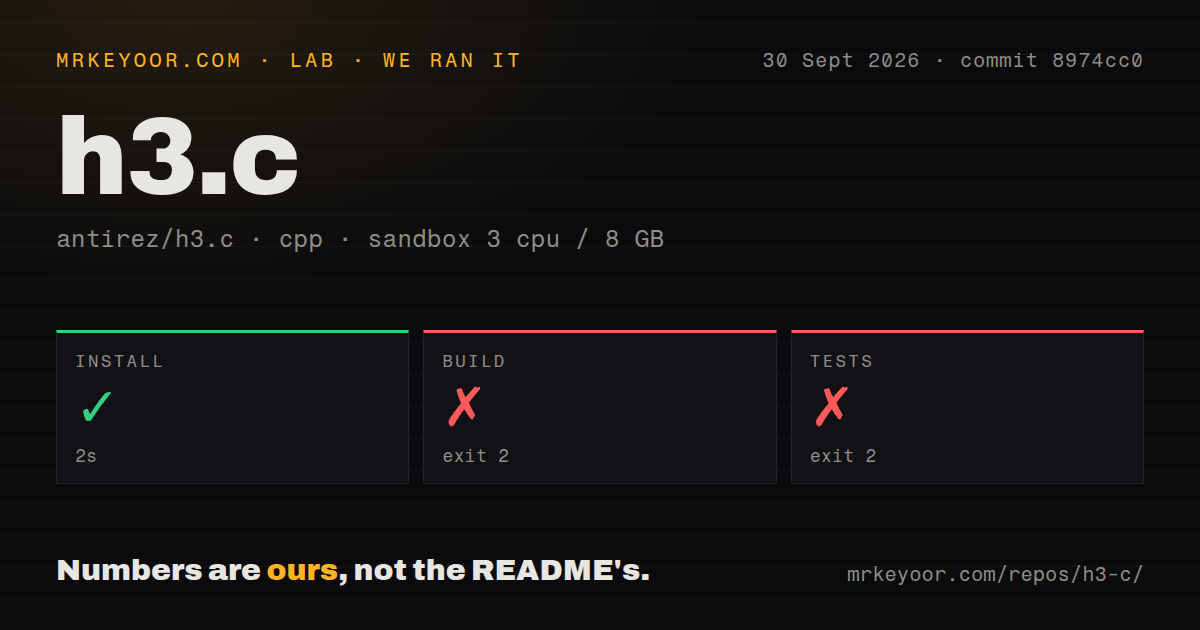
Our sandbox installed commit 8974cc0 successfully in 4 seconds. The checkout had 67 files, about 25,471 lines of source, and occupied 1.6 MB. It contained a tests directory but no CI workflow and no Dockerfile. The environment was an unprivileged Linux container with 3 CPUs and 8 GB of RAM, so this was a portability check for the source and Makefile, not a Metal inference run.
The build failed with exit code 2 after 4 seconds. The log ended with 8 warnings and 2 errors. In h3.c, the compiler reported an implicit declaration of strdup as invalid in C99, then reported that the resulting integer expression could not initialize a char *. Make stopped while producing h3_cli.o and h3.o. The log does not show whether a flag, header change, or supported macOS toolchain would resolve it, so we do not assign a cause beyond those messages.
Tests also failed with exit code 2 after 4 seconds because compilation hit the same strdup diagnostics. The test log again summarized 8 warnings and 2 errors before Make stopped at h3.o; no test-result count was produced. That is a failed test step, not evidence that any runtime assertion failed. A Mac evaluation should begin by building and running make test at the pinned commit, then add the optional parity fixtures before trusting generated media.
SSD streaming exchanges speed for lower resident weights
The normal path uses the original BF16 checkpoint. SSD streaming keeps only a small number of transformer blocks resident and reads the next block while the GPU processes the current one. The README is careful to distinguish tracked transformer tensor storage from total system memory: prompt encoding, video and audio decoders, operating-system use, and media buffers still need headroom. Its terminal preview mode also keeps another decoder resident, so the lowest-memory configuration omits live previews.
This trade is valuable on Macs where unified memory is the fixed ceiling, but storage speed becomes part of inference. SSD streaming cannot be combined with one optional row-wise int8 mode. Interactive users can toggle it during a session. Before buying hardware or exposing this as an internal service, measure a representative 22-frame and longer clip on the exact Mac, with previews either consistently on or consistently off. The project README's machine-specific results are guidance, not a substitute for that capacity test.
Reference media has limits that can stop a run early
First and last frame anchors select one conditioning path, while general ordered references select another and cannot be mixed with those anchors. Standalone audio must accompany an image or video reference. The README caps audio references at 3 inputs and 15 seconds of decoded duration. Frame requests are also rounded to model-supported temporal shapes, so a requested duration can produce a slightly longer clip than the literal number suggests. Applications should display the resolved frame count before starting expensive work.
Issue 47 documents a separate Metal limit in a reference-heavy run. A reference video combined with several images and longer output caused the Qwen text encoder to exceed threadgroup memory before denoising began. The reporter's experiments narrow the trigger toward the reference video's token contribution. That report is specific enough to matter for product design: validate the longest allowed prompt and reference combination, and reject an unsupported request before allocating minutes of user attention to it.
Active issues do not replace a release contract
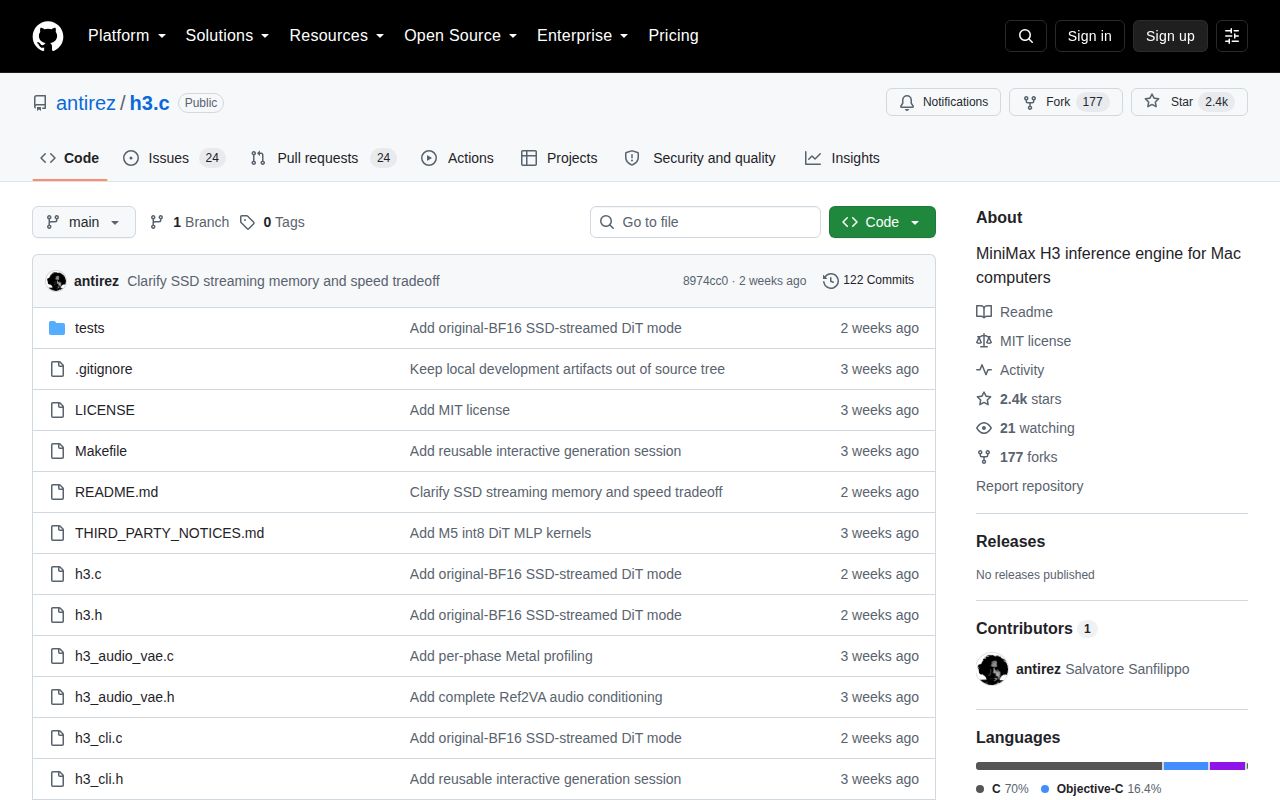
GitHub listed 2,443 stars and 48 combined open issues and pull requests when fetched. The last main-repository push was August 11, 2026, while issues and proposed changes continued later in August. GitHub returned no latest tagged release. Users therefore need to pin a commit and track changes directly rather than relying on semantic versions or release notes. The MIT license is straightforward, while model terms and media rights still need separate review.
h3.c is compelling as an engineering project because its documentation explains the knobs and their failure boundaries with rare precision. Our failed 4-second build keeps the buying advice narrow: try it on the Mac it targets, run its host and parity checks, and compare saved outputs before integrating it. If portability, a supported GUI, or conventional tagged upgrades are requirements, the current mainline does not meet them.