grpcio review
grpcio 1.83.0 is Python's official runtime for gRPC calls over HTTP/2, using compiled code from gRPC's shared core. Your .proto file defines message fields and unary or streaming methods; generated modules turn that contract into protobuf classes, client stubs, and server binders. The runtime then provides sync and asyncio channels, deadlines, metadata, status codes, TLS, and interceptors. Release 1.83.0 requires Python 3.10, adds abort_with_status to the asyncio ServicerContext interface, handles exceptions raised by custom interceptors, and removes internal cygrpc names from public module exposure.
Our grpcio 1.83.0 install completed in 0.3 seconds, used 18 MB, imported in 0.39 seconds, and had no audit findings, but its wheel contained native extensions and no py.typed marker. Use it for controlled cross-language RPC and streaming; do not make it the direct interface for browser users or carry channels across a process fork.
We installed it
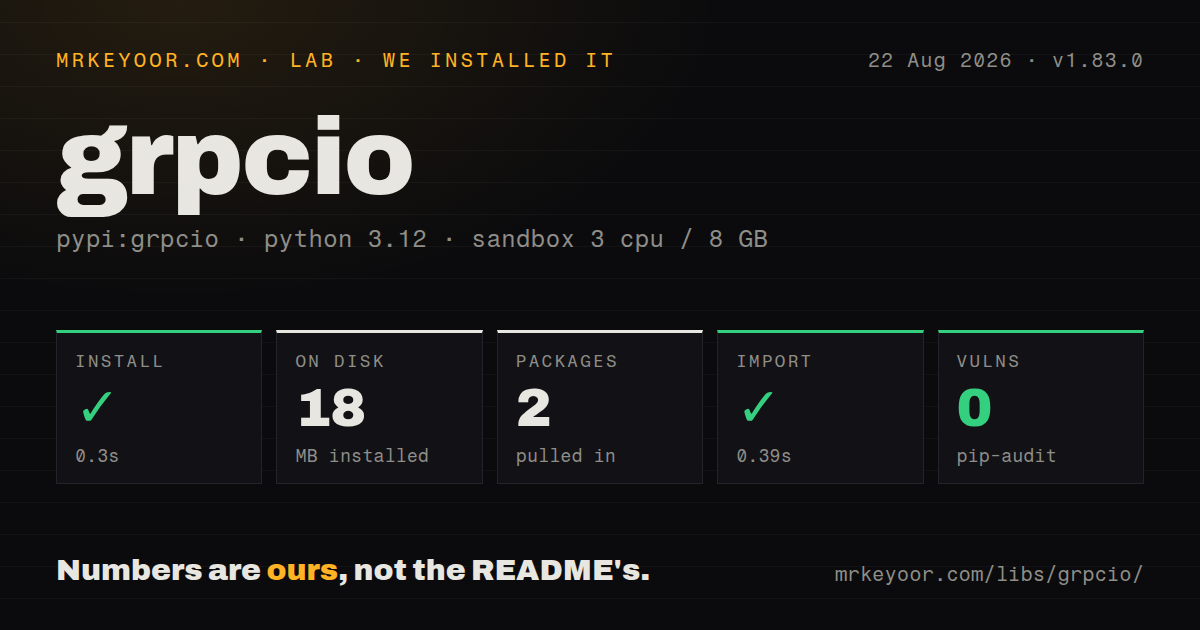
| Install | ✓ · 0.3s | 2 packages on disk · 18 MB |
| Import | ✓ | import grpc in 0.39s · compiled extensions · requires Python >=3.10 |
| Known vulns | 0 | (pip-audit) |
Answers from our run
Does grpcio install cleanly?
Yes. In a fresh container with an empty cache, pip install grpcio finished in 0.3s, leaving 2 packages and 18 MB on disk. pip-audit reported no known vulnerabilities.
What does grpcio need to run?
Python >=3.10, and a platform wheel with compiled extensions. In our run import grpc succeeded in 0.39s.
grpcio or grpclib: which should you use?
grpclib: Choose it for asyncio-first Python services that prefer a Python protocol implementation over gRPC's compiled core. Our grpcio 1.83.0 install completed in 0.3 seconds, used 18 MB, imported in 0.39 seconds, and had no audit findings, but its wheel contained native extensions and no py.typed marker.
When should you not use grpcio?
Browsers are the main callers; grpcio runs in Python, so web clients still need gRPC-Web support or an HTTP translation gateway
Use it if
- Services written in several languages must implement the same protobuf messages and RPC method signatures
- An internal API needs server, client, or bidirectional streaming on long-lived HTTP/2 channels
- Both sides of the boundary are controlled by your team and generated modules can ship with each service
- The platform already models failures through deadlines and gRPC status codes instead of JSON response conventions
- Browsers are the main callers; grpcio runs in Python, so web clients still need gRPC-Web support or an HTTP translation gateway
- Public users need endpoints they can inspect with curl and an OpenAPI document; a Python HTTP framework has fewer moving pieces
- Workers inherit channels created before fork; gRPC's fork notes restrict this and direct applications to create gRPC objects in each child
- Deployment requires pure Python on a platform without a wheel; our package contained .so extensions, making a source build a native toolchain problem
- The runtime package itself must advertise complete typing; our wheel had no py.typed marker
Setup reality
We installed grpcio 1.83.0 into a fresh Python 3.12 container in 0.3 seconds. Two packages occupied 18 MB. The package reports 2 direct dependencies and Python 3.10 or newer; its wheel ships compiled .so files, lacks py.typed, and supplied no license value in the measured metadata. pip-audit returned 0 known vulnerabilities. A first import grpc succeeded in 0.39 seconds.
grpcio is only the transport runtime. Code generation requires grpcio-tools plus your .proto files and a protoc command whose include root matches the package layout. The generated *_pb2_grpc.py file imports the matching *_pb2.py file. Wrong output roots therefore fail during Python import, before a network call can explain the mistake. Generate both outputs together and test them against the locked grpcio and protobuf versions.
Use insecure_channel only on local or otherwise protected traffic. A deployed client normally combines channel credentials with per-call tokens or metadata. Channels are designed for reuse; opening one for every function call discards connection setup and HTTP/2 multiplexing. Generated methods accept timeout, but they do not choose an application deadline. Set one for each remote boundary and map expected server errors to grpc.StatusCode values rather than leaking generic UNKNOWN failures.
A synchronous server assigns calls to the executor you pass, so 16 blocking handlers can consume a 16-worker pool. grpc.aio channels and calls belong to the event-loop thread that created them, and blocking that thread freezes unrelated RPCs. Pre-fork servers need another rule: construct channels after each child begins. The project's fork guide says the multithreaded core does not generally support inherited live gRPC objects and documents only limited client-side cases.
Patterns
Describe one request-response method define-service
syntax = "proto3";
package catalog.v1;

service Catalog {
  rpc GetItem(GetItemRequest) returns (Item);
}
message GetItemRequest { string id = 1; }
message Item { string id = 1; string name = 2; }
A protobuf field number remains its wire identity; reserve deleted numbers instead of assigning them new meanings.
Compile a proto into two Python modules generate-python-stubs
python -m grpc_tools.protoc \
  -I proto \
  --python_out=src \
  --grpc_python_out=src \
  proto/catalog/v1/catalog.proto
This command needs grpcio-tools, and its roots must place _pb2.py where _pb2_grpc.py can import it.
Run handlers on a 16-thread server run-sync-server
from concurrent import futures
import grpc
from catalog.v1 import catalog_pb2_grpc

server = grpc.server(futures.ThreadPoolExecutor(max_workers=16))
catalog_pb2_grpc.add_CatalogServicer_to_server(CatalogService(), server)
server.add_insecure_port('[::]:50051')
server.start()
server.wait_for_termination()
start() does not block; wait_for_termination() holds the process, while max_workers bounds simultaneous blocking handlers.
Give a unary RPC three seconds call-with-deadline
import grpc
from catalog.v1 import catalog_pb2, catalog_pb2_grpc

with grpc.insecure_channel('localhost:50051') as channel:
    stub = catalog_pb2_grpc.CatalogStub(channel)
    item = stub.GetItem(catalog_pb2.GetItemRequest(id='42'), timeout=3.0)
Generated methods leave timeout unset, so each remote boundary needs its own finite value.
Translate a missing row into NOT_FOUND map-domain-error
import grpc

def GetItem(self, request, context):
    item = store.get(request.id)
    if item is None:
        context.abort(grpc.StatusCode.NOT_FOUND, 'item not found')
    return item
context.abort() terminates the call by raising, so no return path follows that branch.
Handle NOT_FOUND without parsing text handle-client-error
import grpc

try:
    item = stub.GetItem(request, timeout=3.0)
except grpc.RpcError as error:
    if error.code() is grpc.StatusCode.NOT_FOUND:
        item = None
    else:
        raise
StatusCode is the stable machine-readable branch; details() is intended for human context.
Stop producing after stream cancellation stream-server-results
def WatchItems(self, request, context):
    for item in store.watch(request.collection):
        if not context.is_active():
            return
        yield item
A server generator may keep running after the client disconnects unless it checks context activity or cancellation.
Keep an asyncio server on one loop run-asyncio-server
import asyncio
import grpc

async def serve():
    server = grpc.aio.server()
    add_services(server)
    server.add_insecure_port('[::]:50051')
    await server.start()
    await server.wait_for_termination()

asyncio.run(serve())
grpc.aio objects belong to their creating event-loop thread; send blocking handlers to a thread or process pool.
Verify the server over TLS open-tls-channel
import grpc

credentials = grpc.ssl_channel_credentials()
channel = grpc.secure_channel('api.example.com:443', credentials)
stub = CatalogStub(channel)
Certificate names must cover api.example.com; pass private root material when the service does not chain to public trust.
Attach a bearer token to one call attach-call-metadata
metadata = (('authorization', f'Bearer {token}'),)
item = stub.GetItem(request, metadata=metadata, timeout=3.0)
Ordinary metadata keys use lowercase ASCII; a key ending with -bin is reserved for byte values.
Cap channel startup at 10 seconds wait-for-channel
channel = grpc.insecure_channel('catalog:50051')
try:
    grpc.channel_ready_future(channel).result(timeout=10)
except grpc.FutureTimeoutError:
    channel.close()
    raise RuntimeError('catalog service unavailable')
Channel readiness confirms transport connectivity, not that a domain-level health check will pass.
Open each worker's channel after fork create-channel-after-fork
def worker_main():
    channel = grpc.insecure_channel('catalog:50051')
    stub = CatalogStub(channel)
    run_jobs(stub)
    channel.close()
The fork guide warns that a child should not inherit a live channel created by its parent process.
Alternatives
| Package | Registry | Pick it when |
|---|---|---|
| grpclib | PyPI | Choose it for asyncio-first Python services that prefer a Python protocol implementation over gRPC's compiled core. |
| grpcio-tools | PyPI | Add it at build time when grpcio applications need Python code generated from .proto contracts. |
| betterproto | PyPI | Choose it when dataclass-style generated messages and its async client conventions better fit the Python codebase. |
More web backend guides
urllib3 · requests · ws · anyio · httpx · undici · the whole shelf →
How this guide is made: grounded in the library's documentation, release notes, changelog, and issue history, on a fixed rubric — not a hands-on install of every release. The 50 most-downloaded entries are additionally install-verified in clean containers. Corrections: contact the desk.