mrkeyoor.com_
Tue 01 Sept 17:45 UTC
LLM Toolsevaluationupdated 25 Aug 2026

grok-bot-0.18-reconstructed review

Grok Bot 0.18 Reconstructed is an unofficial TypeScript reconstruction of the shipped Grok Bot macOS application, with readable replacements for much of its desktop and agent runtime. It keeps the original minified renderer as a pinned input, then adds provider routing for Cursor, Claude Code, Codex, and OpenRouter plus an optional local Docker execution box.

+445stars / 7d
Verdict

Our install added 383 packages, but both the 3-second build and 3-second test run failed, so this reconstruction is research material rather than a dependable desktop-agent dependency. Its readable protocol boundaries and pinned-input discipline make it interesting for reverse engineers on Apple Silicon. Do not distribute a derivative or trust it with production credentials until the licensing question is resolved, the full bootstrap path passes, and the 29 reported dependency vulnerabilities are assessed.

We ran it

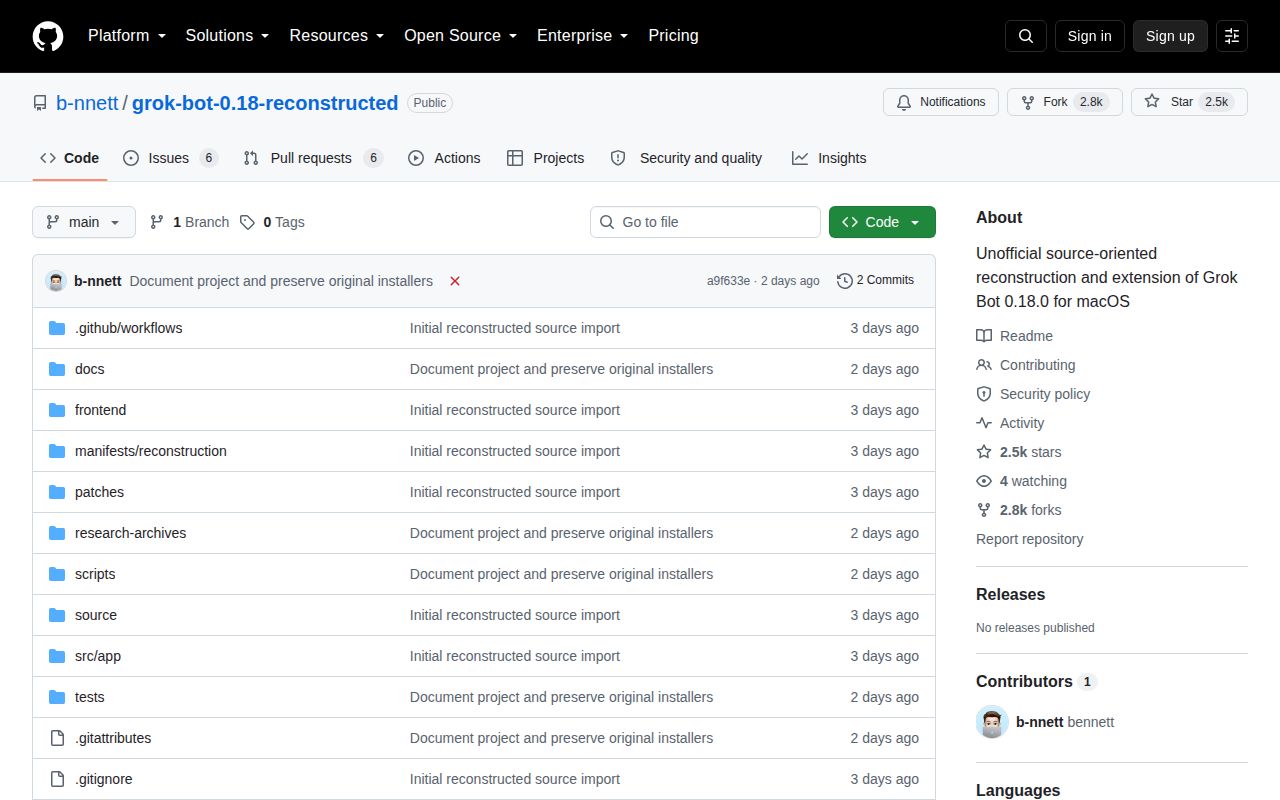
Lab card: what happened when we ran grok-bot-0.18-reconstructedScreenshot of grok-bot-0.18-reconstructed (github.com/b-nnett/grok-bot-0.18-reconstructed)
Install✓ · 21s383 packages · 473 MB
Build✗ · 3s
Tests✗ · 3sran, no count parsed
Known vulns290 critical · 5 high · 20 moderate · 4 low (npm audit)
Repo2111 files~439,143 lines of source · 29 MB · 1 CI workflows · tests dir

Answers from our run

Does grok-bot-0.18-reconstructed build from source?

Dependencies installed in 21 seconds (383 packages), and the build failed. We cloned commit a9f633e into a clean Debian container with 3 CPUs and no project-specific setup.

Do grok-bot-0.18-reconstructed's tests pass?

The test command failed in our container, and its output did not report a pass or fail count.

Does grok-bot-0.18-reconstructed have known vulnerabilities in its dependencies?

npm audit flagged 29 known advisories in the dependency tree at the time of our run.

Who should not use grok-bot-0.18-reconstructed?

Production teams needing a clean license chain: GitHub reports no license, NOTICE describes retained upstream boundaries, and issue 7 asks for licensing and derivative-work permission to be clarified.

What are the alternatives to grok-bot-0.18-reconstructed?

OpenCode, Codex, Continue. Our install added 383 packages, but both the 3-second build and 3-second test run failed, so this reconstruction is research material rather than a dependable desktop-agent dependency.

Setup1/5Install passed; build and tests failed on required reconstructed assets
Docs4/5Clear provenance, architecture, bootstrap, and boundary explanations
Community2/5Recent interest and pull requests, but a small new project
Maturity1/5Experimental pinned reconstruction with unresolved license status

Who it’s for

macOS reverse engineers studying how an Electron agent application connects UI, host processes, protocols, tools, and sandboxes.
Researchers who accept a pinned Grok Bot 0.18.0 binary as an input and want readable runtime boundaries around it.
Advanced Apple Silicon users comparing Cursor, Claude Code, Codex, and OpenRouter behind one experimental desktop interface.
Contributors prepared to audit bootstrap, renderer patching, ad-hoc signing, provider credentials, and local Docker execution.

Who it’s NOT for

Production teams needing a clean license chain: GitHub reports no license, NOTICE describes retained upstream boundaries, and issue 7 asks for licensing and derivative-work permission to be clarified.
Users expecting official support or source parity: the README says this is not Anysphere's monorepo and inferred names may differ from the original code.
Windows, Intel Mac, or Linux users wanting a ready build: the documented target is macOS on Apple Silicon, while ports remain issues or pull requests.
Anyone unwilling to retain an upstream compiled renderer: the original frontend source and source maps were unavailable, so the polished minified renderer stays in the finished hybrid app.
Teams that require a green build and tests before evaluation: our build and test commands both failed, and npm audit found 29 known vulnerabilities.

Setup reality

Our clean install at commit a9f633e succeeded in 21 seconds, adding 383 packages and using 473 MB. The build then failed in 3 seconds because an audit script could not open src/app/dist/renderer/assets/pdf-WLgSwHwh.js. Tests also failed in 3 seconds on an assertion that received 134 instead of 155793020.

The documented path requires macOS on Apple Silicon, Node.js 26.5.x, Xcode Command Line Tools, Git LFS, and a pinned Grok Bot 0.18.0 DMG. Claude Code and Codex routes reuse local authenticated clients; OpenRouter uses an API key. Docker Desktop is optional for local execution.

Our checkout contained 2,111 files, about 439,143 source lines, and occupied 29 MB before installation. npm audit reported 29 vulnerabilities: 5 high, 20 moderate, and 4 low. There was one CI workflow, a tests directory, and no Dockerfile. The failed asset lookup suggests the documented bootstrap input was absent from our run, but the log alone does not say why.

This is a hybrid reconstruction of Grok Bot 0.18.0

The project does not claim to be Anysphere's original source. It reconstructs Electron main-process code, preload boundaries, host logic, a coordinator, protocols, and settings in readable TypeScript. The polished renderer remains compiled upstream JavaScript and CSS because the distributed application did not include authored frontend source or source maps. A narrow transform inserts the new Router settings into that retained UI.

Grok Bot 0.18.0 is treated as a pinned build input. Bootstrap obtains the macOS arm64 DMG from a Git LFS preservation copy, an original public URL, or a user-supplied application path. It verifies the DMG and app.asar, records original and patched renderer hashes, assigns a separate bundle identifier, and ad-hoc signs the result. That discipline makes the reconstruction inspectable, while the result still depends on upstream compiled material.

Four provider routes are useful experiments, not a support promise

The Router can select Cursor, Claude Code, Codex, or OpenRouter for new turns. Cursor uses the existing Grok Bot or Cursor session. Claude Code and Codex reuse authenticated local clients, while OpenRouter needs an API key stored through the desktop secrets bridge. The reconstruction attempts to preserve streaming, thinking state, reactions, plugin mentions, and MCP tool execution across these different paths.

Open issues show where that abstraction is incomplete. Issue 11 says routed-provider secrets do not reach the Mac-side coordinator, and issue 9 says one routed path sends tools without executors. Two reports are enough to rule out a claim that all four providers behave alike. They also illustrate the main engineering risk: a UI can expose the same switch while authentication, tool calls, usage reporting, and failure modes differ underneath.

The local Docker option replaces the remote box with an owned container bound to loopback. Host and daemon artifacts mount read-only, and the coordinator validates the container before connecting. This is useful for studying local execution, but the README still requires Docker Desktop or a compatible daemon and says remote mode remains the default. Container isolation also does not remove the risk attached to credentials reused from local provider clients.

The target is one Apple Silicon release

The documented environment is macOS on Apple Silicon with Node.js 26.5.x, Xcode Command Line Tools, and Git LFS. Windows x64 installer research is preserved, yet Windows support remains an issue. Linux and Intel Mac work appears in open pull requests rather than the quick-start contract. Anyone outside the supported Mac target is evaluating unfinished port work, not following the maintained path.

That narrowness is reasonable for reverse engineering. Pinning one binary reduces ambiguity while contracts are recovered. It is a poor fit for an application team that needs durable upgrades, because the README makes no promise of compatibility with future Grok Bot versions. A new upstream renderer can change hashes, RPC shapes, UI chunks, or authentication behavior and force another recovery cycle.

What happened when we ran it

Our sandbox cloned commit a9f633e into an unprivileged Node environment with 3 CPUs, 8 GB of RAM, and no secrets. The repository contained 2,111 files and about 439,143 source lines in a 29 MB checkout. npm installation succeeded in 21 seconds, adding 383 packages and taking 473 MB on disk.

The build failed after 3 seconds. Its final stack trace came from scripts/audit-runtime-composition.mjs, which tried to open src/app/dist/renderer/assets/pdf-WLgSwHwh.js and received ENOENT. The log establishes that this generated or hydrated renderer asset was missing at that path. It does not establish whether Git LFS, bootstrap, platform mismatch, or another step caused the absence, so we will not pick a cause.

Tests also failed after 3 seconds. tests/research-archives.test.mjs expected 155793020 and received 134 in a strict equality assertion. The supplied log showed a failing-test summary but no total count, so no pass rate can be reported. npm audit found 29 known vulnerabilities: 5 high, 20 moderate, and 4 low. The checkout had one CI workflow and no Dockerfile.

Licensing is the reason to keep this in the lab

GitHub reports no repository license. The README points to PROVENANCE and NOTICE files, distinguishes reconstructed code from retained upstream boundaries, and says the app uses a separate identity without overwriting the installed upstream application. Those are responsible disclosures. They do not grant permission by themselves. Issue 7 explicitly asks for licensing and permission around a derivative to be clarified.

The repository was pushed on August 23, 2026, with 12 open issues and pull requests during our research. There was no latest GitHub release. Active work includes RPC recovery, a Docker gateway, transcript handling, CI archive checkout, and platform ports. That is healthy activity for a new research repository, while the absence of releases and the open reconstruction plan reinforce its experimental status.

Grok Bot 0.18 Reconstructed is worth reading if your subject is Electron reverse engineering, agent protocols, or provider routing. It is not the clean way to obtain a multi-provider coding agent. OpenCode, Codex, or Continue gives a team a source-first product with a clearer adoption path. Keep this project isolated, use disposable credentials, and resolve permission before distributing anything built from the retained upstream renderer.

Alternatives

ProjectWhat it isPick it when
OpenCode gh↗An open-source coding agent with terminal and desktop surfaces and support for multiple model providers.pick this instead when you need an actively developed agent whose own source and releases are the product, not a reconstruction of a shipped binary.
Codex gh↗OpenAI's open-source local coding agent for terminal-based repository work.pick this instead when the Codex workflow itself is enough and you do not need Grok Bot's reconstructed desktop UI or provider router.
Continue gh↗An open-source coding-agent platform with IDE integration and configurable models and tools.pick this instead when supported IDE workflows and configurable assistants matter more than reverse-engineering research.

What people are saying

  1. [velocity-scout] b-nnett/grok-bot-0.18-reconstructed

Sources

  1. Grok Bot 0.18 Reconstructed README
  2. Repository facts
  3. Licensing clarification issue
  4. Routed provider secrets issue
  5. Routed tool executor issue
  6. Project provenance

More llm tools reviews

rig · open-knowledge · graphiti · cve-mcp-server · minimind · SillyTavern · the whole board →