A model release, not a chatbot package
Grok-1 is easiest to understand as a publication artifact. xAI released the model weights, tokenizer, checkpoint loader, JAX model definition, and a small runner that samples one prompt. The repository does not include a chat interface, an HTTP API, model training code, or the operational pieces needed to serve concurrent users. Its job is narrower: let researchers inspect and execute the original architecture.
That architecture is substantial. The README describes a 314B-parameter mixture-of-experts model with eight experts, two selected for each token, 64 layers, and an 8,192-token maximum sequence length. It uses rotary position embeddings, activation sharding, and optional 8-bit quantization. The tokenizer is checked into the repository, while the much larger checkpoint must be downloaded separately.
The Apache 2.0 license covers both the source files and the released Grok-1 weights. That is useful if you need to examine, modify, or build around this specific model. It does not turn the example into a finished product. A team choosing it inherits nearly every decision above the sampling loop.
What happened when we ran it
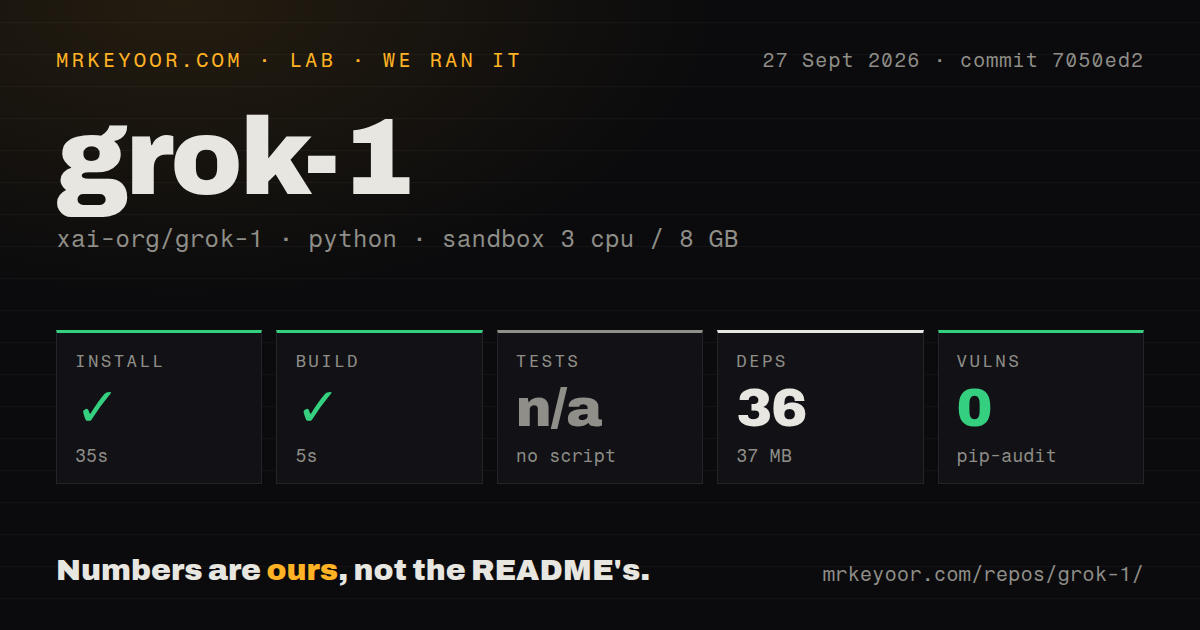
We cloned commit 7050ed2 into an unprivileged Debian container with 3 CPUs and 8 GB of RAM. The repository contained 12 files, about 2,300 lines of source, and occupied 2.3 MB after checkout. Installing the Python environment succeeded in 25 seconds. It added 34 packages and used 36 MB on disk.
The build step also succeeded, taking 7 seconds. There was no test script or target, so we skipped tests rather than inventing a substitute. The repository has no tests directory, no CI workflow, and no Dockerfile. A pip-audit scan reported zero known vulnerabilities in the installed Python packages.
These results say the small code wrapper can be prepared cleanly. They do not show that Grok-1 generated text in our sandbox. The checkpoint was not part of the checkout, and the README requires enough GPU memory for the 314B-parameter model. Our run had CPUs and 8 GB of RAM, so an install and build result must not be read as an inference result.
The setup instructions stop where the expensive work begins
The README gives two commands after the checkpoint is in place: install requirements.txt, then run python run.py. Getting the weights is a separate step through a magnet link or Hugging Face. The expected directory is fixed as ./checkpoints/, and the script looks for the tokenizer in the repository root.
Hardware is the bigger boundary. The included run.py configures a (1, 8) local mesh, which means the example is written around eight local devices. It also sets activation sharding and an eighth of a batch per device. Readers with a different topology must understand the JAX mesh and checkpoint layout rather than merely changing a friendly configuration file.
xAI is candid about speed. The mixture-of-experts layer avoids custom kernels so that the released implementation is easier to use for correctness checks, and the README calls it inefficient. That is a reasonable trade for reference code. It is a poor basis for assuming production throughput, latency, or hardware cost. The project publishes none of those promises in the README, and our lab did not measure them.
What you can learn from the code
The small surface area is an advantage for architecture work. model.py contains the transformer and expert implementation. checkpoint.py maps the released parameter tree into JAX arrays. runners.py handles the mesh, checkpoint restore, tokenization, memory, and sampling. run.py puts those pieces together with a fixed prompt and conservative sampling temperature. There is much less application scaffolding to read through than in a general inference platform.
That same sparseness limits reuse. There is no authentication, queue, streaming endpoint, observability layer, or deployment definition. The example chooses one padding bucket and one checkpoint location. If your goal is an internal API, you must design the request boundary and decide how model state stays resident. If your goal is training or fine-tuning, this repository does not document that workflow.
Maintenance signals are weak
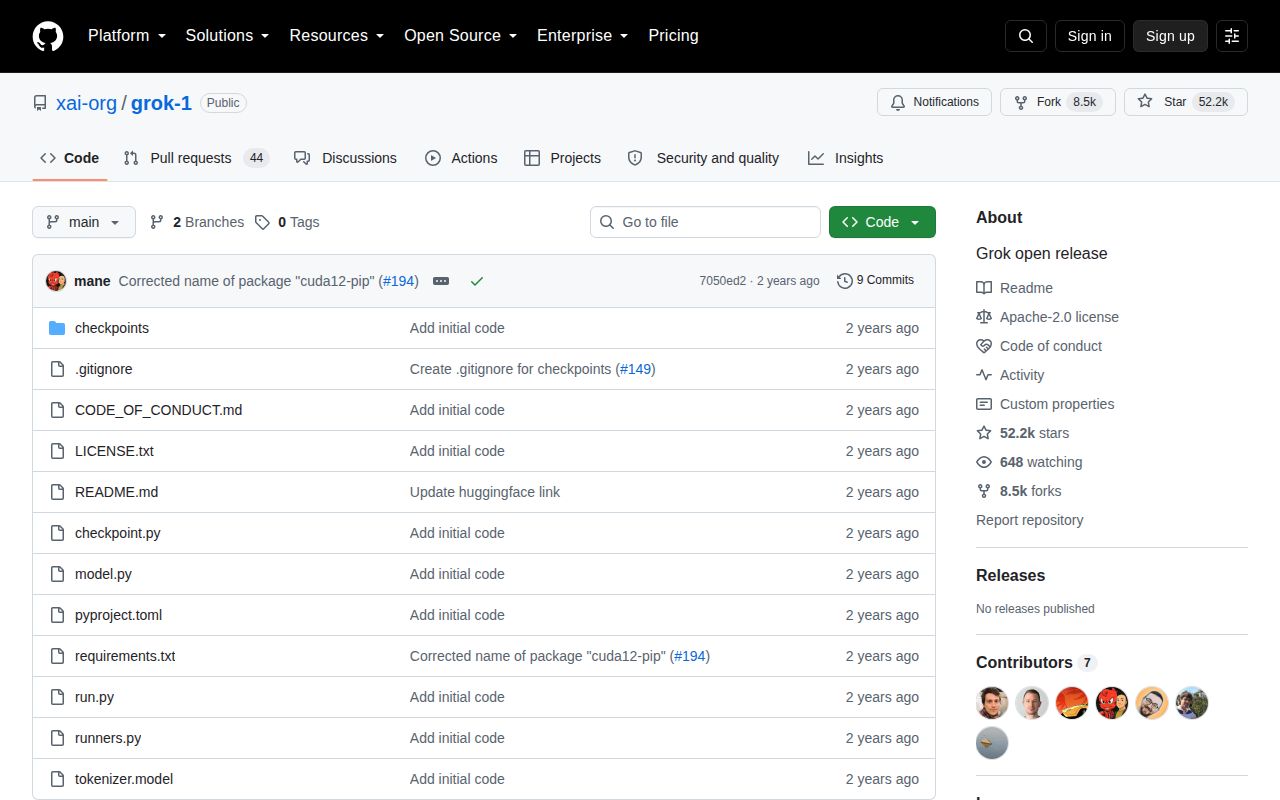
The default branch was last pushed on August 30, 2024. GitHub reports 124 open items, but Issues are disabled, so that figure represents open pull requests rather than a normal issue and pull-request queue. Contributors were still updating pull requests in 2026, including work on a fused Triton rotary-embedding implementation, yet recent contributor activity has not produced corresponding default-branch updates.
There is also no latest GitHub release record. The repository has no CI workflow and no automated test target in the measured checkout. Those facts do not make the published model unusable, but they change the support expectation. Treat the code as a fixed research release that your team may need to fork, audit, and maintain.
The buying decision
Grok-1 makes sense when you specifically need xAI's original weights or want to study this mixture-of-experts design. The code is short enough to inspect, the license is permissive, and our dependency setup completed without drama. Access to suitable hardware remains the entry price, and the supplied implementation openly favors clarity over efficient execution.
For an application that simply needs a capable language model, this is an awkward starting point. A current serving project gives you APIs, scheduling, supported model formats, and active release machinery. Choose Grok-1 for research tied to Grok-1, then budget for a fork if it becomes part of a long-lived system.