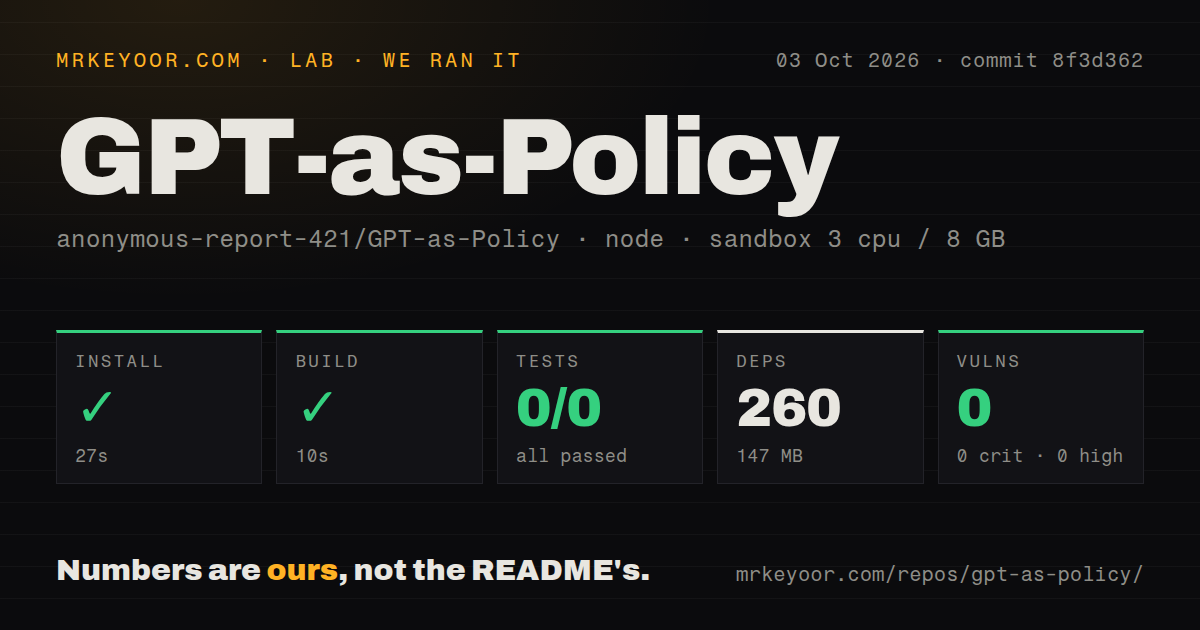
The 37-second install and build path rebuilds the report
Our sandbox installed 260 npm packages in 27 seconds and built the Vite report in 10 seconds. That is the friendly part of GPT-as-Policy. The app under hybrid_rollout/report_site/app turns the preserved report source into one self-contained HTML file, while scores, media, licenses, and citation data sit beside it. You can also serve the prebuilt report with Python and switch between English and Chinese.
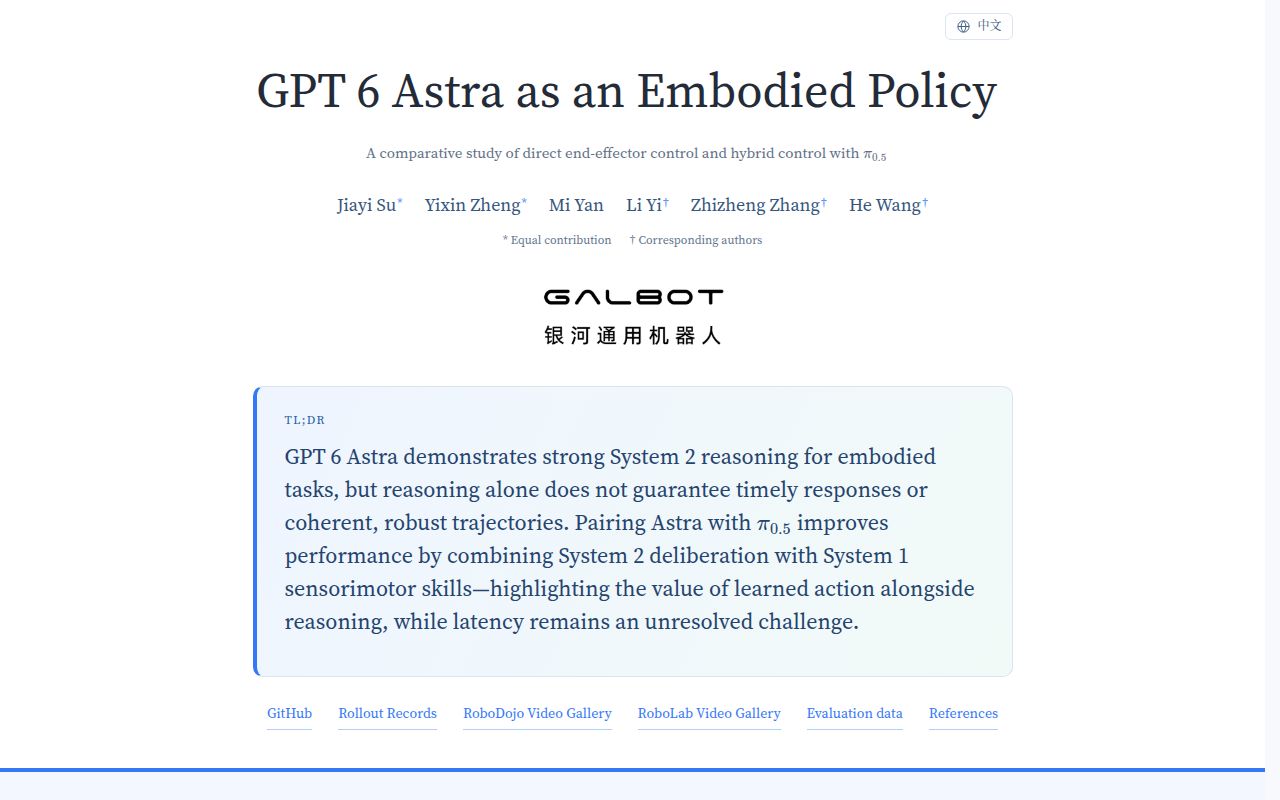
That success says nothing about launching a robot. The public repository is a research release around two evaluation paths: GPT 6 Astra Direct chooses actions itself, while the hybrid policy reviews a fresh proposal from π₀.₅ and may correct it. The release includes code, selected results, and provenance, but it deliberately excludes model checkpoints, simulator assets, raw model sessions, private annotations, and original operations logs.
The hybrid policy reports 48% success across 50 cases
The project README reports 10 RoboDojo tasks with five aligned cases per task. Its hybrid policy reaches a mean score of 62.60 and 48% success, with GPT corrections on 14.4% of executed control steps. GPT 6 Astra Direct reaches 26% success, and its mean score is 37.81 over the 48 episodes that had native scores. Both success rates use all 50 selected cases.
Those figures support a narrow conclusion: on this selected evaluation, reviewing π₀.₅ proposals beat direct GPT control. They do not establish performance across the full RoboLab catalogue. The README also says official-model comparisons are reweighted public references rather than same-seed reruns. Open issue 6 asks about extending the work from 10 tasks to the full 120-task suite, and no answer is posted.
What happened when we ran it
We cloned commit 8f3d362 into an unprivileged Debian container with 3 CPUs, 8 GB of RAM, no secrets, and a Node 22 image. The checkout contained 850 files, about 55,671 lines of source, and occupied 91.4 MB. The project app lives several directories below the root, which matters if you expect npm ci at the checkout top level.
Our npm install succeeded in 27 seconds, adding 260 packages and consuming 147 MB. The build completed in 10 seconds. Npm audit found 0 known vulnerabilities across critical, high, moderate, and low severity. These measurements cover the report app only; we made no simulator, policy-model, or paid API call.
The test command exited successfully in 8 seconds, yet node:test reported 0 passed and 0 failed of 0. The repository scan also found 0 CI workflow files, no Dockerfile, and no tests directory. A zero exit code here confirms that the command returned cleanly. It does not show that any assertion ran.
The npm test script points to a directory that is absent
The app's package script calls node --test tests/*.test.mjs, while the measured checkout has no tests directory. That matches the 0-test result. The wider source tree does contain Python test modules, and the README gives separate unittest and pytest commands, but our lab did not run those suites. Treat the npm result as an empty frontend test target, not as coverage for the controller or report.
This distinction is easy to miss because the build performs a protected-runtime verification before Vite. That integrity check can prove that preserved files match expected digests. It cannot replace behavioral tests. A team reusing the frontend should wire its actual tests into the package script and CI before relying on green automation.
A new rollout needs Isaac Sim 5.1 and authorized model access
The public snapshot is not a standalone simulator distribution. RoboDojo requires Isaac Sim 5.1, matching RoboDojo source and assets, and the π₀.₅ OpenPI/JAX checkpoint. The model is fixed to gpt-6-astra with xhigh reasoning, with no provider fallback promised. You must also configure paths, container identity, credential locations, a gateway, and the exact evaluation case.
The missing material is documented rather than hidden. Source revisions and checkpoint identity are recorded, public results align task, scene, and seed, and the release notes explain that deployment paths and gateway endpoints were replaced with generic examples. Still, full reproduction requires upstream assets plus authorized and potentially paid services outside the checkout. A successful 10-second report build should never be presented as a reproduced robotics experiment.
Two open issues expose the remaining decision gaps
GitHub showed 569 stars, two open issues, no open pull requests, and a last push on September 16, 2026. The source release was recent, so that date does not suggest abandonment. Both issues are relevant, though neither had a reply when checked: issue 5 asks for episode runtime and control-loop latency, while issue 6 asks about all 120 RoboLab tasks.
No GitHub release tag exists, despite a checked-in source-release note and an initial public-release commit. For reading the report, commit 8f3d362 is a clear pin. For adopting the controller, wait for your own simulator run before making cost or latency promises. GPT-as-Policy is most useful as a transparent evaluation artifact: its strongest product is the boundary it draws between rebuilding the report and reproducing the experiment.