GoFr's appeal is the service plumbing it documents in one framework. The adoption question is whether those conventions suit your service, and what the recorded setup run actually verifies.
What the framework documents
The GoFr README describes an opinionated microservice framework focused on Kubernetes deployment and out-of-the-box observability. It lists REST defaults, configuration, logs, traces, metrics, authentication middleware, gRPC, HTTP services with circuit breakers, Pub/Sub, health checks, migrations, cron jobs, remote log-level changes, Swagger rendering, abstracted filesystems and websockets.
The documentation introduction describes logging, response types, health and readiness monitoring, Prometheus metrics and tracing. These sources explain the intended feature set. Our run did not verify each integration or a Kubernetes deployment.
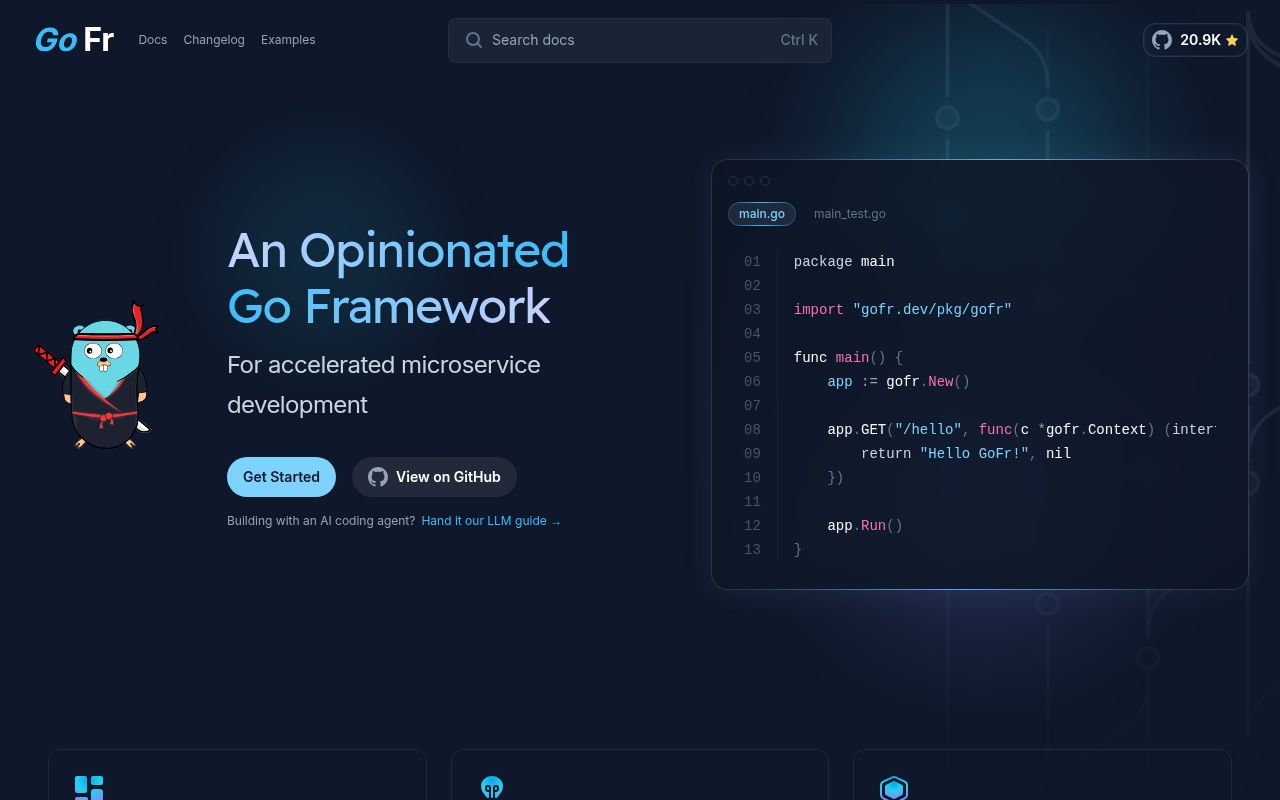
The README example uses gofr.New(), a GET handler and Run(). A short example helps explain the API, but does not measure the work needed to configure your databases, messaging or telemetry.
What our recorded run establishes
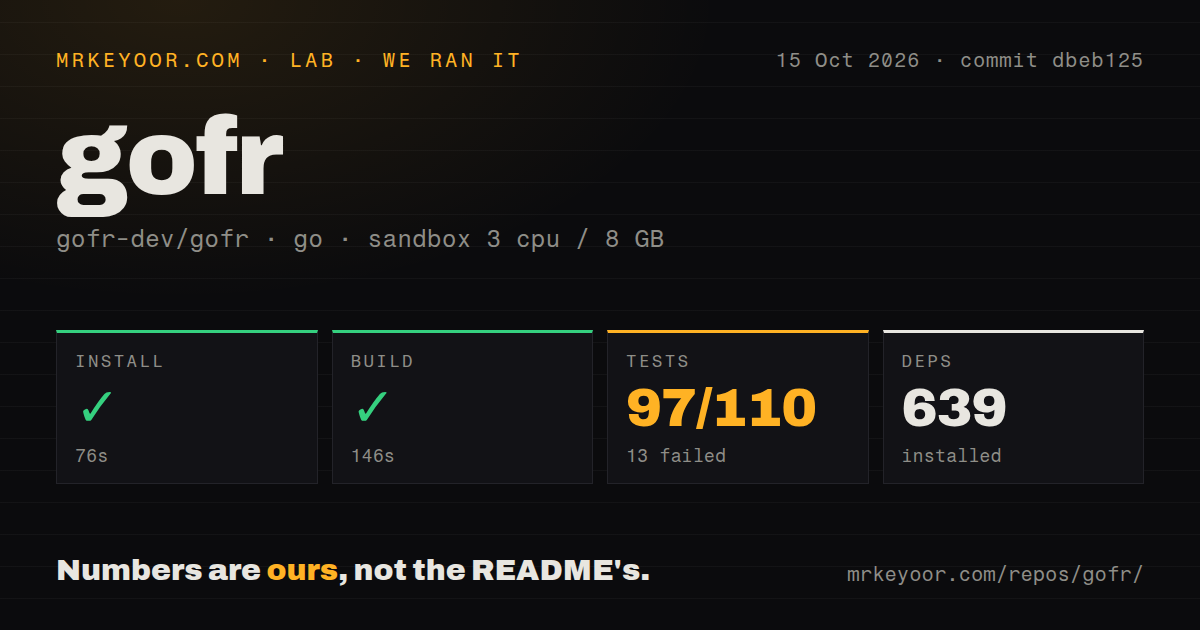
Our stored run began on 2026-10-15 at 03:20:37.143 UTC against commit dbeb125c20def775a1f1b670d63547c8835c1d14. The recorded sandbox had 3 CPUs, 8 GB of memory and image golang:1.24-bookworm. That image label does not establish the toolchain used: the install tail explicitly records go: downloading go1.26.0 (linux/amd64).
| Step | Recorded result | What it establishes |
|---|---|---|
| Install | Exit 0, 76 seconds; dependency count 639 | The harness install step completed. Its retained output shows a toolchain download, not an installed CLI check. |
| Build | Exit 0, 146 seconds; tail vet-exit:0 |
The harness build step completed successfully. The retained tail does not establish that an application binary was produced or run. |
| Tests | Exit 1, 156 seconds; no harness timeout | The test command failed in this checkout and environment. The retained output includes multiple failing packages. |
The parser summary records 97 successful package results, 13 failing package results and seven packages without tests. Its total of 110 concerns the successful and failing package results, not individual test cases. These are recorded parser counts; no complete-log reconciliation established exhaustive unique coverage.
The retained output includes failures in HTTP-server, Redis, migration and subscriber examples, as well as gofr.dev/pkg/gofr/metrics/exporters. It names TestMainInitialization, TestBuildResource_carriesRequiredLabelSources and TestBuildResource_schemaURLConflictIsNotAFailure among the failures. This is broader than an isolated exporter-package failure.
The excerpt does not establish the cause of every failure, the state of upstream CI or production reliability. The absence of a harness timeout also does not explain each test's failure. No sample endpoint check, installed-binary check, security audit or measured service workload is recorded.
Toolchain and version boundaries
Both the supplied commit-pinned README and the current repository extract require Go 1.26 or above. Plan around that documented requirement rather than the sandbox image's Go 1.24 label. The download line alone does not prove the exact toolchain used by every later command.
The existing page carries the version label v1.60.1. Our measurements belong to commit dbeb125, not a verified run of that release tag. The supplied evidence does not establish that v1.60.1 is the latest release or support a release-cadence assessment.
Choosing the scope you need
Evaluate GoFr if several of its documented service features are requirements and you are comfortable adopting its conventions. Build a representative service with your actual dependencies, then verify startup, health checks, telemetry and failure handling. Those checks remain work to do; they are not results of this review.
For an HTTP-focused project, Gin documents middleware, JSON binding and validation, route grouping and rendering. Its supplied README also requires Go 1.26 or above. chi documents a composable router compatible with standard net/http handlers and middleware. Choose between these approaches by the scope and handler model you need. We have no comparable setup or workload measurements supporting speed or resource-use rankings here.
How to read the scores
These are editorial evidence ratings, not benchmark results. The rubric is: 1 means the available record cannot support an assessment; 2 means limited evidence with substantial gaps; 3 means useful evidence with material limits; 4 means broad evidence across the relevant tasks; 5 means comprehensive, independently corroborated evidence. A 1 for unknown community health does not mean the community is poor.
Setup receives 2 because the recorded steps lack an application or binary check and the test command failed. Documentation receives 3 because the README and documentation introduction explain setup and feature scope, while deeper guide accuracy was not tested. Community receives 1 because the supplied extracts do not establish response times, contributor activity or adoption. Maturity receives 2 because package-level execution provides some evidence, but failure causes and production behavior remain unresolved.
Start with the README's supported toolchain and a service that resembles your intended deployment. Reproduce and diagnose the package failures before treating this run as an adoption decision.