This is an admin starter first and an AI tool second
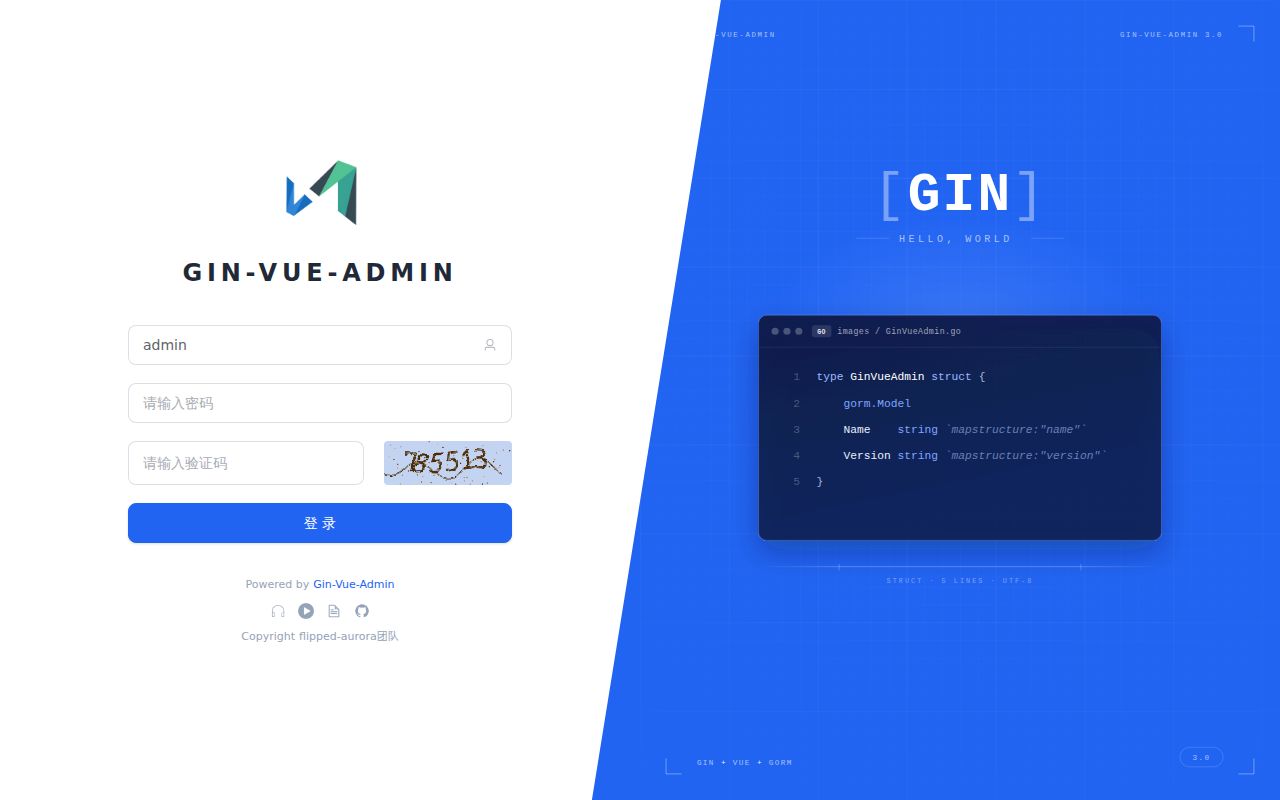
Gin-Vue-Admin gives you a working business-admin shape: a Vue interface, a Gin API, Gorm data access, JWT login, and Casbin permissions. Dynamic menus and routes sit beside user, role, and API management. The README also documents form and CRUD generation, file uploads, Swagger output, MySQL or MariaDB, and Redis-backed multi-login control. Apache-2.0 licensing makes the source practical to alter, provided you keep the notices the license requires.
The AI layer extends that existing system. MCP tools create or inspect APIs, menus, dictionaries, roles, and generated code, while AGENT.MD and the aiDoc tree give coding agents project-specific rules and memory files. That can save setup time when the generated conventions already match your team. It also means the agent can reach operations that change an application. Our server install pulled 532 Go packages, a reminder that this is a substantial application base rather than a small code-generation utility.
The English README trails the Chinese setup requirements
The current Chinese README asks for Go 1.22 or newer and Node above 18.16. It tells developers to open the server directory directly, run go generate, and install the Vue project separately. It also links initialization documentation, deployment videos, a live demo, paid support, and a plugin market. A Chinese-speaking team gets a usable path through the product even though configuration still spans the database, cache, uploads, and frontend.
English documentation exists, which is better than having none, but it cannot be treated as a current translation. It still lists Go 1.14 and Node 8.6, refers to old master and develop branch arrangements, and describes older database guidance. Our measured backend used Go 1.24 on commit ffd868f, so the old English minimum did not drive the successful build. Verify commands against the Chinese README and current files instead of copying the English setup verbatim.
What happened when we ran it
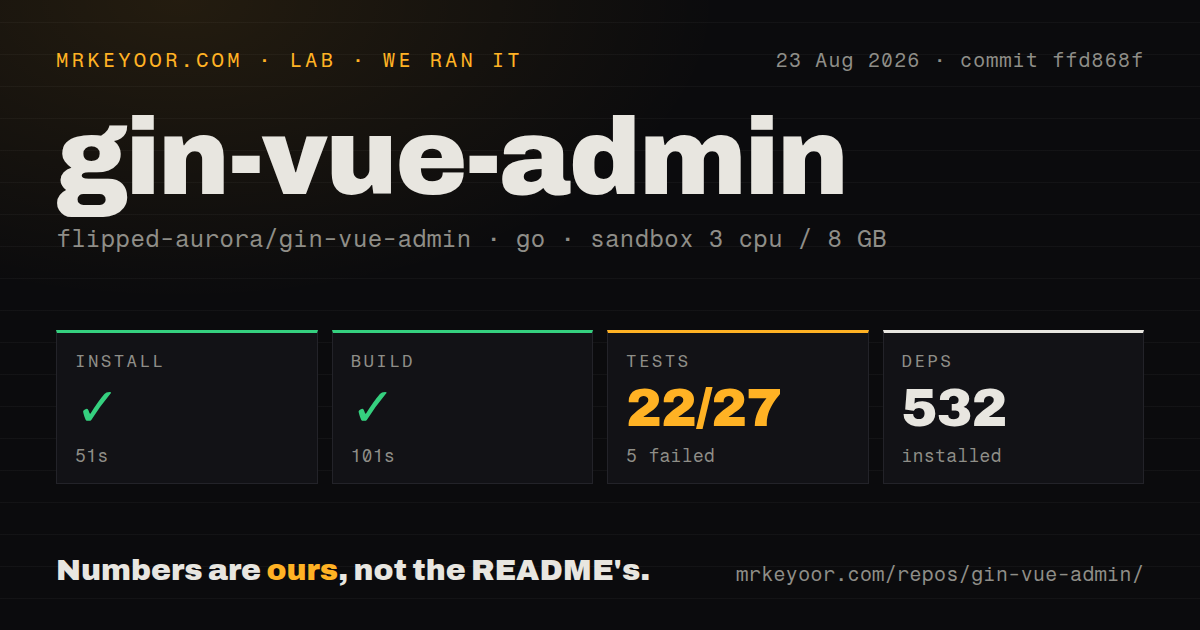
Our sandbox entered ./server/, installed 532 packages in 51 seconds, and built in 101 seconds. We used commit ffd868f in an unprivileged Debian container with 3 CPUs and 8 GB of RAM. The checkout contained 1,074 files, roughly 120,668 lines of source, and occupied 6 MB before the Go dependency install. Those figures describe the backend exercise. We did not run a separate Vue install or configure a live database.
The test command failed with exit code 1 after 32 seconds. Go reported 22 package results passing and 5 failing out of 27. The supplied tail shows successful results for captcha, data-scope, cache, logger, SSE, timer, and upload utilities. It also lists several packages with no test files, followed by the final FAIL. Since the tail does not contain the failing package names or assertions, it cannot support a claim about missing services, configuration, or a code defect.
MCP startup exposes every registered static tool
Open issue 2245 traces the static MCP registry and reports that all registered tools are mounted when the service starts. The examples include code execution and review plus API, menu, dictionary, and role-assignment operations. The reporter could not find a tool-level environment or role switch and asked for allow or deny controls. The issue remains open. If an MCP endpoint will survive beyond development, put it behind its own network and authentication boundary and inspect the registered tool list yourself.
Release v2.9.2 says the project moved automated code work into a plugin, added agent memory and planning files, and fixed a high-risk command-execution vulnerability. That history makes access review part of setup, especially across a measured checkout of 1,074 files. A second open report, issue 2248, says the frontend build does not pin pnpm through packageManager and does not commit its pnpm lockfile. Neither issue proves the product is unsafe, but both identify work a production owner must close locally.
Recent September merges sit beside 42 open issues and pull requests
GitHub recorded the last push on September 14, 2026, two days before this review. The repository had 25,013 stars, 31 open issues, and 11 open pull requests when fetched. Recent merged work fixed a misplaced Go generation directive, propagated database contexts in generated services, and upgraded a cache dependency. That is current maintenance rather than a repository coasting on an old release. The latest release entry is v2.9.2-stable from July 17, and its notes list several fixes.
Activity does not clear the failed suite or make the integration small. A team choosing Gin-Vue-Admin is accepting its permission model, generated structure, Chinese-first docs, and MCP controls together. The 101-second build says the backend can compile cleanly in a fresh Go container. The 5 failed package results say you still need a local baseline before adding business code. Trial it if those conventions fit, then make test status and the MCP tool list release gates rather than cleanup work for later.