fzf turns any line-oriented command into a picker
fzf's contract is simple: send it newline-separated candidates, type a query, and receive the selected line on standard output. That makes it useful far beyond files. Command history, process lists, Git branches, hostnames, environment variables, and application-specific records all fit the same model. The fuzzy matcher tolerates gaps, while exact, prefix, suffix, inverse, and OR terms give you more control when the broad match returns too much.
The small contract hides a capable terminal interface. Fullscreen, inline height, tmux popup, and Zellij popup modes cover common layouts. Multi-select, mouse input, previews, labels, colors, and a large binding system let a script feel like a purpose-built tool. Our checkout was only 160 files and 1.8 MB, with about 42,025 source lines. That is compact enough to audit and package without adopting an application framework.
Shell integration gives Ctrl-R, Ctrl-T, and Alt-C real value
The bundled shell setup turns Ctrl-R into searchable history, Ctrl-T into file selection, and Alt-C into directory selection. Bash, Zsh, Fish, and Nushell have documented paths, though Nushell writes a generated integration file instead of piping into source. Fuzzy completion also knows about paths, directories, process IDs, hostnames, variables, aliases, and supported commands. A plain binary install does not activate those behaviors by itself.
Defaults are deliberately adjustable. The built-in walker can include files, directories, hidden entries, and followed links, while skip rules can omit .git, node_modules, and target. Users can replace the candidate generator with fd, ripgrep, or another command. Our sandbox added just 19 packages during the 7-second install, so the core stays light. Fancy preview recipes can still accumulate external dependencies that your dotfiles must install separately.
What happened when we ran it
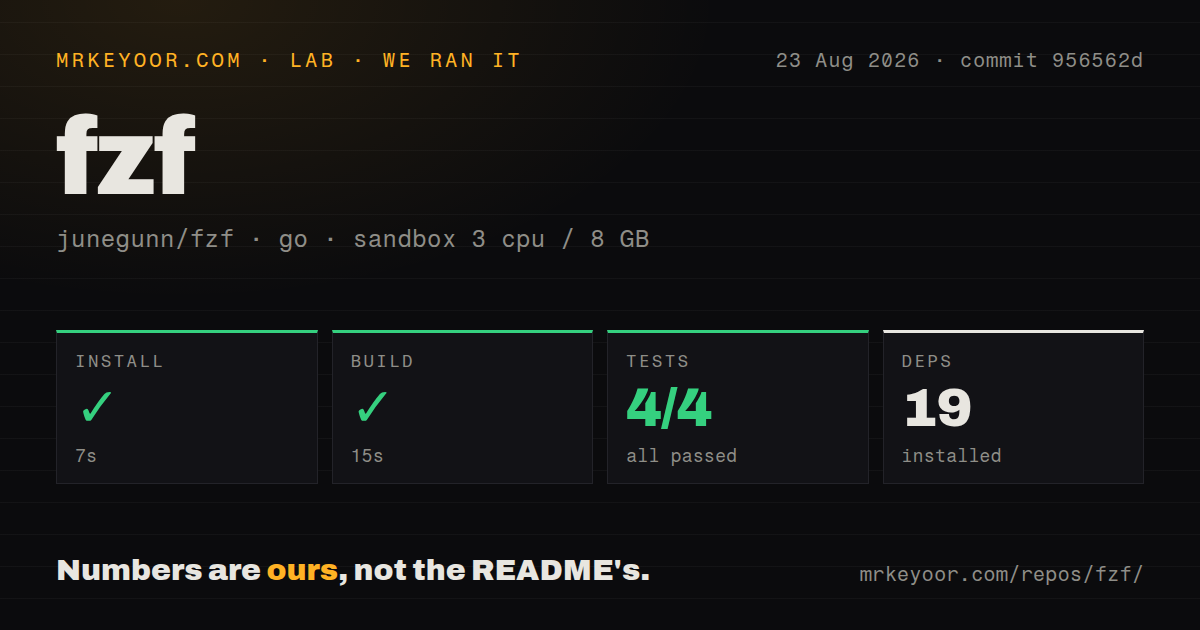
Our run installed fzf in 7 seconds, then completed the build in 15 seconds. The test step took 13 seconds and all 4 tested Go packages passed, with 0 failures. We used commit 956562d in a fresh unprivileged Debian container with 3 CPUs and 8 GB of RAM. Nothing in the supplied logs showed a missing package, compiler error, or failed test.
Those measurements cover the repository, not interactive behavior in every terminal. The project contains 8 CI workflow files, a Dockerfile, and a tests directory, which supports the clean result we saw. A 13-second Go test cannot reproduce each combination of shell, editor terminal, multiplexer, keyboard mode, or escape-sequence handling. Teams should still try their chosen bindings in the actual terminals their developers use.
Preview and reload actions can replace small terminal apps
A preview command runs whenever focus changes and can show text, metadata, diffs, trees, or images. The reload action can rebuild the candidate list on an event, which powers the documented interactive ripgrep example. execute starts a program and returns to fzf; become replaces fzf with the chosen command. These pieces are enough for branch switchers, log viewers, process tools, and repository browsers without maintaining a custom interface.
They also execute shell text. The README states that preview commands use $SHELL -c COMMAND, and placeholders are interpolated into actions. Correct quoting matters when candidates contain spaces, quotes, control characters, or text from an untrusted source. The documentation recommends null-delimited output with --print0 and xargs -0 for safer filename handling. Treat copied snippets as shell programs, especially once a binding can delete, kill, or overwrite something.
Recent terminal regressions are the main adoption caveat
GitHub showed 82,666 stars, 326 combined issues and pull requests, and a last push on August 26, 2026. Release v0.74.3 arrived on August 17. Its notes include fixes for bracketed paste handling, startup on terminals that do not answer escape sequences, preview image rendering under tmux, and query replacement. That is current maintenance, and it also shows how much terminal state the program must handle.
Open reports deserve attention if your standard setup matches them. Issue 4883 describes an extra displayed space in Emacs with v0.74.1 and v0.74.2, while issue 4892 reports broken wrapped input after using Ctrl-R in a VS Code PowerShell terminal. These are specific integrations, not evidence that the 4 tested Go packages are generally broken. Pin a known version and add a brief manual check for history search, cancellation, multiline input, and paste behavior.
The 35-second local check makes fzf easy to trial
Install, build, and tests took 35 seconds combined in our sandbox. The quickest evaluation is therefore practical: pipe a real list into the binary, add one preview, and connect one shell binding. If that removes a repeated search-and-copy routine, fzf has earned its place. Its output remains ordinary text, so removing it later does not strand data or force a migration.
Power users can spend days tuning colors and actions, but the base value arrives much earlier. Start with history and file selection, avoid a global preview command, and keep destructive actions out of bindings until quoting has been tested. For developers who live in terminals, fzf is the default fuzzy picker to beat. For teams centered on graphical tools, its 15-second build is irrelevant because the interface still asks people to work in a shell.