FounderOS puts a solo business on a shared operator screen
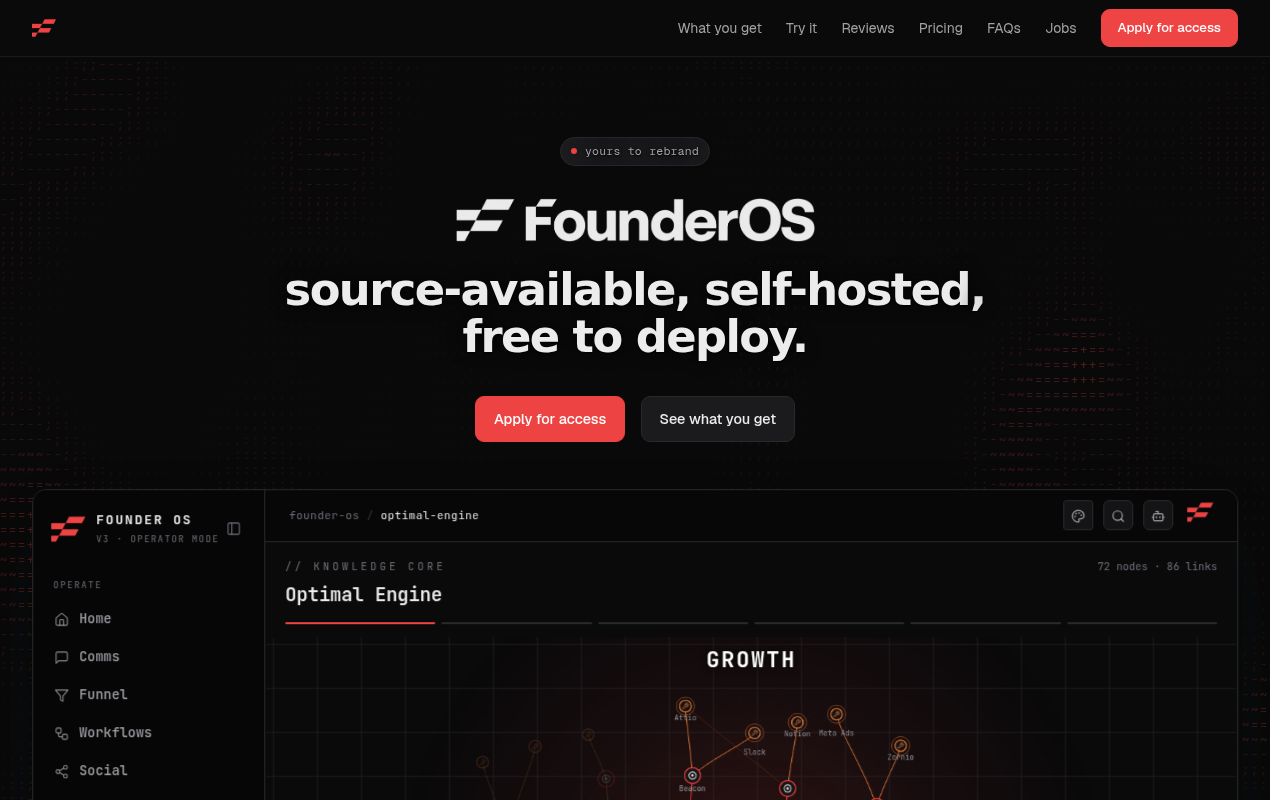
Connecting an inbox to a business dashboard means giving that dashboard access to real correspondence. FounderOS brings communication and client work into an operator console, alongside named AI agents. Its README targets solo founders and freelancers who still coordinate everything themselves. The attraction is understandable: you can inspect a client funnel and pending work without reconstructing the business from unrelated tabs.
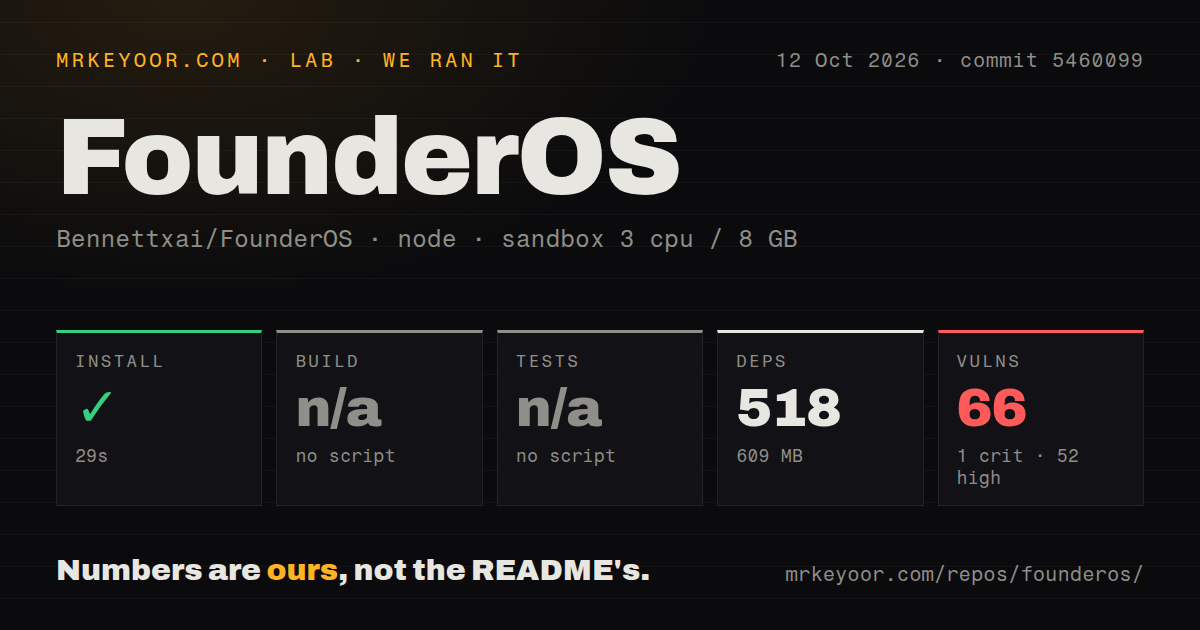
Our npm install succeeded in 29 seconds, but the audit reported 66 known vulnerabilities. That combination changes the recommendation. The dashboard deserves an isolated trial before you connect customer communications or payment credentials. A successful dependency install tells you that packages arrived. It doesn't tell you whether an agent takes the right action, whether access restrictions hold, or whether the installed dependencies are acceptable for your business.
The current application needs several services beyond Electron
The README's current architecture uses SvelteKit with a Go backend, PostgreSQL and Redis, plus the bundled Elixir-based Optimal Engine for knowledge. Electron is optional. The operator routes sit under /os, and the project also inherits workspace and team features from BusinessOS. This gives a technically comfortable founder room to shape the application, while making a quick dashboard trial more involved than opening an Electron window.
The checkout we measured contained 5,281 files, roughly 841,087 source lines, and occupied 90.9 MB. Our lab identified a Node project inside desktop/, whereas GitHub identifies Go as the repository's primary language. Both can be true in this mixed stack. The important boundary is that our successful npm step covered that directory, rather than proving the database, knowledge engine, backend, and browser interface work together.
What happened when we ran it
Our sandbox installed commit 5460099 in 29 seconds, adding 518 npm packages and occupying 609 MB on disk. The run took place on October 12, 2026, in a fresh Debian container with 3 CPUs, 8 GB of RAM, and the lab-node:22 image. It ran without secrets or elevated privileges. That is a repeatable description of the environment, not a measurement of business automation.
The harness found no build script or target and no test script or target in its selected project, so it skipped both steps. Its scan recorded 8 CI workflow files, no Dockerfile, and no tests directory. These are findings about the route the harness inspected. The repository README separately documents Go and frontend checks. We have no completed build or test result for the whole application, and a skipped command mustn't be called a passing one.
Npm audit reported 66 known vulnerabilities: 1 critical, 52 high, 8 moderate, and 5 low. The supplied result doesn't identify advisory names, affected execution paths, or which packages are used at runtime. It supports asking for dependency triage before attaching live credentials. It doesn't support declaring that an attacker can exploit a specific route, or that a particular upgrade will remove every finding.
The local launcher preserves database state between starts
The BusinessOS setup notes describe isolated PostgreSQL and Redis instances and local state under .run/. They explicitly warn against deleting the PostgreSQL data directory to fix startup trouble. The engine has its own local data, and the backend owns the migration ledger. For a founder who expects to close an app and forget its internals, backups and service recovery are extra work.
That operating work sits outside our 609 MB installed footprint. The root environment template includes database and Redis passwords, encryption and HMAC secrets, and frontend/backend URL settings. It defaults to a local Ollama provider and allows Anthropic credentials instead. You can choose local model infrastructure or a hosted provider, but either route needs configuration beyond the npm install we measured.
Demo records don't establish that connectors can act safely
The README says the demo populates workspaces with example records and knowledge. Connector states distinguish configured connections from missing configuration and errors. Outbound actions require FOUNDEROS_WRITES=1, while scheduled agent runs require FOUNDEROS_CRONS=1. Both switches default off. Those are sensible controls for exploring the interface before enabling actions that send messages or affect outside services.
Keep those controls off while resolving the 1 critical and 52 high audit findings from our run. Then introduce a connector with limited permissions and verify its behavior using a disposable account. Check that displayed records belong to the intended workspace and that an action reaches the intended recipient. The agent roster and busy-looking demo screens can't answer those questions. Neither can our package-install result.
The setup documents disagree about the PostgreSQL starting point
FounderOS's quick start pairs PostgreSQL with pgvector and warns that the extension must match the selected database installation. The bundled BusinessOS notes give a different PostgreSQL example. Prefer the FounderOS instructions for its own schema and use the launcher override when pointing at another compatible installation. This documentation mismatch is a concrete reason to expect setup work, especially when translating the macOS commands to Debian.
Our 3-CPU sandbox result doesn't establish complete service-stack startup, so we can't settle the database choice through a runtime result. The notes provide local account registration and distinguish optional Google OAuth integrations. An older access-control report concerns the previous Next.js application. It warrants reading the history, but it cannot establish the same defect in the current Go backend.
Recent activity earns a trial, while the audit limits adoption
The repository was pushed on October 10, 2026. GitHub lists 1,094 stars and 5 open issues and PRs; an October WhatsApp cache report was closed shortly after opening. The latest-release endpoint returned no release, which isn't evidence of abandonment alongside that activity. For a focused client database, compare Twenty. For connecting tools through explicit workflows, compare n8n. I would keep FounderOS disconnected from live business accounts until dependency triage and a complete service-stack trial justify connecting one.