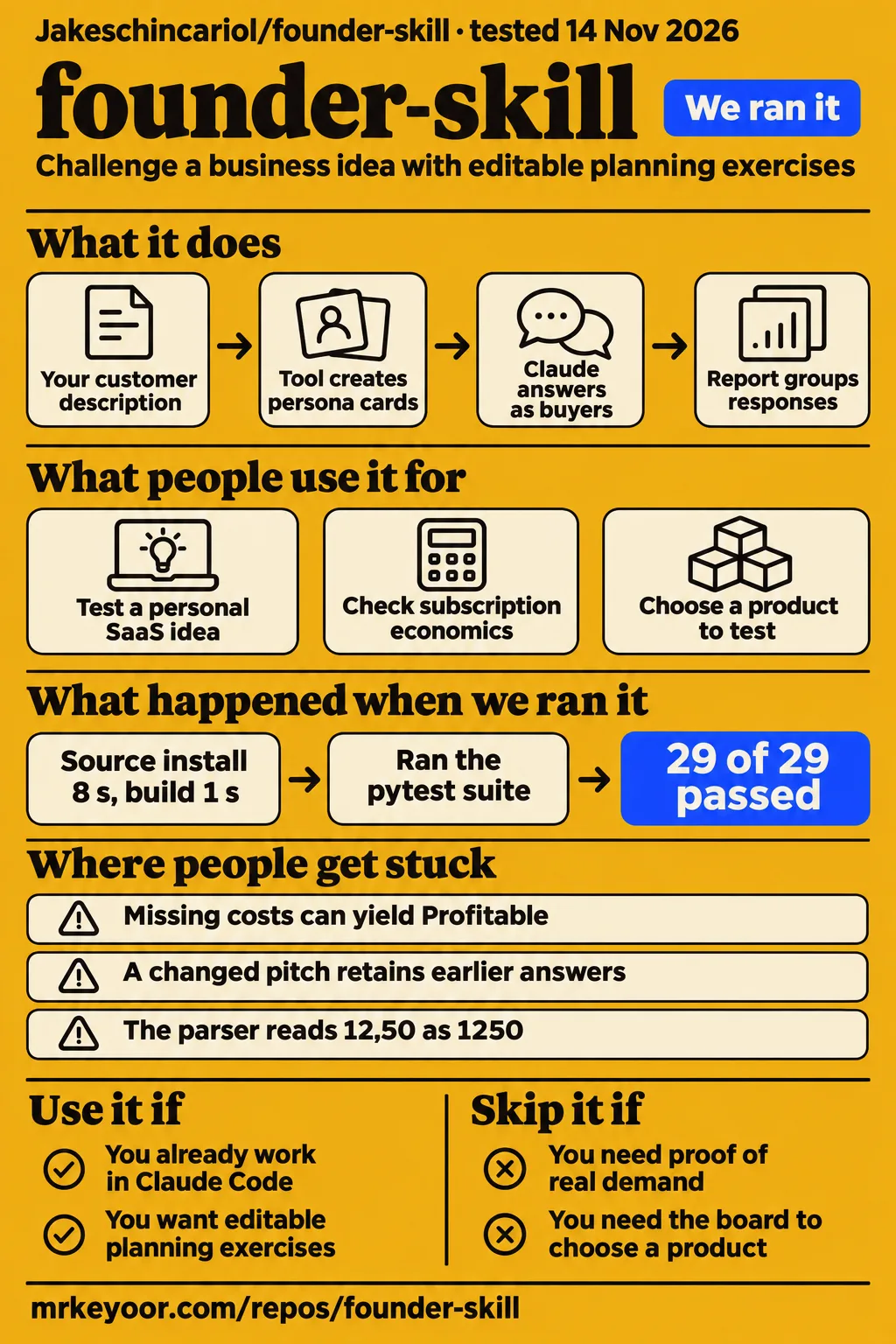
Use founder-skill if you already work in Claude Code and want a structured way to challenge a business idea. Skip it if you need a simulated buy rate to justify spending real money. Our sandbox passed all 29 Python tests, but the strongest reason to try the pack is its objection research, not its profitability label.
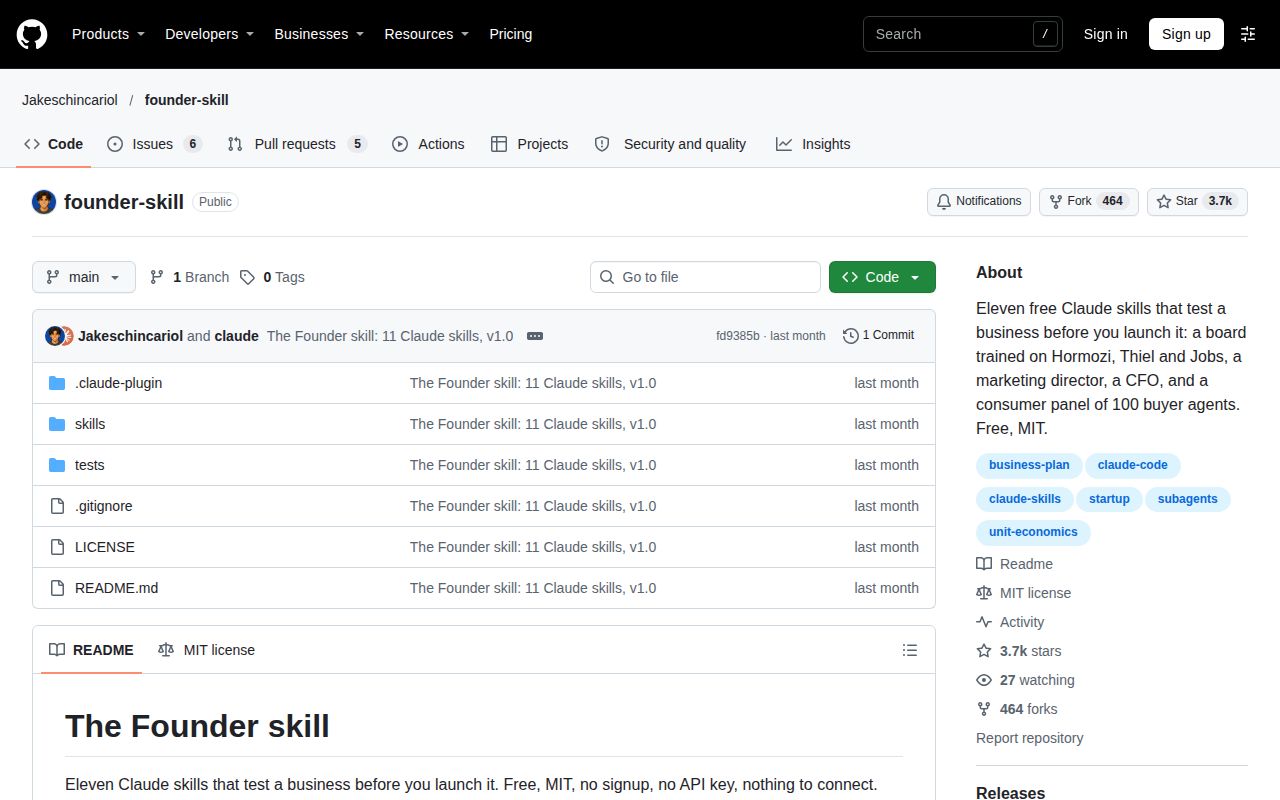
Jake Schincariol's project supplies eleven MIT-licensed Claude skills, from a board discussion to a compiled business plan. The README itself says simulated buyers are not a forecast. That distinction matters more than the promise of an AI launch team: a plausible objection can improve your next customer conversation without proving that anyone will pay. Project README
What people use founder-skill for
The concrete user reports describe a personal SaaS evaluation, a Brazilian adaptation and a board discussion about an undecided product. They are more useful than a directory's feature list because they show where someone changed the workflow to fit a business question.
| Who used it | What they did | What they reported |
|---|---|---|
| The author of founder-skill-br | Evaluated their own SaaS idea with the original pack | Found it useful enough to make an MIT derivative for Brazilian founders. Issue #6 |
| The same adaptation author | Added subscription economics and a personal-income calculation | Reported that 13 subscribers covered servers, while 126 were needed before the founder got paid. These figures concern the adaptation. Issue #6 |
| The same adaptation author | Ran the adapted pack on a fictional SaaS | Reported a simulated 15% buy rate and a segment and feature that could change the answer. This was an example, not customer purchases. Issue #6 |
| The reporter of issue #11 | Asked founder-board which product a content profile should test first | Manually added the question to each member's brief after the workflow requested the missing product and price. Issue #11 |
The server-cost example is the most useful decision aid here. Before accepting a break-even result, ask which costs it covers and where your own pay enters the calculation. The adaptation author added that question explicitly. A business that sustains its infrastructure can still fail the person running it. This is a reason to inspect the inputs, rather than carry the Brazilian example's subscriber counts into your own plan.
What happened when we ran it
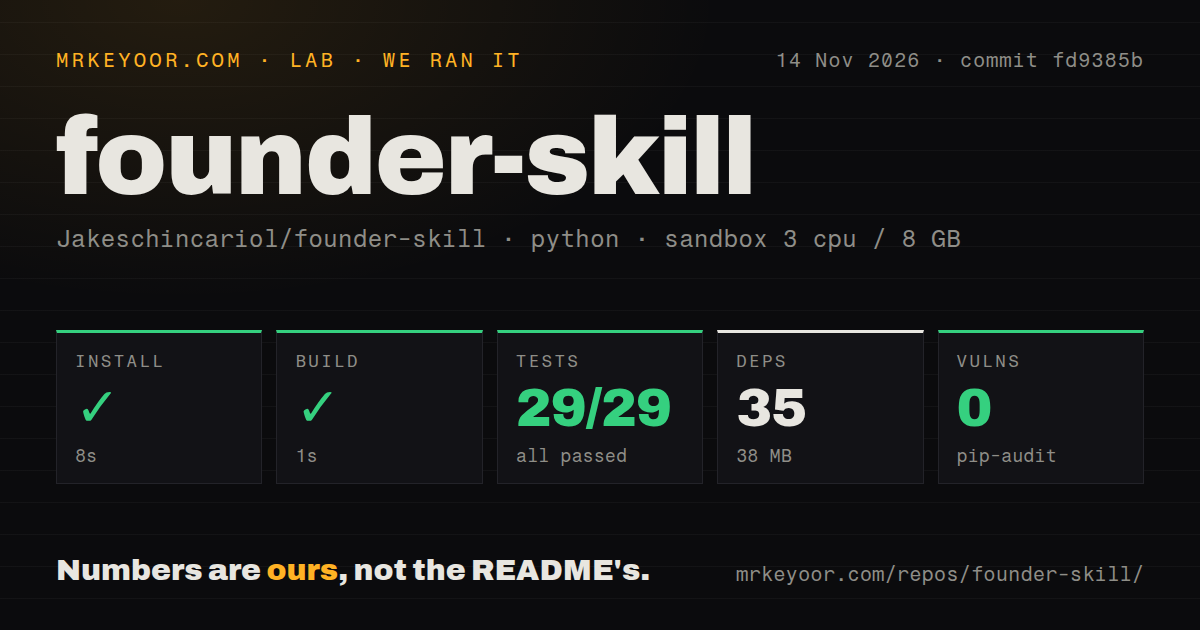
Our November 14, 2026 sandbox installed the Python checkout in 8 seconds, built it in 1 second and passed all 29 tests in 2 seconds at commit fd9385b. Those are repository checks, separate from running the Claude workflows.
| Repository check | Our recorded result |
|---|---|
| Install | Succeeded in 8 seconds |
| Dependencies and disk | 35 dependencies recorded; 38 MB on disk |
| Build | Succeeded in 1 second |
| Tests | Succeeded in 2 seconds; pytest reported 29 passed, 0 failed of 29 |
| Dependency audit | pip-audit reported 0 known vulnerabilities |
| Checkout | 30 files, about 1,462 source lines, 0.1 MB |
| Repository signals | Tests directory present; 0 CI workflow files; no Dockerfile |
Our measurement setup allocated 3 CPUs and 8 GB RAM and named the image ghcr.io/astral-sh/uv:python3.12-bookworm. The image name is a configuration label. Actual runtime and operating-system versions require the raw toolchain logs. Our run covered a small checkout with 30 files and about 1,462 source lines. A passing suite cannot resolve a separately reported input-handling defect by itself.
A separate hands-on attempt stopped at the safety step because its runner required a Compose file. It found none of compose.yaml, compose.yml, docker-compose.yaml or docker-compose.yml and labelled the repository unsafe under that rule. That is a runner requirement, not evidence of dangerous project code. The run-summary record nevertheless says it was deployed with its own Docker Compose; that conflicts with the failed safety step, so we count no successful deployment from that summary. The teardown record says cleanup succeeded.
Where people get stuck: missing costs and reused answers
Issue #1 reports three consequential problems with costs, retest answers and decimal-comma prices at fd9385b. Preuve's author says their code review corroborated those three, while disclosing that they sell a competing buyer-panel product. Keep that commercial interest attached to the assessment. Audit report, Preuve review
| Problem reported | What it means for your decision | Practical response and recorded status |
|---|---|---|
| A price-and-volume input can produce Profitable while missing costs default to zero | The verdict can reward an incomplete cost model | Supply and inspect costs before using the label. The issue proposes Incomplete for missing costs; the supplied thread documents no implemented fix. |
| Reinitializing a changed pitch with the same seed retains earlier answers | An unchanged after rate can be old data rather than a response to the new offer | The reporter proposes clearing answers or a separate directory per pitch. Preserve the original run before making a fresh comparison; these are proposed workarounds. |
| The parser reads 12,50 as 1250 | A familiar decimal format can distort a price range | Correct decimal-comma inputs and inspect the parsed values. No parser correction is documented in the supplied issue. |
| The report says --quick is not a panel.py option | A skill-level instruction and a script flag can be confused | The README advertises the skill invocation, while the consumer instructions define quick as 20 buyers. The supplied evidence does not settle the complete quick-mode path. |
All four rows refer to issue #1. Its most consequential example supplies price and planned daily sales without the underlying costs, yet reports a profitable verdict. That is exactly the situation in which a novice most needs the tool to stop and ask another question. Treat the plan's label as a result to inspect alongside its inputs, rather than permission to commit money.
Issue #11 exposes a different mismatch: a user wanted the board to choose a product, while the board's opening step asked them to supply one. The reporter worked around it by inserting the question into each member's brief and proposed carrying undecided questions through the idea file, memos and chair summary. The supplied thread is open and shows no implemented change. If product selection is your task, state it explicitly in every brief. Pre-product board report
Claude Code installation changes the command names
Plugin installation exposes namespaced commands such as /founder-skill:founder-board; copied skill folders expose plain commands such as /founder-board. Choose the route before following a tutorial, because a correct command for one route can be the wrong command for the other. README installation instructions
The documented plugin route is:
/plugin marketplace add Jakeschincariol/founder-skill
/plugin install founder-skill@founder-skill
The README also allows copying the skill folders into your global or project-local .claude/skills directory. Pasting one SKILL.md into a chat provides the instructions without the sub-agents or Python tools. That is a useful way to read the method, but it changes what can execute. Installing a single instruction-only skill also differs from taking the complete bundle, which contains executable Python helpers.
QAI's static checks report unsupported argument-hint frontmatter for Claude apps/API uploads of founder-launch and founder-pricing. Its suggested response is to remove unsupported fields or move custom data under metadata. QAI says it does not run skills in the target agents, so read this as a format warning with a proposed adjustment. In issue #2, a user requests versions for different agents; the supplied record has no response or implementation. Launch format check, pricing format check
A panel of 100 buys you more simulated answers
The default consumer panel creates 100 persona cards, then Claude supplies the buyer answers and Python tallies them. According to the README, cards vary by income, habits and objections, and the same seed recreates the same cards. It does not mean the buyers are people who have encountered your product. Panel design
Preuve's code review describes each persona receiving an objection drawn from the founder's supplied list. That makes the customer file an editorial decision with consequences: if you describe only buyers who want your product and only doubts you already know how to answer, more simulated replies will not repair that framing. Use the competitor research to challenge the customer description before collecting the answers. Preuve's panel analysis
The useful output is a list of reasons to investigate: an existing habit, a trust objection, a price concern or a missing feature. Take one specific objection into a customer conversation and ask about the person's current behaviour. The README directs founders toward real-world tests before large commitments and forbids turning panel answers into testimonials. Its caution belongs beside the result, especially when a neat percentage makes the output feel more certain than the inputs deserve.
Security starts with the files your agent can read
The README describes four standard-library Python helpers that do not touch the network, while the wider workflow runs through Claude. A helper's network behaviour and an agent's access to business documents are different boundaries. The shared founder/ folder contains the idea, customer assumptions and planning outputs that the skills read from one another. Tools and file layout
Keep that work in a project whose documents and permissions you understand. Review script requests and file edits in the context of the selected skill. QAI calls founder-launch instruction-only but describes founder-pricing as bundling scripts and running shell commands. Its pattern checker explicitly warns that nothing flagged is not proof of harmlessness. Those descriptions help you decide what to inspect; a directory score is no substitute for reading the files you install. QAI launch scope, QAI pricing scope
English instructions need local business inputs
The upstream README is in English, while the author of founder-skill-br reports adapting the pack into Brazilian Portuguese with local rules and subscription economics. Their changes include Brazilian currency and income conventions, tax and payment considerations, and a founder-income check. Those are stated reasons for a country-specific derivative, rather than proof that one pack is universally better. Brazilian adaptation report
For a worldwide reader, the practical lesson is to supply local facts instead of accepting a generic business model. The original README asks for supplier quotes and professional checks on tax, payroll and legal matters. Use the pack to organize those questions, then enter sourced costs appropriate to the actual business. The decimal-comma report makes local formatting part of that input review too.
founder-skill vs Preuve AI, founder-skill-br and real buyers
Choose founder-skill for an editable Claude workflow, founder-skill-br for its author's Brazilian adaptation, and real customer tests for evidence of purchasing behaviour. Preuve is a paid buyer-panel alternative identified by its own author, whose review discloses the competitive relationship. These choices solve different parts of the decision.
| Option | Reason to consider it | What the evidence supports |
|---|---|---|
| founder-skill | You want to inspect and change the planning instructions | The README supplies an MIT-licensed pack and shared planning files. README |
| Preuve AI Buyer Panel | You want to consider a paid panel product instead of this editable pack | Preuve's author identifies their panel as a competitor and discloses that interest. Preuve review |
| founder-skill-br | Your planning needs Brazilian Portuguese and local business assumptions | Its author reports adding local rules, subscription calculations and a personal-income check. Adaptation report |
| Customer conversations and a real launch test | Your next decision depends on people committing time or money | Upstream calls for confirmation with real people and puts a cheap real-world test first in founder-launch. README |
SkillsLLM also compares this repository with hermes-agent and mattpocock/skills using popularity and metadata. Its own pages caution against treating stars and forks as evidence of which project is better. That comparison cannot choose a founder workflow for you. Decide which output you need, then inspect how the candidate produces it. Hermes comparison, skills comparison
What the other reviews get wrong
SkillsLLM says founder-skill has no SKILL.md file, but the upstream README lists one in each skill folder. Its comparison pages therefore give readers the wrong picture of the repository's basic structure. SkillFoxx also pairs plugin installation with plain commands, whereas upstream documents namespaced plugin commands. Follow the installation method and invocation together. SkillsLLM, SkillFoxx, upstream file and command lists
The skills-hub description says pricing finds what buyers will actually pay. The README limits the simulated panel to preliminary research and calls for confirmation with real people. Likewise, descriptions of founder-offer as retesting a changed offer need to account for issue #1's retained-answer report. A workflow description should not erase a recorded failure mode. Pricing listing, offer overview, audit issue
Explainx recommends keeping the seed fixed for offer comparisons. A fixed seed recreates persona cards, but issue #1 reports that earlier answers can survive reinitialization. Freshly generated model answers can also vary, as Preuve's review notes. Keep separate evidence for the same personas, fresh answers and a changed offer before attributing a difference to the offer. Explainx, audit issue, Preuve analysis
Questions people ask
founder-skill is an MIT-licensed collection of eleven Claude skills for examining a business idea and assembling a plan. The repository is Jakeschincariol/founder-skill, with a singular skill in the name. That identity matters because search results also contain unrelated projects called Founder Skills. Project README
What is founder-skill?
It is Jake Schincariol's pack of eleven Claude skills covering business planning tasks, including a board discussion, competitor research, simulated consumers and financial calculations. Skills share files in a founder/ folder, and you can use one independently. README
Where is the founder-skill GitHub repository?
The founder-skill GitHub repository is Jakeschincariol/founder-skill. Use that owner and singular repository name when choosing installation instructions. The README identifies Jake Schincariol as its creator. Project identity
How do I use founder-skill with Claude?
In Claude Code, the README documents plugin installation or copying the skill folders. Plugin commands use the founder-skill namespace. Pasting a single SKILL.md into a chat runs its instruction mode without sub-agents or Python tools. Claude instructions
Is founder-skill worth installing?
Yes, for a Claude Code user who wants editable planning exercises and reasons to challenge an idea. Skip it if you need simulated responses to prove demand. The project's own guidance says to confirm consequential decisions with real people. README's limits
How does founder-skill's panel of 100 simulated buyers work?
The consumer tool creates persona cards from your customer description, Claude answers as the buyers, and Python checks and tallies the replies. The seed reproduces cards, while the report groups responses and reasons for passing. Panel workflow
Can simulated buyers tell me whether real people will buy?
No. Upstream calls the panel a way to explore objections, segments and wording, warns that language models lean agreeable, and directs users to confirm big decisions with real people. A simulated response is research material, never a customer testimonial. Panel fine print
How do I test a business idea with Claude Code?
Upstream's sequence begins with the board and competitor research, then runs the consumer, pricing and offer steps before financial and launch planning. Start with a clear customer and pitch, inspect the assumptions, and use founder-launch's real-world test before major spending. Recommended sequence
How does founder-skill calculate break-even and an acceptable price range?
The CFO helper reads cost and sales inputs to report unit economics and daily break-even. The pricing helper reads four price answers per respondent from the panel or a real-survey CSV and computes Van Westendorp price points. Tool descriptions
What determines whether founder-plan calls an idea profitable?
The README describes positive unit earnings, year-one profit, break-even within capacity and enough simulated buyers. Issue #1 reports that missing costs can nevertheless yield Profitable. Inspect the supplied financial data before relying on the computed label. Intended conditions, reported verdict defect
Can founder-plan report Profitable when cost inputs are missing?
Yes, according to issue #1: its minimal price-and-volume example receives that verdict because omitted costs default to zero. Preuve's author reports corroborating the defect in code at fd9385b. Audit report, code-based review
How do I ensure an offer retest generates fresh panel answers?
Issue #1 proposes clearing old answers or using a separate run directory per pitch. Preserve the previous output and inspect whether new briefs and answers were created. The supplied record describes proposals, not a shipped upstream correction. Retest report
Does founder-skill correctly parse prices written with decimal commas?
Issue #1 reports that the pricing parser turns 12,50 into 1250. Normalize such input and inspect the resulting numbers before using a price range. The supplied issue contains no implemented parser fix. Decimal parsing report
What we have not tested yet
Our evidence covers successful repository checks and a blocked Compose-based hands-on attempt, not a completed Claude business-planning session. We have not measured model spending, panel runtime, repeated file approvals, answer quality or the quick-mode path. The actual runtime versions also require the raw toolchain logs. No screenshots or known-answer task records accompany the blocked attempt, so there is no interface or answer-quality result to display.
We did not reproduce the reported bugs through live Claude sessions, assess another agent's complete orchestration or upload the skills to Claude apps. The listed workarounds need their own execution checks. The records contain no verified business revenue or purchasing outcome attributable to the original pack. The Brazilian adaptation's fictional example and subscriber calculation are its author's reports. Preuve is a commercially interested code reviewer, not our head-to-head benchmark.
The supplied YouTube records have empty extracts. The X search mostly concerns generic founder skills, and the Bilibili results concern other tools. None supports a project-specific adoption claim. Search volume, market demand and comparative performance remain unknown. QAI's format and pattern checks are static findings, and our dependency audit is not a runtime security assessment.
All four score cards are unassessed: the Python checks do not settle Claude installation effort, we have not executed the documented paths to rate documentation reliability, the issue excerpts cannot establish support capacity, and no complete planning run supports a maturity score. The next useful evaluation is one documented business question carried through fresh panel answers, explicit costs and a small test with real prospective customers.