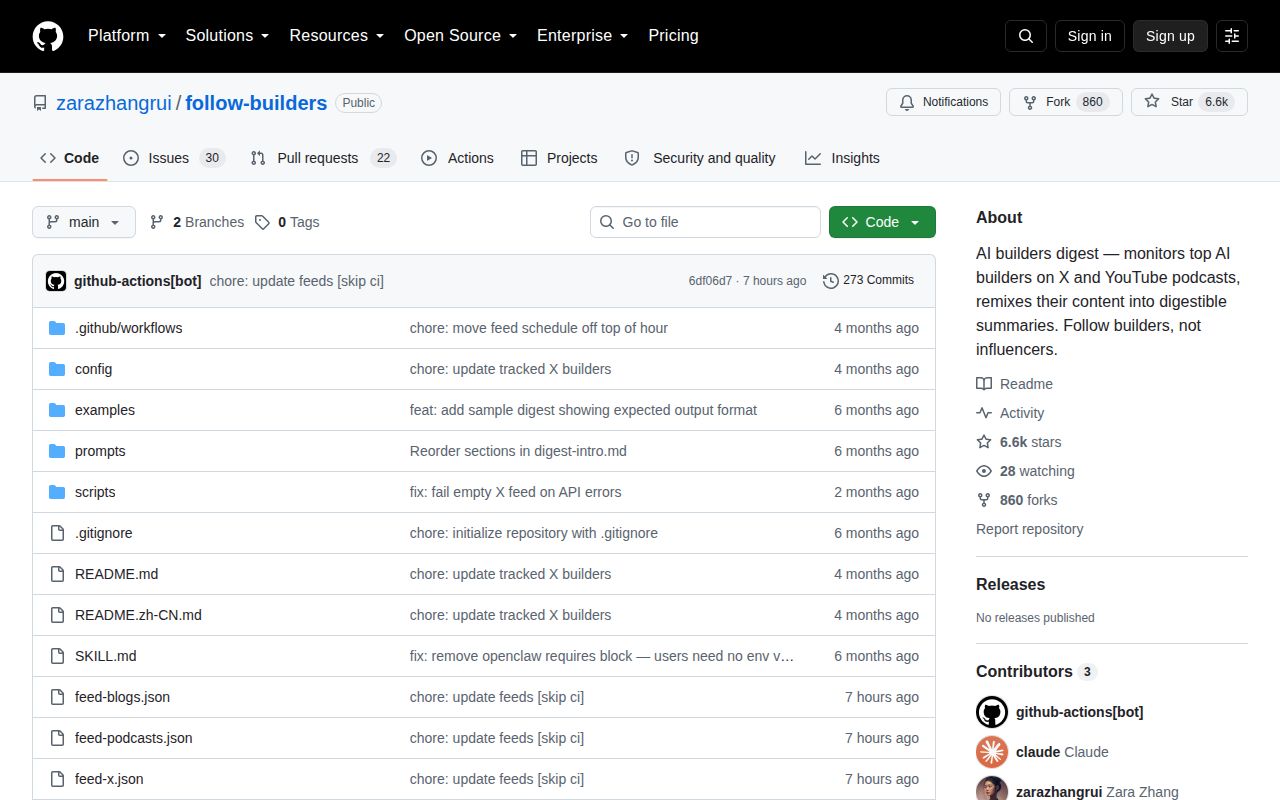
A fixed feed covers 6 podcasts, 26 X accounts, and 2 blogs
Follow Builders packages a narrow editorial idea as an agent skill. Its default catalog lists 6 AI podcasts, 26 people or organizations on X, and 2 official company blogs. The agent fetches centrally prepared material, follows plain-text prompts for summaries and translation, then shows or delivers a digest. That can save time for someone who already lives in Claude Code or OpenClaw and wants the same compact reading list each morning.
The repository supports English and Chinese documentation, plus English, Chinese, or bilingual digests. Five prompt files control podcast summaries, X summaries, blog summaries, the introduction, and translation. A reader can ask the agent for shorter copy or directly edit the prompts. The package inside scripts identifies itself as version 1.0.0. This is an agent workflow, rather than a standalone web reader with subscription management and a browsing archive.
What happened when we ran it
commit 6df06d7 produced no install, build, or test result in our sandbox. On 2026-09-03, our harness found no supported ecosystem for the repository's JavaScript layout, and there was no Dockerfile to use as a fallback. The environment had 3 CPUs, 8 GB of RAM, no secrets, and an unprivileged Debian container. Our standard run therefore could not establish whether the documented npm setup, scripts, or delivery paths work.
There are no package counts, timings, audit results, or test totals to report for this checkout. Treat the README's quick start as documentation, not as a result we reproduced. Test the path you intend to use: an interactive Claude Code invocation, an OpenClaw scheduled job, or system cron with Telegram or email. Success in one would not prove the other 2 delivery routes.
System cron sends raw JSON without the agent remix
OpenClaw gets the intended experience because its scheduled job can invoke an isolated agent session, remix the prepared feed, and announce the result to a named channel. The instructions require an explicit channel and recipient, then tell the installer to run the job once and confirm delivery. Setup is more involved than the README's line about having no configuration files suggests: the skill writes local config, may write an environment file, and creates a scheduled task.
Claude Code and other non-persistent agents have a bigger compromise. The documented crontab command pipes prepare-digest.js straight into deliver.js. The skill explicitly says this bypasses the agent and delivers raw JSON rather than the remixed digest. Issue 67 asks for Claude Code Scheduled Tasks instead, but the current skill text still describes the raw route. Use the manual command or verify another scheduler before promising an automatic polished digest.
The central feed removes API keys and source control together
Users do not need credentials for X, YouTube transcripts, or blog collection because the maintainer prepares that material centrally. Telegram delivery still requires a bot token and chat ID, while email requires a Resend API key. The skill says those delivery secrets and reading preferences stay under the user's home directory. That keeps provider billing and scraping code away from each installation.
The same design prevents readers from changing the source list. Users cannot add or remove tracked accounts locally and must open an issue to suggest one. Requests 89 and 88, both filed shortly before the repository's 2026-09-03 push, show that this process is active. Still, a team cannot immediately remove a noisy source or add an internal one. RSSHub, FreshRSS, or Miniflux makes more sense when the subscription list belongs to the reader.
One HTTP 402 incident emptied the X portion of the feed
Issue 68 documents an upstream failure on July 11, 2026. Its attached feed snapshot had zero tweets after all X user-lookup batches returned HTTP 402. That report does not prove the feed is empty now, but local users cannot repair the provider quota or swap collectors when the shared feed loses a source. Podcast and blog material remained available in that reported case, so the failure reduced the digest rather than stopping every category.
Issues 59 and 60 contain digests that could not reach Telegram or Resend because those hosts were absent from a Claude Code web environment's egress allowlist. That is a host-policy problem, yet it is still a setup cost. Anyone running scheduled delivery in a restricted workspace should confirm outbound access with a real test message, as the skill tells OpenClaw users to do.
The MIT label lacks a license file and release record
The README ends with MIT, but the repository root has no license file and GitHub reports no recognized license. Open issue 44 asks the maintainer to add one so a contributor can publish a fork with attribution. Until that paperwork exists, a company planning to copy, modify, or redistribute the code should ask for clarification. A README label is weaker than the full license text.
There is no latest GitHub release returned by the releases API. That alone is not a sign of neglect: GitHub records a push on September 3, 2026, and a source-request issue was opened the previous day. The repository showed 52 combined open issues and pull requests, not 52 confirmed defects. The evidence points to active iteration without formal release packaging. A managed fleet should pin the commit and inspect changes before rolling them out.
Use it for an agent briefing, not owned feed infrastructure
Follow Builders is easiest to recommend as a personal experiment for someone already using an AI agent. On-demand use avoids the weaker scheduler path. The missing lab result, central-feed outage report, fixed sources, and incomplete license signal change the decision for teams. A dependable shared news system should start with a feed reader you control, with summarization added after the collection layer proves reliable.