mrkeyoor.com_
Fri 02 Oct 14:58 UTC
Automationevaluationupdated 02 Oct 2026

flycoinrh review

flycoinrh feeds browser screenshots into a simulation built from a measured male fruit-fly connectome, then maps descending-neuron activity back to cursor movement and clicks. It is a research-art rig with separate code that completes a Robinhood Chain token-launch form, signs a transaction, streams the roaming fly, and lets a language model narrate its telemetry.

Verdict

Our 609 MB environment built in 5 seconds, but pip-audit found 37 known vulnerabilities and no test target was available, so flycoinrh should stay away from a funded production wallet. Read and fork it as a candid connectome experiment: the code and README do a rare job of labeling where the fly ends and the rig begins. For browser automation, token operations, or publishable neuroscience claims, choose narrower tools and design fresh controls.

We ran it

Lab card: what happened when we ran flycoinrhScreenshot of flycoinrh (github.com/fruitflydev/flycoinrh)
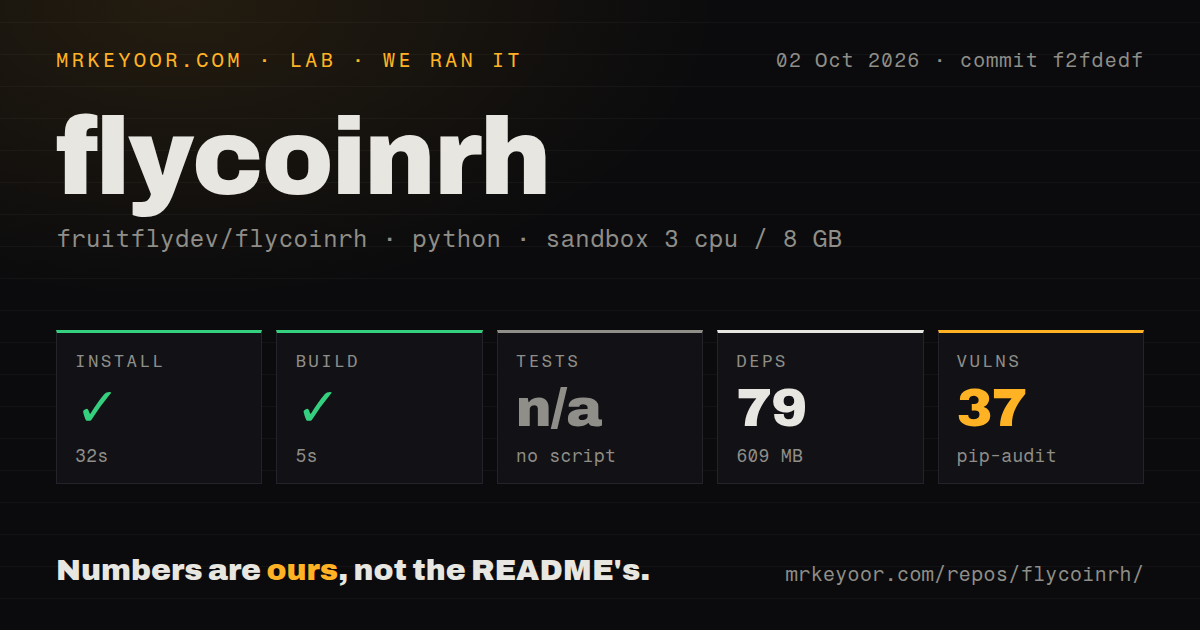
Install✓ · 32s79 packages · 609 MB
Build✓ · 5s
Testsn/ano test script
Known vulns37(pip-audit)
Repo134 files~36,155 lines of source · 5.2 MB · 0 CI workflows · Dockerfile

Answers from our run

Does flycoinrh build from source?

Dependencies installed in 32 seconds (79 packages), and the build succeeded in 5 seconds. We cloned commit f2fdedf into a clean Debian container with 3 CPUs and no project-specific setup.

Does flycoinrh have tests you can run?

Not through a standard command: the project exposes no test script or target that our harness could run.

Does flycoinrh have known vulnerabilities in its dependencies?

pip-audit flagged 37 known advisories in the dependency tree at the time of our run.

Who should not use flycoinrh?

Anyone seeking an autonomous scientific agent: the README says the rig fills missed fields, chooses the paired asset and tax, and presses the final confirmation.

What are the alternatives to flycoinrh?

Nengo, Playwright for Python, web3.py. Our 609 MB environment built in 5 seconds, but pip-audit found 37 known vulnerabilities and no test target was available, so flycoinrh should stay away from a funded production wallet.

Setup2/5609 MB install plus Chromium, 1.1 GB data, and graph generation
Docs5/5Exceptionally specific about measured, chosen, and invented behavior
Community3/5191 stars and active issues and PRs in its first week
Maturity1/537 vulnerabilities, no release, and no runnable test target

Who it’s for

Computational-neuroscience tinkerers who want a readable bridge from connectome data to an embodied browser experiment.
Artists and researchers studying how biological wiring behaves when attached to an artificial visual and motor loop.
Python developers willing to inspect which outputs come from the simulated brain and which come from human-authored rig logic.
Contributors interested in reusing the connectome for a game, robot, microscope, or controlled offline task.

Who it’s NOT for

Anyone seeking an autonomous scientific agent: the README says the rig fills missed fields, chooses the paired asset and tax, and presses the final confirmation.
Wallet automation handling meaningful funds: the project can sign and broadcast a live transaction, while our dependency audit found 37 known vulnerabilities.
Researchers who need a validated biological model: reward is human-defined, the motor mapping is chosen, the retina is tuned for dark UI, and open pull request 4 challenges the mushroom-body compartment split.
People with a small download or container budget: our installed environment used 609 MB before the separately downloaded 1.1 GB connectome.
Operators who want an unrestricted browsing agent: the project says its first keyword fence failed and now relies on an allowlist plus click vetoes.
Traders or token buyers: the README labels the test tokens as tests and says nobody should buy them.

Setup reality

Our commit f2fdedf run installed 79 Python packages in 32 seconds and occupied 609 MB. The build succeeded in 5 seconds. No test script or target was available, so tests were skipped. Pip-audit reported 37 known vulnerabilities.

A working browser run also needs Playwright's Chromium, three connectome files including a 1.1 GB weight file, and a generated graph. Live launch mode needs a fresh wallet, ETH for fees, and two separately enabled environment flags. The language-model voice and X posting need additional credentials.

The Dockerfile covers the roaming service and intentionally omits wallet keys and signing packages. Its image still expects generated graph and data files that are absent from Git. The unrestricted roaming flag removes the domain fence and should not be left on for an unattended public stream.

165,122 neurons steer the cursor, while the rig finishes the launch

flycoinrh builds a graph from a male fruit-fly connectome containing 165,122 traced neurons and 10,228,000 signed connections. A Chromium screenshot is reduced through 892 retinal columns, neuron activity is simulated, and four descending-neuron groups control horizontal movement, vertical movement, reverse, and click. That loop is genuinely more interesting than a random cursor because the wiring comes from measured anatomy.

The fly does not independently launch a token. The README says it reliably fills the description, often fills the ticker, rarely fills the name, and does not reach the launch button alone. Human-authored rig code completes missing fields, picks one of 57 paired assets, sets the creator tax and social handle, and presses Confirm. The project discloses that boundary instead of dressing the whole sequence up as autonomy.

What happened when we ran it

Our sandbox cloned commit f2fdedf, a repository with 134 files, roughly 36,155 lines of source, and a 5.2 MB checkout. Python installation succeeded in 32 seconds, pulling 79 packages and using 609 MB. The build passed in 5 seconds. Those results cover repository mechanics, not a connectome build, Chromium session, wallet signature, or live chain transaction.

No test script or standard target was available to our harness, so it skipped tests. The repository puts many test_*.py files at its root, but our supplied measurement has no executed cases and no counts. Our scan also found no CI workflow and no tests directory. A buyer should run the intended root test commands and record the result before using any path that can browse, post, or sign.

Pip-audit found 37 known vulnerabilities in the installed environment. The report supplied to us does not break those findings down by package or severity, so we cannot say which are exploitable in this application. We can say that a wallet-bearing process with 37 reported advisories is not ready for funds until every item has been traced, patched or accepted with a documented boundary.

The 1.1 GB connectome is outside the checkout

The repository does not ship its largest input. The README directs users to download a 1.1 GB connectome-weight file plus 14 MB of annotations and 42 MB of neurotransmitter data, then run build_graph.py. The result should contain the 165,122 neurons and 10,228,000 edges used in the published experiment. The data remains CC-BY even though the project code is MIT.

Running the browser also requires Playwright's Chromium. The full Python dependency set includes scientific arrays, Feather readers, FastAPI, browser automation, and Ethereum signing. Our 609 MB environment is therefore only one part of local storage. The separate Docker path expects the generated graph and data to exist before build, because a deploy made straight from GitHub has nothing to load.

Two flags stand between a dry run and a transaction

FLY_ALLOW_BROWSER=1 permits a real site to open, while FLY_RH_LIVE=1 permits transaction signing. Both default to off. The documented dry run checks chain ID, nonce, gas, signing, address recovery, and estimation without broadcasting. Live use creates a secp256k1 wallet, keeps its secret in a gitignored environment file, injects an EIP-1193 provider into the launchpad, and signs the site's request in Python.

This is still cryptocurrency automation. The README records a live $FLYBRAIN launch and gives its transaction and contract, but it also tells readers not to buy the test tokens. The project is strongest as evidence that the interface loop reached an on-chain outcome. It offers no reason to treat the resulting asset as an investment, and the fly's behavior provides no market signal.

The roaming container has no wallet by design

roam.py gives the connectome a browser with no instructions, but the public service removes the wallet, keyboard, downloads, popups, dialogs, and sensitive click targets. Its first keyword blocklist failed, according to the README, so the current design uses an allowlist of link-rich domains. FLY_ROAM_OPEN=1 removes that fence and is explicitly unsuitable for an unattended public stream.

The Dockerfile reinforces the separation by omitting eth-account and private keys. An optional paper executor can read quotes and maintain a pretend ledger, but it cannot sign. The language-model narrator is another separate layer: it receives allowlisted observations, rejects ungrounded numbers and trading language, then may post through capped X credentials. Any first-person curiosity in those posts belongs to the narrator, not the fruit fly.

Eight open issues and PRs expose useful scientific disputes

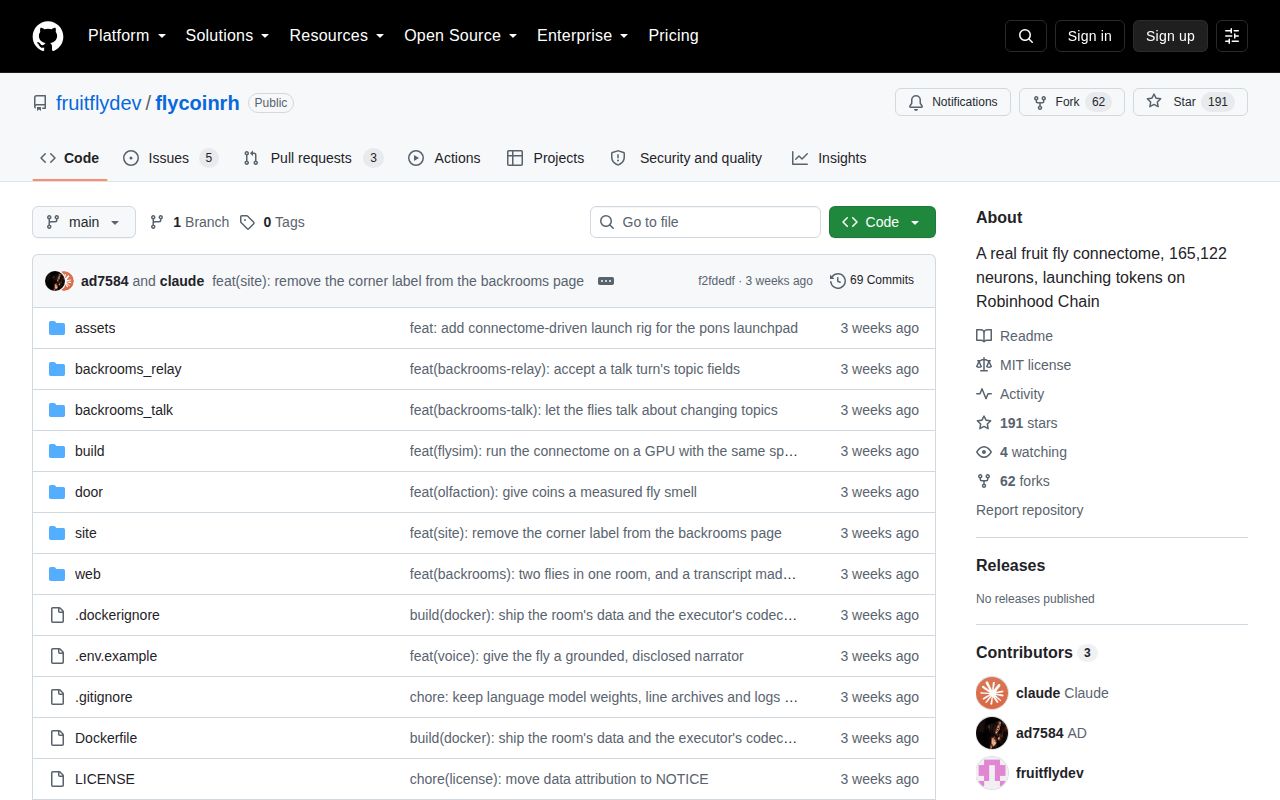
The repository was created September 10, 2026 and pushed through September 14. GitHub showed 191 stars, 62 forks, and eight open issues and pull requests on October 2. One open pull request argues that the code classified reward and punishment compartments from the wrong matrix direction, and says the README's earlier controlled result needs to be rerun under the corrected split.

That dispute is exactly why the repo works better as an experiment than a finished platform. Biological data, simulator choices, visual encoding, reward definition, web selectors, and transaction code all meet in one result. A green 5-second build cannot validate that chain of reasoning. The honest next step is to isolate the part you care about, reproduce it with fresh controls, and leave the funded wallet out until the 37 audit findings and unexecuted tests are resolved.

Alternatives

ProjectWhat it isPick it when
NengoA Python framework for building and simulating large neural models with explicit experiments.pick this instead when controlled neuroscience modeling matters more than driving a browser from a specific fly connectome.
Playwright for PythonA browser automation library for repeatable navigation, input, and verification.pick this instead when the task is dependable web automation rather than observing biological wiring make noisy choices.
web3.pyA Python interface for explicit Ethereum-compatible chain calls and transactions.pick this instead when you need reviewed, deterministic blockchain integration without the browser-and-connectome experiment.

What people are saying

  1. [velocity-scout] fruitflydev/flycoinrh

Sources

  1. flycoinrh README
  2. Roaming service Dockerfile
  3. Mushroom-body compartment pull request
  4. Setup issue and maintainer follow-up

More automation reviews

WA-AKG · MacDuo · IDM_Pro_Tool · stonkfly · gongwen-gbt9704-skill · mactap-app · the whole board →