Passing 41 tests does not prove the fly can trade
Stonkfly is unusually direct about the line between working software and a working strategy. It retains a large fly connectome, sends chart pixels into mapped visual cells, reads activity from selected descending neurons, and converts that signal into buy, sell, or hold. Coinbase integration can place a real spot order. None of those facts demonstrates that the network learns a profitable policy, and the project's own model document says it has not done so.
That distinction should govern your decision. This is an experimental neural controller with serious execution controls, not evidence that fly anatomy contains market insight. Paper mode starts with public BTC-USDC data and a $100 simulated balance. A fixed decoder turns a firing-rate difference into a proposal, while a separate guard may reject it for budget, inventory, price, time, or account-state reasons. The guard never replaces the neural choice with a smarter trade.
166,700 neurons receive pixels instead of price indicators
The retained MaleCNS v1.0 graph contains 166,700 neurons and about 25.6 million directed connections. Stonkfly renders a 320 by 180 price chart, then maps luminance into 3,335 R1-R6 cells and color proxies into 811 R8 cells. The simulator does not receive moving averages, balances, profit, or raw price columns as sensory inputs. That makes the experiment easier to describe honestly: a neural graph sees an image and emits activity.
The biological claims stop well before a living fly. Documentation calls the neuron model approximate, lists simplified transmitter signs, and identifies the display adapter as unvalidated physiology. Each market observation advances 500 ms of neural time even though wall observations are at least 60 seconds apart. Positive and negative portfolio changes stimulate selected dopamine cells, but those engineered signals are not modeled pleasure, pain, or proof of causal credit assignment.
What happened when we ran it
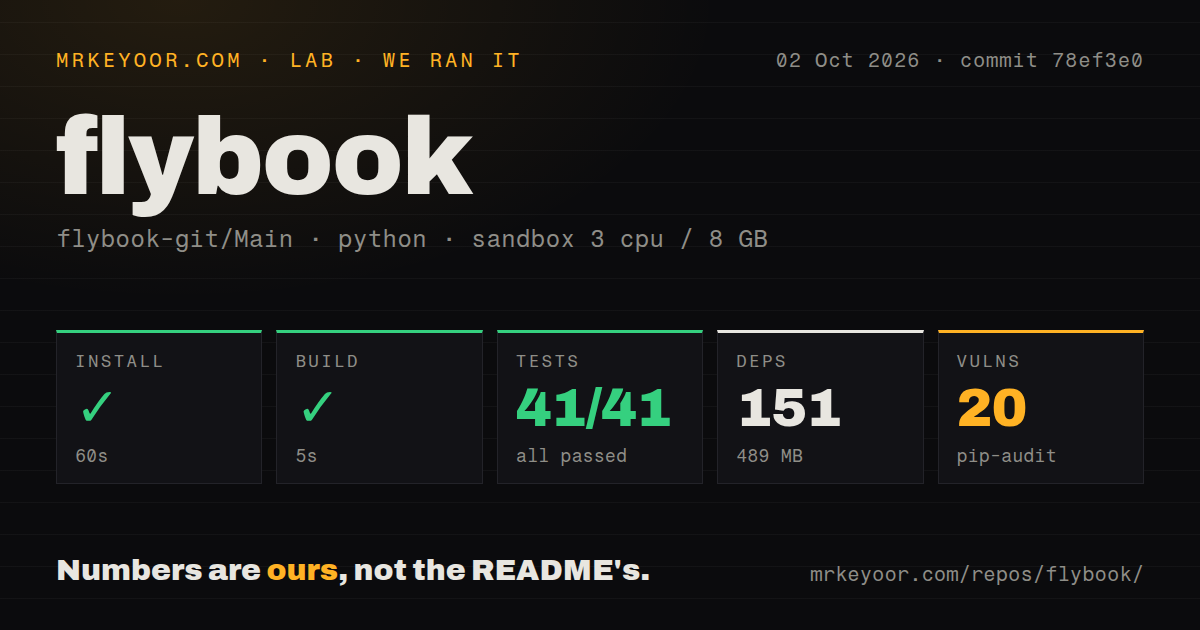
Our sandbox installed commit 78ef3e0 in 60 seconds. It added 151 packages and occupied 489 MB on disk. The build succeeded in 5 seconds, then pytest completed in 47 seconds with 41 passed, 0 failed, and 1 skipped in the supplied 41-test report. Pip-audit found 20 known vulnerabilities. A buyer should resolve or accept those advisories before placing credentials beside the environment.
The checkout itself had 45 files, roughly 3,374 lines of source, and measured 1.5 MB. It included one CI workflow and a tests directory, but no Dockerfile. Our run checked installation, build, and the supplied tests in an unprivileged Python 3.12 Bookworm container with 3 CPUs, 8 GB RAM, and no secrets. It did not demonstrate trading returns, exchange reliability, neural realism, or safe handling of live money.
A 1.1 GB dataset follows the 60-second install
The README calls for Python 3.11, a C++17 compiler, and macOS or Linux. python -m stonkfly prepare then downloads about 1.1 GB of upstream connectome data, verifies locked hashes, and builds the graph. The operations guide says to allow several additional gigabytes for dependencies, derived data, and two checkpoints. It recommends 16 GB RAM, twice the memory available in our lab container.
Paper mode needs no Coinbase credential and stores logs, rendered sensory images, and resumable brain state under a local run directory. The process must stay running for continued observations. SQLite is the authority after a crash, while alternating checkpoints preserve neural state. A STOP file prevents future submissions, though an order already sent as fill-or-kill may still complete. Recovery from an uncertain exchange response requires human inspection rather than an automatic retry.
The 20 USDC drawdown trigger does not cap loss
Live setup requires a dedicated Coinbase Advanced portfolio funded with at most 100 USDC at initialization. The API key must use ECDSA, allow View and Trade, disable Transfer, and be scoped to that portfolio. Live execution also needs an environment acknowledgment, the --live flag, and a preflight command. These layers reduce accidental activation. They do not make the experiment suitable for unattended savings.
Each buy is limited to 10 USDC including a fee reserve, with no borrowing, shorting, transfers, or margin-trading actions exposed. The worker permits at most 24 order attempts per UTC day. At a 20 USDC drawdown it stops opening new orders, but it does not sell existing holdings. Their value can keep falling, and a move between observations can pass the threshold. The documentation says the experiment can lose its entire allocated balance.
A September push and zero open items offer little history
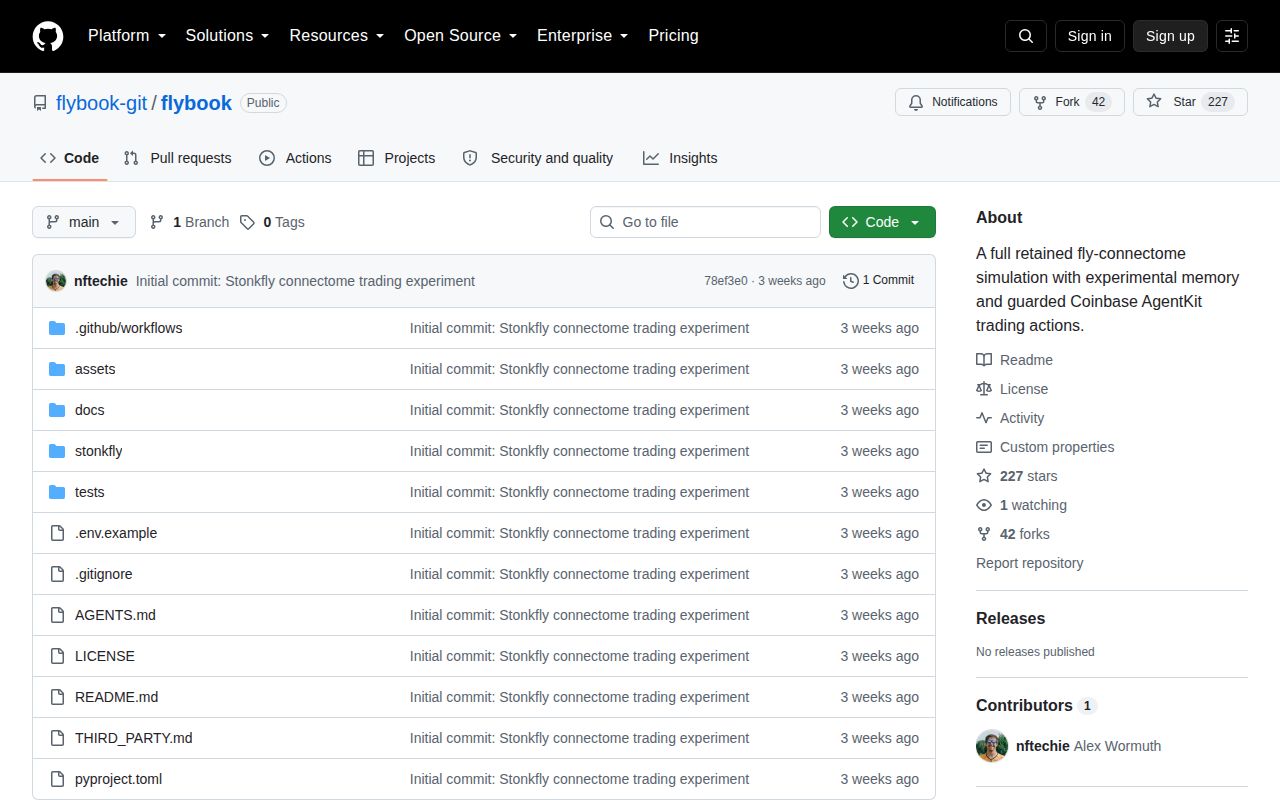
GitHub redirected the requested repository to flybook-git/flybook, which showed 227 stars, no open issues or pull requests, and a last push on September 10, 2026. There was no GitHub release returned. The Python package identifies itself as version 0.1.0. Those facts describe a young codebase with a quiet tracker, not a long operating record.
Stonkfly earns attention because it labels its assumptions and failure boundaries with unusual care. The valuable artifact is the experiment design, paper mode, audit trail, and guarded exchange bridge. The missing artifact is the one a trader needs most: controlled evidence of profitable learning. Run it on paper if the connectome question interests you. Choose Freqtrade or Jesse when your job is to test an explicit trading strategy, and choose Brian 2 when exchange plumbing would only muddy the neural research.