The 822-file repository covers dispatch, tracking, and extensions
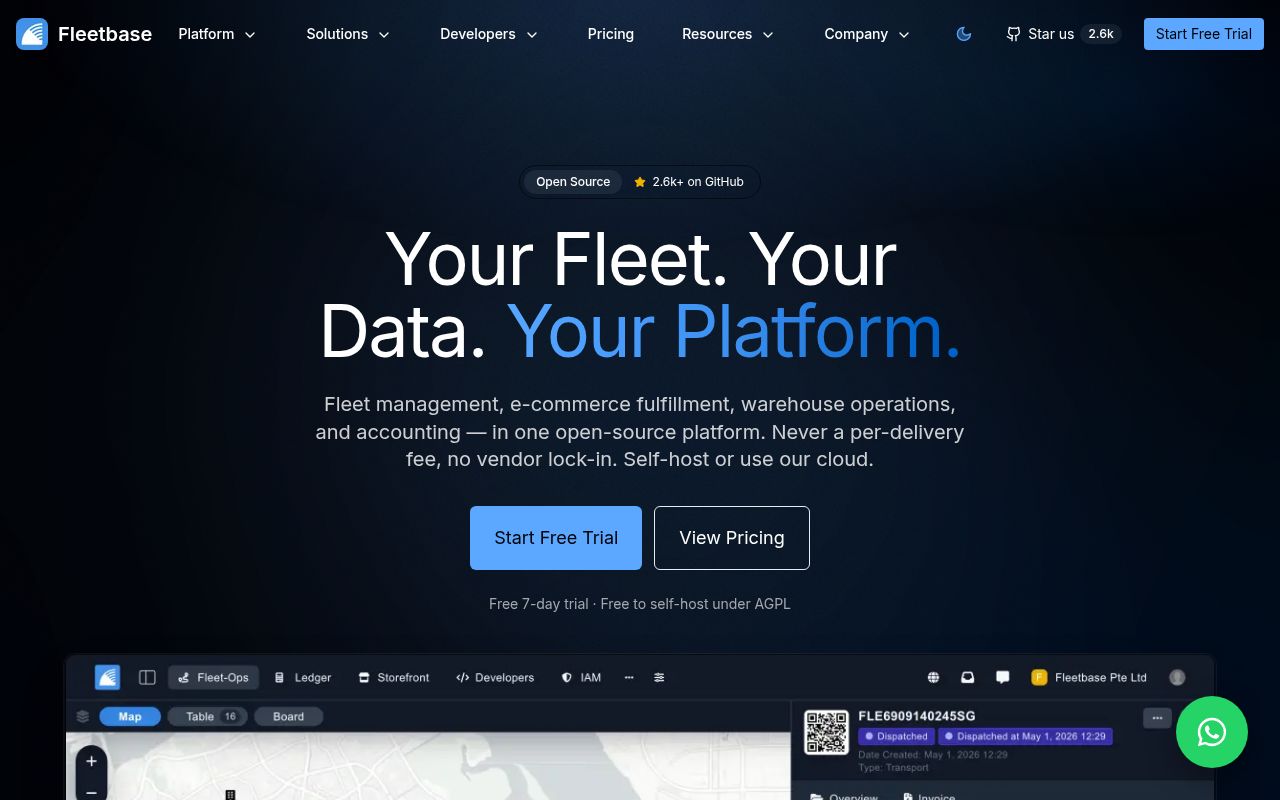
Fleetbase is aimed at organizations that move goods or people and need more than a pin on a map. The 822-file checkout connects order entry, driver and vehicle records, live maps, service zones, route planning, customer tracking, chat, and dashboards. Its REST API, sockets, and webhooks give developers places to join external storefronts or operational systems. Extensions add warehouse, fleet, storefront, ledger, and other domain packages without forcing each deployment into the same feature set.
Eight services sit behind the two-command quickstart
The supplied Compose configuration runs 10 SocketCluster workers and defines 8 services: MySQL, Redis, SocketCluster, a scheduler, a queue worker, the console, the application, and an HTTP front end. The README's quickstart reduces installation to a global CLI plus flb install-fleetbase, but it does not make those moving parts disappear. Persistent database and uploaded-file volumes, background jobs, WebSocket origins, health checks, upgrades, backups, and recovery still belong to whoever runs the self-hosted instance.
The API manifest requires PHP 8.0 through 8.2 and Laravel 10, while the console uses Ember 5.4 and requires Node 22 or newer. SocketCluster is fixed to a linux/amd64 image and uses 10 workers plus 10 brokers in the provided configuration. That deserves an early check on ARM hosts. The default console listens on port 4200, the public API on 8000, and the socket container maps through port 38000.
What happened when we ran it
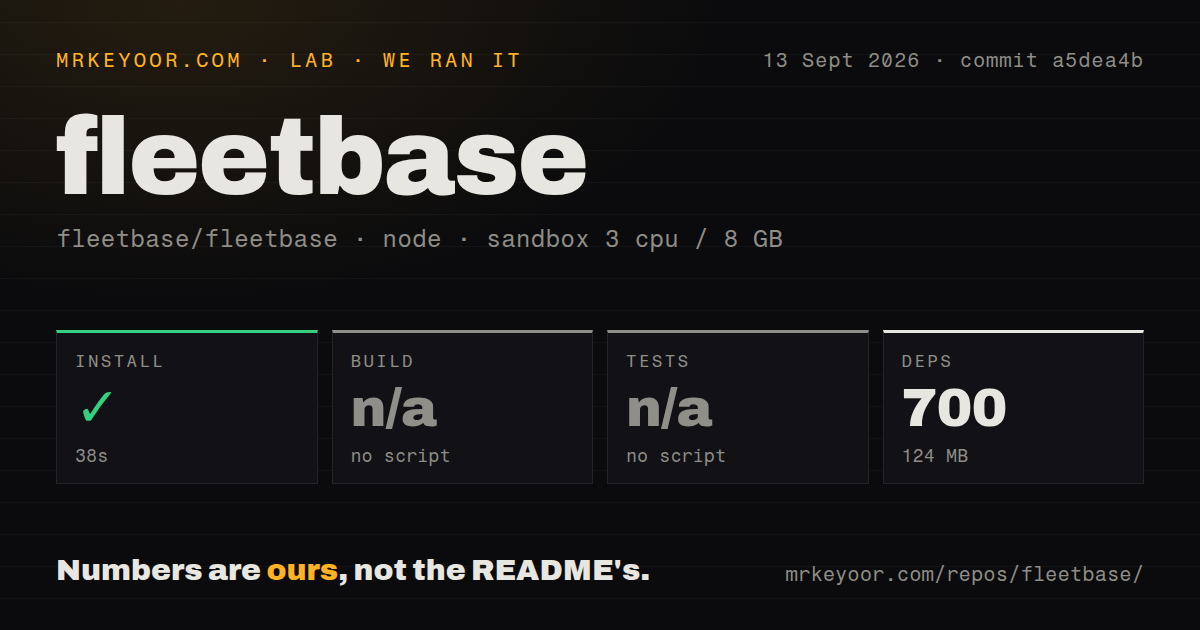
Our sandbox installed 700 pnpm packages from ./api/ in 38 seconds. The dependency tree occupied 124 MB after installation. The command succeeded without a package-install error. That is the full positive result: the measured package offered no build script or target and no test script or target, so the lab skipped both steps instead of treating their absence as a pass.
The run used commit a5dea4b in a fresh unprivileged Debian container with 3 CPUs, 8 GB of RAM, Node 22, and no secrets. The repository measured 14.6 MB, with 822 files and roughly 44,377 source lines. Our scan found 15 CI workflow files and a tests directory. Those signals suggest other project checks exist, but no test result came from this run, and we will not borrow one from a badge or release note.
MySQL on port 3306 is an adoption constraint
The default database service is MySQL 8.0 on port 3306, and the API environment is written around MySQL and Redis. Open issue 548 asks for PostgreSQL and PostGIS support, describing MySQL-specific SQL, JSON, geometry, date, query, and migration assumptions that would need compatibility work. A Postgres-standardized company should budget a separate MySQL service or choose another product. An unmerged request for database portability is not a supported deployment option.
Configuration continues above the storage layer. Fleetbase needs an application key and explicit console, session, and WebSocket origins. Routing points to the public router.project-osrm.org server unless you supply another compatible endpoint. Mail can use several providers, while Google Maps, IPInfo, Twilio, S3-style storage, and the extension registry each introduce optional credentials. Production review should cover which third parties receive addresses, phone numbers, or location data before live orders enter the system.
v0.7.59 adds trailers while an order-form reset remains open
Release v0.7.59 arrived on September 9, 2026 with trailer records, trailer attachment flows, inspection data, UI work, and authorization fixes. On the same date, issue 651 reported that editing a pickup, dropoff, or waypoint place in the new-order screen can wipe customer, order type, notes, custom fields, and line items already entered. The report includes reproduction steps and a proposed cause. Until a deployed version proves otherwise, test that exact action with a realistic draft order.
International and warehouse requirements need similar care. Issue 517 shows FleetOps action labels staying in English after switching to Spanish. The README still lists the Pallet warehouse extension as in development with an expected Q2 2026 release, while Dynamic Rules is marked for 2027. Those entries state project intentions, not delivered capabilities. Verify each required extension in the version you intend to run instead of buying around a roadmap row.
September 2026 pushes show activity, while AGPL shapes deployment
The last push was September 11, 2026, 2 days after v0.7.59. GitHub listed 2,644 stars and 20 combined open issues and pull requests. The queue includes a fresh order-entry bug as well as older feature requests, and the latest release contains changes across the console, API, Fleet-Ops, and shared UI packages. Together, the push and issue activity show ongoing maintenance. They do not settle whether a specific operational path is ready for a busy dispatch desk.
Fleetbase defaults to AGPL-3.0-or-later. A modified network service must meet that license's source-sharing conditions. The README separately advertises commercial terms, including $25,000 per year, $2,500 per month, and one-time licenses for a fixed major or minor version. Those prices and terms can change, so treat the repository as the starting quote. Legal review belongs early in a proprietary rollout, before custom extensions become difficult to separate from the platform.
A 38-second install is the start of a pilot, not the pilot
Our 700-package install makes source evaluation cheap enough, but the missing build and test targets leave the full application unproven in this sandbox. Odoo is the better comparison when fleet operations must sit inside a larger ERP. Traccar is narrower and better suited to GPS devices and location history. ERPNext fits inventory and back-office work. Fleetbase has the sharper logistics vocabulary when orders, dispatch, drivers, maps, and customer tracking must share one extensible system.
A serious trial should deploy all 8 services, restrict socket origins, replace or approve the public routing endpoint, set backup and queue-recovery procedures, and run representative order flows. Include the place-edit reset from issue 651, Spanish labels if needed, and every extension on the buying list. Fleetbase offers a substantial head start for a team prepared to own that work. Anyone seeking a small fleet tracker or a verified one-command appliance should choose the narrower product.