FlashAttention computes exact attention with less memory traffic
FlashAttention changes how attention is tiled and moved through GPU memory. It still computes exact attention, unlike approximations that alter the operation to save work. The package is useful because attention can become expensive as sequence length grows, and data movement can dominate the kernel. This repository contains the published implementation rather than a model, training framework, or inference server. You call its functions from a surrounding PyTorch workload.
The API covers packed or separate query, key, and value tensors. It also documents variable sequence lengths, local windows, causal masks, ALiBi, grouped-query attention, multi-query attention, and in-place KV-cache updates. Those options do not guarantee that every combination follows the same kernel on every card. Our measured checkout contained 26,471 files, roughly 3,819,473 source lines, and occupied 615.1 MB, much of it tied to architecture-specific code and included third-party work.
FlashAttention-2 needs CUDA 12.0 or ROCm 6.0
The main NVIDIA FlashAttention-2 path supports Ampere, Ada, and Hopper according to the README. It handles fp16 and bf16, with head dimensions through 256 on the documented CUDA path. Turing cards such as the T4 and RTX 2080 are directed to a separate repository. AMD users have Composable Kernel and Triton routes for selected MI and RDNA GPUs, with their own data-type and feature matrices.
Installation therefore starts with the machine, not pip. The README requires PyTorch 2.2 or newer, a CUDA or ROCm toolkit, and a working ninja, plus small Python packaging utilities. On systems with many CPU cores and limited RAM, it advises limiting parallel jobs through MAX_JOBS. Our sandbox had 3 CPUs and 8 GB of RAM, which was enough for its measured 10-second build step, but that result does not demonstrate a kernel on your GPU.
What happened when we ran it
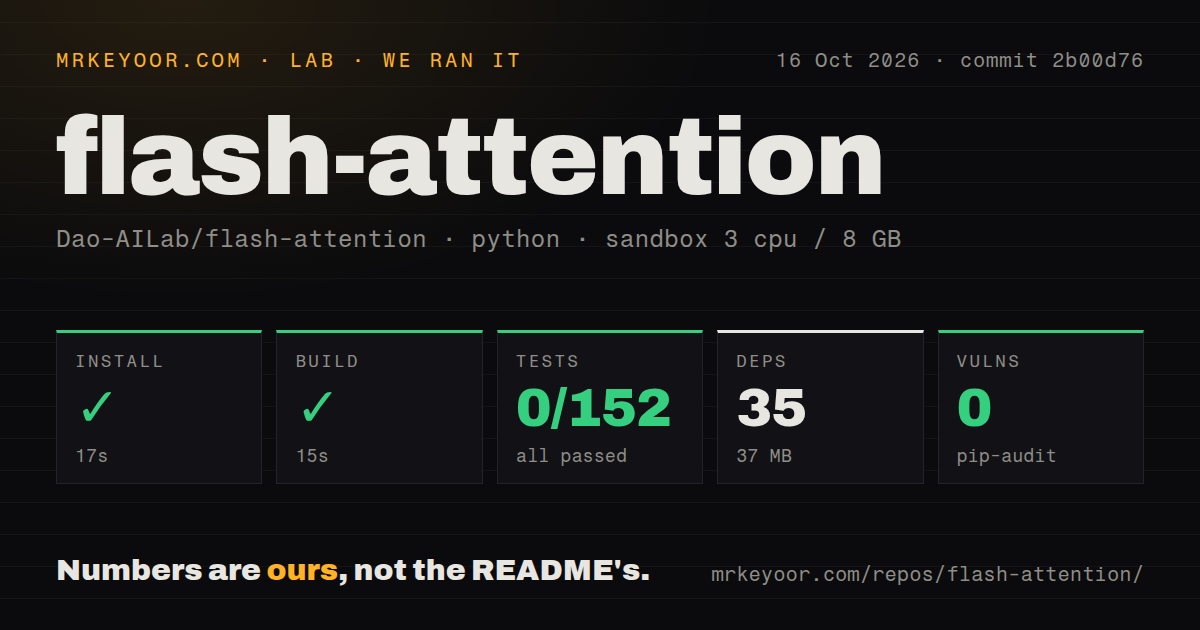
Our sandbox installed commit 117d189 in 20 seconds. It added 35 packages and used 37 MB on disk. The build then succeeded in 10 seconds. Pip-audit reported 0 known vulnerabilities in the installed Python environment. These are results from a fresh unprivileged Python 3.12 Bookworm container with 3 CPUs and 8 GB of RAM, rather than the project's published performance plots.
Pytest failed after 11 seconds with exit code 3. It reported 0 passed, 0 failed, and 122 collection or setup errors out of 122. The tail ends inside third_party/aiter/op_tests/opus/device/test_opus_device.py, where importing the module called sys.exit(0). Pytest surfaced that as an internal SystemExit: 0, followed by 1 warning and the 122-error summary. The log does not establish a deeper cause, so we will not assign one.
No functional test reached a pass or fail outcome in that run. The 10-second build proves that the harness's build step completed; it does not prove CUDA or ROCm correctness, numerical agreement, or speed for a model. The repository had 6 CI workflow files and a tests directory, with no Dockerfile. A buyer should run the specific attention calls, shapes, forward and backward paths, and GPU generation that production will use.
FlashAttention-3 is still a separate Hopper beta
FlashAttention-3 sits under the hopper directory and is labeled beta for testing and benchmarking before integration into the rest of the repository. The README names H100 or H800 hardware and CUDA 12.3 or newer for that path, with fp16 and bf16 forward and backward plus fp8 forward. FlashAttention-4 uses CuTeDSL and targets Hopper and Blackwell, which adds another install and compatibility track rather than replacing every earlier path.
That version spread makes the project powerful and easy to misread. A paper name, Python import, and GPU model are insufficient deployment coordinates. Record the FlashAttention family, package or commit, PyTorch build, toolkit, GPU compute capability, data type, head dimension, and whether the path needs backward computation. The measured commit had 615.1 MB of source before the 37 MB Python dependency install, so vendored and generated kernel code deserve deliberate cache and image policies.
Windows and head dimension 512 still have live gaps
The README says Linux is supported and Windows compilation needs more testing. Issue 2832 reports that a Windows source build using CUDA 13.4 and newer PyTorch headers needs compiler flag and architecture updates. A related pull request proposes those build changes. This is exactly the kind of compatibility edge a prebuilt framework operator can hide and a direct compiled extension exposes. Windows teams should prove their precise wheel or compiler path before adopting it.
Issue 2581 documents another boundary: head dimension 512 on Ada compute capability 8.9. The report says FA2 rejects that dimension there, while newer CuTe work depends on hardware features unavailable on Ada. On September 10, 2026, a new pull request was exploring dimension 512 for an SM100 path. That active work does not expand the supported matrix until the required architecture and mode are merged and released.
Version 2.8.3.post1 trails an actively changing main branch
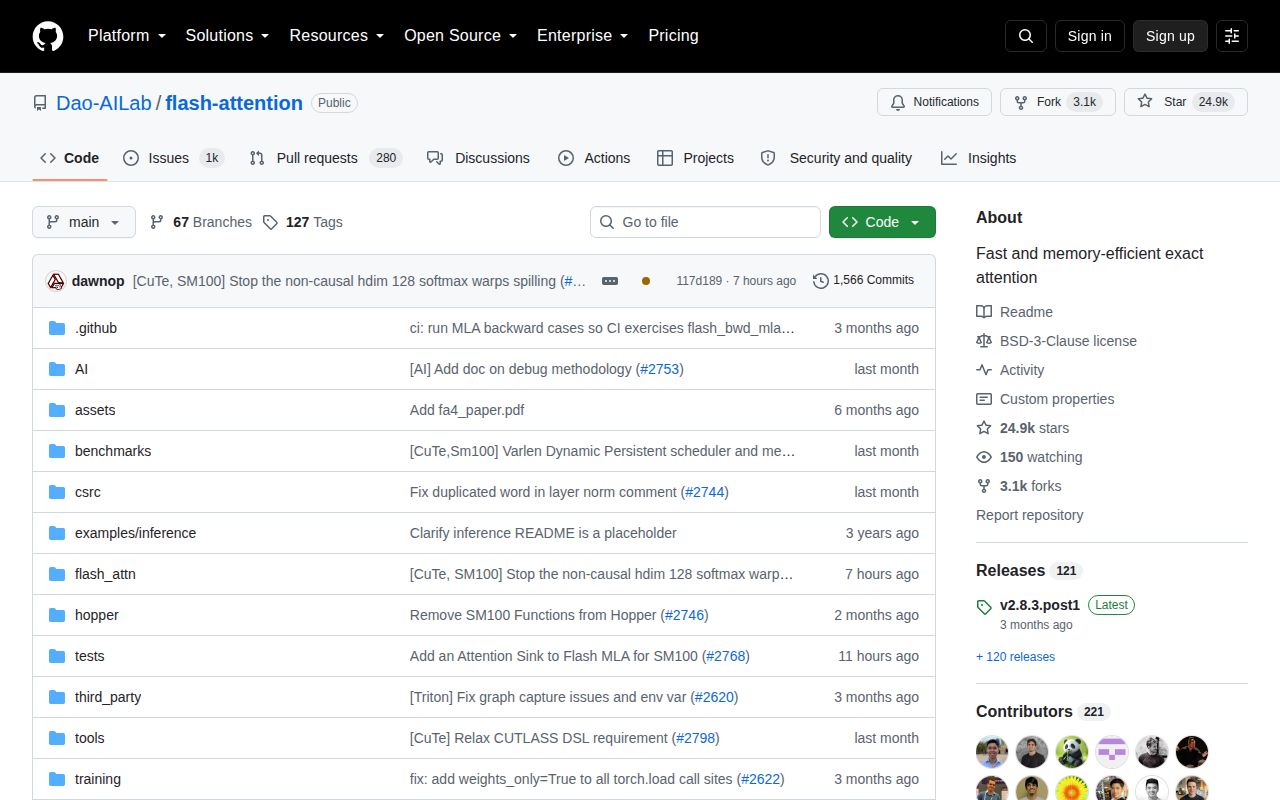
GitHub returned v2.8.3.post1 as the latest release, published June 10, 2026. The repository's last push was September 10, and GitHub listed 24,876 stars plus 1,311 open issues and pull requests combined. Fresh pull requests cover new Blackwell kernels, gradient support, and configuration fixes. The project is active even though the latest release tag is older than current main; release age alone would give the wrong health signal.
FlashAttention deserves a controlled trial when attention is material to your model's cost and your hardware appears in the documented matrix. Our 30 seconds of successful install and build make the source approachable, while 122 collection errors mean the lab run supplied no test confidence. Compare it against PyTorch on the same shapes, verify outputs and gradients, then pin the complete software and GPU combination. If that sounds excessive for the expected gain, the framework default is the better engineering choice.