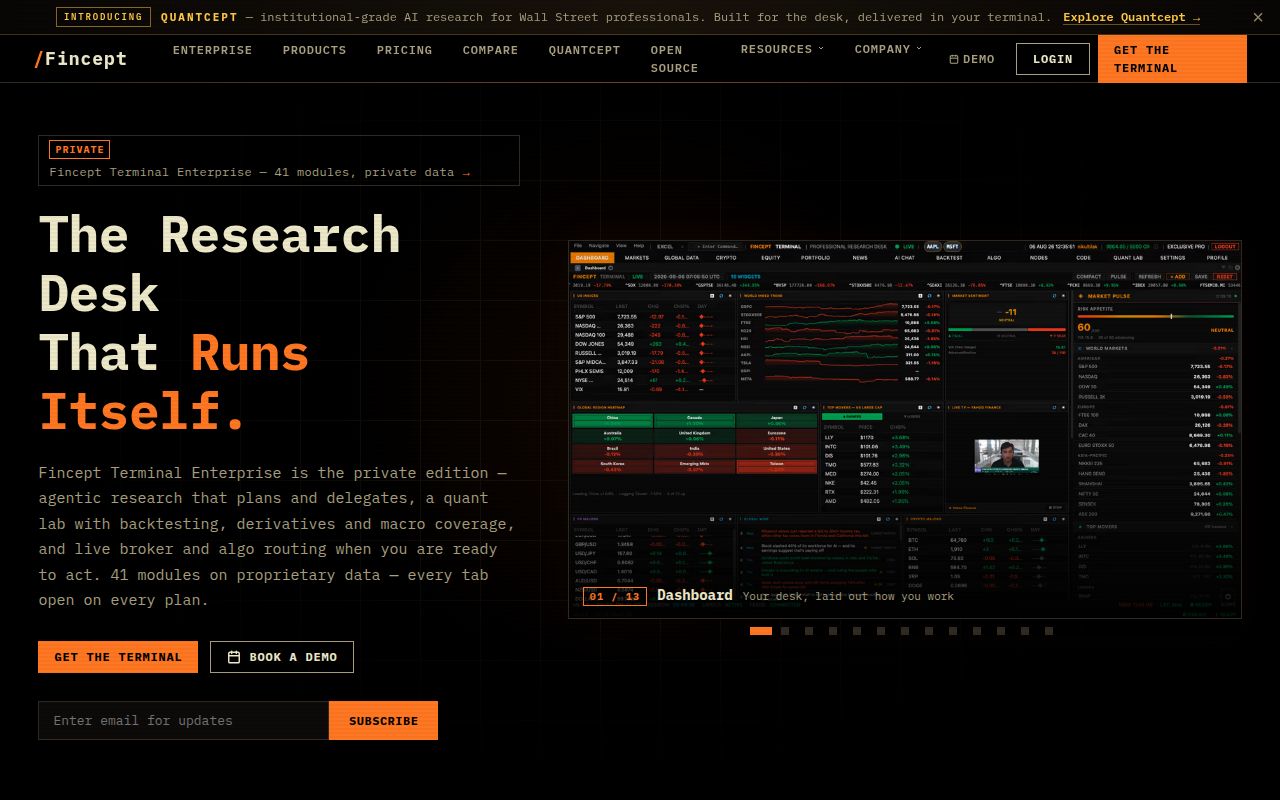
More than 100 data connectors sit inside one desktop app
FinceptTerminal groups more than 100 data connectors with an 18-module QuantLib suite, portfolio tools, news, charts, paper trading, and AI research. The open edition is a native C++20 application with a Qt 6 interface and embedded Python analytics. That breadth is the reason to try it: one screen can move between a FRED series, an equity, a portfolio, and a model-assisted research task without assembling a dashboard yourself.
The same breadth creates the buying question. The README lists 37 finance and geopolitics agents, 16 broker integrations, a visual node editor, and more than 50 screens. FinceptTerminal makes those capabilities visible in one app, but it cannot make provider limits, credential policies, data quality, or trading behavior uniform. You are adopting a workstation with many edges, not one small analytics package.
What happened when we ran it
Our 3-CPU, 8 GB Debian sandbox did not run commit 4ecda75 because the lab has no supported ecosystem for this C++ project. We did not attempt the install, build, or tests. The checkout did contain a Dockerfile, but we did not execute it. There is therefore no honest timing, dependency count, compiler result, or test total for us to report.
That limit matters because the repository presents two easier paths: platform installers and setup.sh for Linux or macOS. Their presence does not turn an unexecuted build into evidence. Our run can confirm only that this project fell outside the lab's supported ecosystems and that a container recipe existed. Judge the packaged app separately from source-build confidence, especially if you plan to modify broker or data code.
Source builds require Qt 6.8.3 and Python 3.11
The development guide calls for C++20, CMake 3.27 or newer, Qt 6.8.x, and Python 3.11.x. The README is tighter, naming CMake 3.27.7, Ninja 1.11.1, Qt 6.8.3, and Python 3.11.9 as the supported set. Windows also needs a Visual Studio 2022 developer shell. Linux needs Qt, OpenGL, XCB, audio, and other system libraries that the Dockerfile installs explicitly.
The Docker route is still a desktop deployment. Its runtime uses Debian, bundles Qt 6.8.3, and starts the app through X11 with the host display socket and networking. That can be useful for a reproducible Linux build, but it is awkward on a remote server and unlike deploying a browser dashboard. Official v4.5.0 downloads cover Windows x64, Linux x64, and Apple Silicon Macs. Intel Mac and Windows on Arm packages are not listed.
The open edition moves data and model bills to you
The open build advertises more than 100 connectors and several language-model providers, including OpenAI, Anthropic, Gemini, Ollama, and OpenRouter. Public feeds may be enough for exploration, while other screens require keys or paid accounts. The README says the open edition's data and model charges are yours, with token billing that has no ceiling. A free application can still produce a variable monthly bill when agents call hosted models.
Guest mode lets a developer open the app without registration, according to the setup guide. Useful coverage is a separate matter. Before relying on a screen, record its upstream source, credential type, rate limit, history depth, and fallback behavior. For AI work, set spending limits at the provider and test which text leaves the machine. For trading, start with paper accounts and reconcile the terminal's state against the broker.
AGPL-3.0 appears beside conflicting commercial terms
The README labels the open edition AGPL-3.0-or-later and says Fincept no longer sells a separate commercial license for this repository. The LICENSE file at commit 4ecda75 calls the project dual-licensed, says the AGPL option is for noncommercial use, and states that internal company use requires a paid Fincept Commercial License. Those statements give a business two different answers to the same basic question.
Do not solve that contradiction by choosing the paragraph you prefer. Ask Fincept for written terms and have counsel review them before company use, distribution, hosting, or a branded fork. Individual personal research has a clearer path in both documents. The proprietary Enterprise edition is also distinct from this repository, so its private datasets, live routing, access controls, and support should not be credited to the open build.
Two open v4.5.0 reports affect FRED data and paper orders
Issue #389 reports that the FRED panel in v4.5.0 displays zero observations even with a valid key. The report traces the behavior to Python emitting numeric values while the C++ panel reads them as strings and skips them. Issue #392 reports a separate routing problem: an Alpaca account in paper mode uses FinceptTerminal's local paper engine instead of Alpaca's native paper API, leaving the terminal and broker blotters out of agreement.
Both reports were open on September 19, 2026, so they are warnings to reproduce, not proof that every screen is broken. They also land in basic financial workflows, where a quiet empty chart or mismatched order ledger is worse than a visible crash. Confirm data row counts against the provider, reconcile paper orders outside the app, and keep real-money routing out of scope until the same checks pass.
A same-day push and 31,791 stars show active attention
GitHub recorded the last push on September 19, 2026. The repository had 31,791 stars and 7 combined open issues and pull requests, split into 5 issues and 2 pull requests when fetched. Release v4.5.0 arrived on September 1, and the README says the open edition now follows a monthly release cycle while daily development happens in the private Enterprise product. This is active maintenance with an explicit second priority.
FinceptTerminal v4.5.0 is worth a packaged personal trial if its broad research desk replaces several tabs for you. Keep the first trial narrow: one data source, one portfolio, one paper broker, and a capped model account. If the results reconcile and the missing platform support does not matter, expand from there. For company use, the conflicting license text remains the decision gate, regardless of how many screens work.