mrkeyoor.com_
Tue 06 Oct 06:36 UTC
Dataevaluationupdated 06 Oct 2026

awesome-jev review

Awesome Jev is an English-language directory of open-source projects that use TypeSafe Jev or implement a compatible decision interface. Its 176 entries are stored as source-backed JSON records, checked locally, and screened by an advisory Jev review workflow before a maintainer decides whether to merge them.

Verdict

Our run installed 0 packages, built in 7 seconds, and passed all 4 tests, so the catalog mechanics are unusually easy to verify. Awesome Jev is a good first stop for discovering concrete Jev integrations because descriptions need source evidence and the reviewer cannot merge anything. Treat every entry as a lead for your own technical review, especially when its saved report is missing or the workflow exceeded its evidence budget.

We ran it

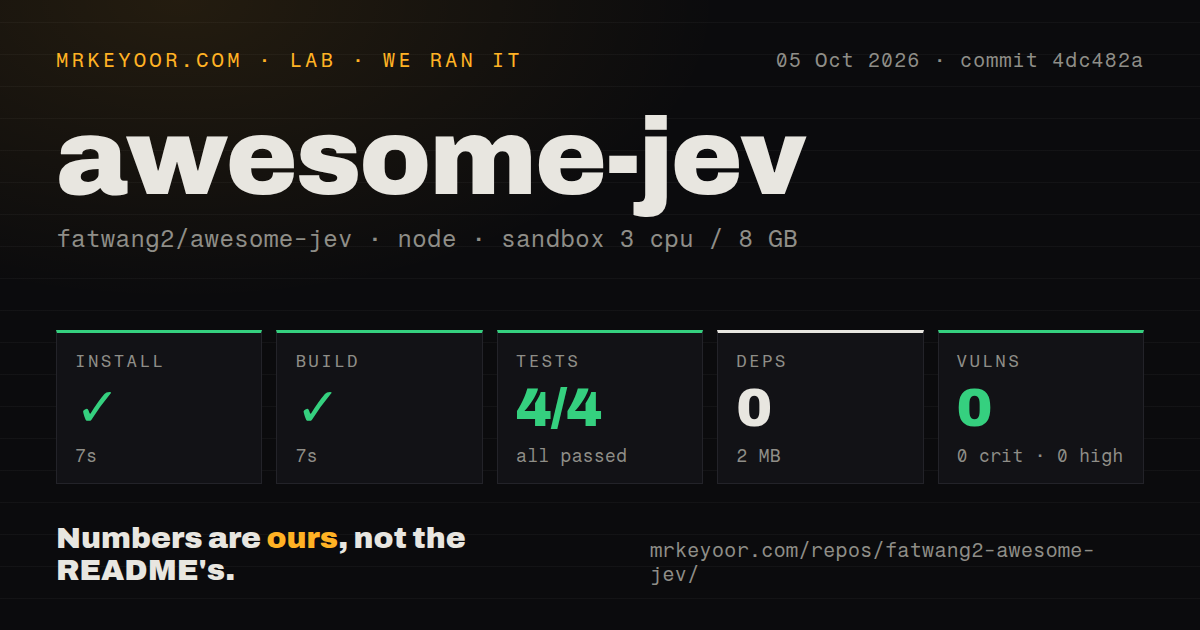
Lab card: what happened when we ran awesome-jevScreenshot of awesome-jev (github.com/fatwang2/awesome-jev)
Install✓ · 7s0 packages · 2 MB
Build✓ · 7s
Tests✓ · 6s4 passed · 0 failed of 4 (node:test)
Known vulns00 critical · 0 high · 0 moderate · 0 low (npm audit)
Repo194 files~102 lines of source · 0.1 MB · 2 CI workflows · tests dir

Answers from our run

Does awesome-jev build from source?

Dependencies installed in 7 seconds (0 packages), and the build succeeded in 7 seconds. We cloned commit 4dc482a into a clean Debian container with 3 CPUs and no project-specific setup.

Do awesome-jev's tests pass?

Yes: 4 of 4 passed when we ran the project's own test command (node:test). Some failures need services or credentials a bare container does not have.

Does awesome-jev have known vulnerabilities in its dependencies?

npm audit found none in the dependency tree at the time of our run.

Who should not use awesome-jev?

Readers who want a ranked shortlist: inclusion shows source evidence for Jev use, not product quality, security, or fitness for production.

What are the alternatives to awesome-jev?

Awesome TypeSafe Jev, Awesome Decision Models, Awesome. Our run installed 0 packages, built in 7 seconds, and passed all 4 tests, so the catalog mechanics are unusually easy to verify.

Setup5/5Zero-package install and all four local tests passed
Docs5/5Submission, evidence, data flow, limits, and review policy are explicit
Community4/5220 stars, 176 entries, and October submission activity
Maturity3/5Strong checks, but no release tags and review artifacts expire

Who it’s for

Developers looking for Jev SDKs, integrations, tools, research, and working examples.
Maintainers who want each catalog description tied to specific source files.
Reviewers who prefer model-assisted screening with a human merge decision.
Teams studying how to build a constrained GitHub Action around untrusted submissions.

Who it’s NOT for

Readers who want a ranked shortlist: inclusion shows source evidence for Jev use, not product quality, security, or fitness for production.
Teams that need every old entry to have a saved live review: the contribution guide says seed entries were maintained by hand and must not be described as Jev-reviewed without a linked report.
Organizations that cannot send repository files to TypeSafe or an enabled gateway: live review transmits the README, manifests, selected source, and supplied evidence.
Large integrations whose proof cannot fit the review budget: the workflow accepts at most 10 files and 48,000 file-content characters, then warns instead of making a clean recommendation.
Maintainers expecting automation to merge or reject submissions: every result is advisory, and a human handles uncertain evidence and categories.
Consumers who need versioned releases: the repository has no GitHub release tag.

Setup reality

Our sandbox installed commit 4dc482a in 7 seconds. It added 0 packages and used 2 MB on disk. The build passed in 7 seconds, all 4 Node tests passed in 6 seconds, and npm audit reported 0 known vulnerabilities.

Local checks need Node.js 22 or newer and no API key. A live pull-request review needs a configured TYPESAFE_API_KEY, or credentials for an enabled Vercel AI Gateway or Cloudflare Workers AI fallback.

The build regenerates the README from entry JSON and documentation fragments. Review runs send selected repository material to the configured provider, retain their Action artifact for 14 days, and never merge or edit a submission.

The catalog contains 176 source-backed Jev projects

Awesome Jev is a directory rather than an SDK or model server. Its 176 entries cover client libraries, integrations, developer tools, research, demos, and other projects built around TypeSafe Jev or a compatible decision schema. Each listing starts as a small JSON file with the exact repository name, a factual sentence, a category, and optional source paths that support the description.

That structure makes the list more useful than a long README edited by feel. The README is generated from the entries, so the machine-readable record is the source of truth. A contributor can point the reviewer at up to 6 evidence paths, while the workflow also searches the README, manifests, filenames, and file sizes for likely integration code. The final decision still belongs to a maintainer.

Four local tests validate the catalog without an API key

Local development requires Node.js 22 or newer. npm run check validates the entry set, npm test runs the supplied Node tests, and npm run build regenerates the README. The package declares no dependencies, which keeps the catalog check separate from the hosted model review. A contributor can verify formatting and generated output without spending model quota or receiving repository secrets.

The live review has its own credential boundary. A repository owner configures a dedicated TYPESAFE_API_KEY, or explicitly enables a Vercel AI Gateway or Cloudflare Workers AI fallback with its credentials. Submitted pull requests never receive those secrets. The privileged workflow runs trusted code from the base branch and reads the proposed entry files as data, reducing the chance that a submission can replace the reviewer before secrets are available.

What happened when we ran it

Our unprivileged Node sandbox with 3 CPUs and 8 GB of RAM installed commit 4dc482a in 7 seconds. Npm installed 0 packages and used 2 MB on disk. The build succeeded in 7 seconds, and the test step finished in 6 seconds with 4 passed and 0 failed. Npm audit reported 0 known vulnerabilities.

The repository contained 194 files but only about 102 lines counted as source by the lab scanner, because most of the project is JSON entries and generated documentation. The checkout occupied 0.1 MB. It had 2 CI workflow files, no Dockerfile, and a tests directory. Those numbers fit the product: the value sits in its records and review policy, not a large runtime.

Our run tested the local catalog mechanics. It did not call Jev, grade a new repository, or measure whether the model accepts and rejects the right submissions. The contribution guide recommends calibrating on human-labeled genuine integrations, keyword false positives, weak evidence, incorrect descriptions, and ambiguous categories. No accuracy rate should be inferred from the 4 passing unit tests.

One review reads at most 10 files and 48,000 characters

For a live submission, Jev first chooses up to 6 likely source files without seeing their contents or the optional hints. A second call reads the chosen files plus supplied evidence, then judges whether the integration is concrete, the description is supported, and setup instructions are usable. It also suggests a category. The report names the reviewed commit, model version, policy hash, probabilities, and evidence links.

The evidence budget is visible: up to 10 files and 48,000 file-content characters. Files are never silently truncated. If one cannot fit, the workflow omits it and adds a warning that requires maintainer review. There is no second retrieval round. That makes a recommendation reproducible enough to inspect, while a large or oddly organized codebase may need the submitter to choose better evidence paths.

The model advises, and a maintainer controls the merge

A recommendation never merges or rejects a pull request. Uncertain categories, missing source support, and conflicting descriptions go to a person. Batch submissions receive separate reviews, and one unresolved entry makes the Action fail while preserving completed sibling reports. Since GitHub merges the whole pull request, the contributor must fix, remove, or split the unresolved entries before a maintainer can accept the batch.

This boundary prevents the directory from laundering a model score into an endorsement. It also means inclusion is narrow evidence: the code appears to use Jev for the described purpose. The review does not install the listed project, run its suite, test its security, or prove its model claims. Initial seed entries were maintained manually, and the guide explicitly forbids saying they passed a live Jev review unless a report is linked.

Review artifacts expire after 14 days

GitHub Actions stores the JSON report for 14 days. The repository has a validation-record area for saved reports, but contributors or maintainers must preserve the artifact before expiry if they want a permanent record. That matters because the report retains selection probabilities, file paths, model identity, usage, hashes, and the policy version behind the recommendation. The README alone cannot reconstruct all of that later.

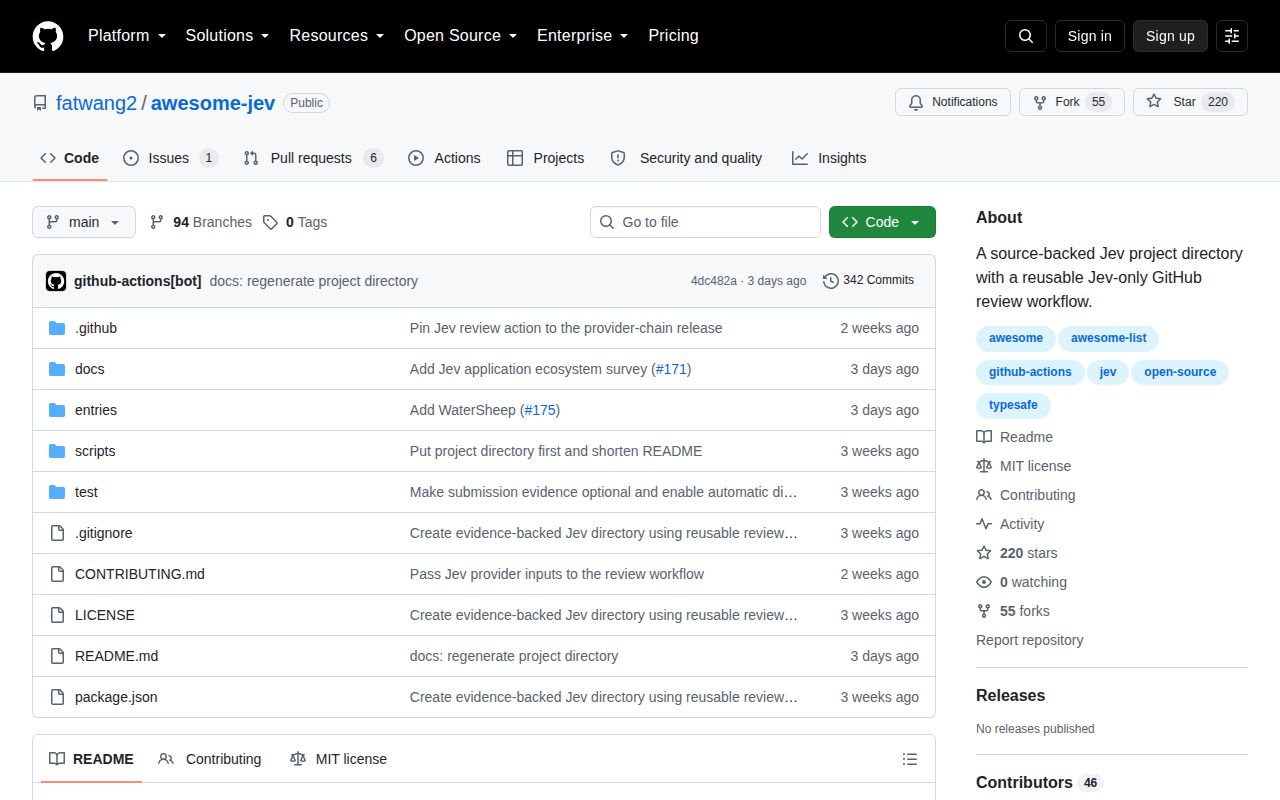
GitHub showed 220 stars, 55 forks, and 7 open issues and pull requests on October 6, 2026. Six of those were pull requests, and submission activity continued that day after the October 3 push. There is no release tag, which is acceptable for a living directory but weakens snapshot discovery. Use the catalog to find candidates, then follow its own evidence links and inspect the target repository before adopting anything.

Alternatives

ProjectWhat it isPick it when
Awesome TypeSafe JevA source-backed field guide covering Jev SDKs, demos, tools, and evaluations.pick this instead when you want explanatory field-guide material alongside the project links.
Awesome Decision ModelsA directory spanning hosted and open decision models, runtimes, applications, benchmarks, and papers.pick this instead when you want to compare Jev with the wider typed-decision model category.
AwesomeA broad directory of curated lists across software and other technical subjects.pick this instead when your search is not specific to Jev or decision models.

What people are saying

  1. [velocity-scout] heyjunpenn/awesome-jev
  2. [velocity-scout] kydlikebtc/awesome-jev
  3. [velocity-scout] Promethe-us/awesome-jev
  4. [velocity-scout] logicrw/awesome-jev-projects
  5. [velocity-scout] v-modal/awesome-jev-tools
  6. [velocity-scout] fatwang2/awesome-jev

Sources

  1. Awesome Jev repository
  2. Awesome Jev contribution and review policy
  3. Awesome Jev saved review records
  4. Awesome Jev open submissions

More data reviews

tax-doc-classifier · awesome-jev · awesome-jev · lead · prophet · awesome-zhuiju-free · the whole board →