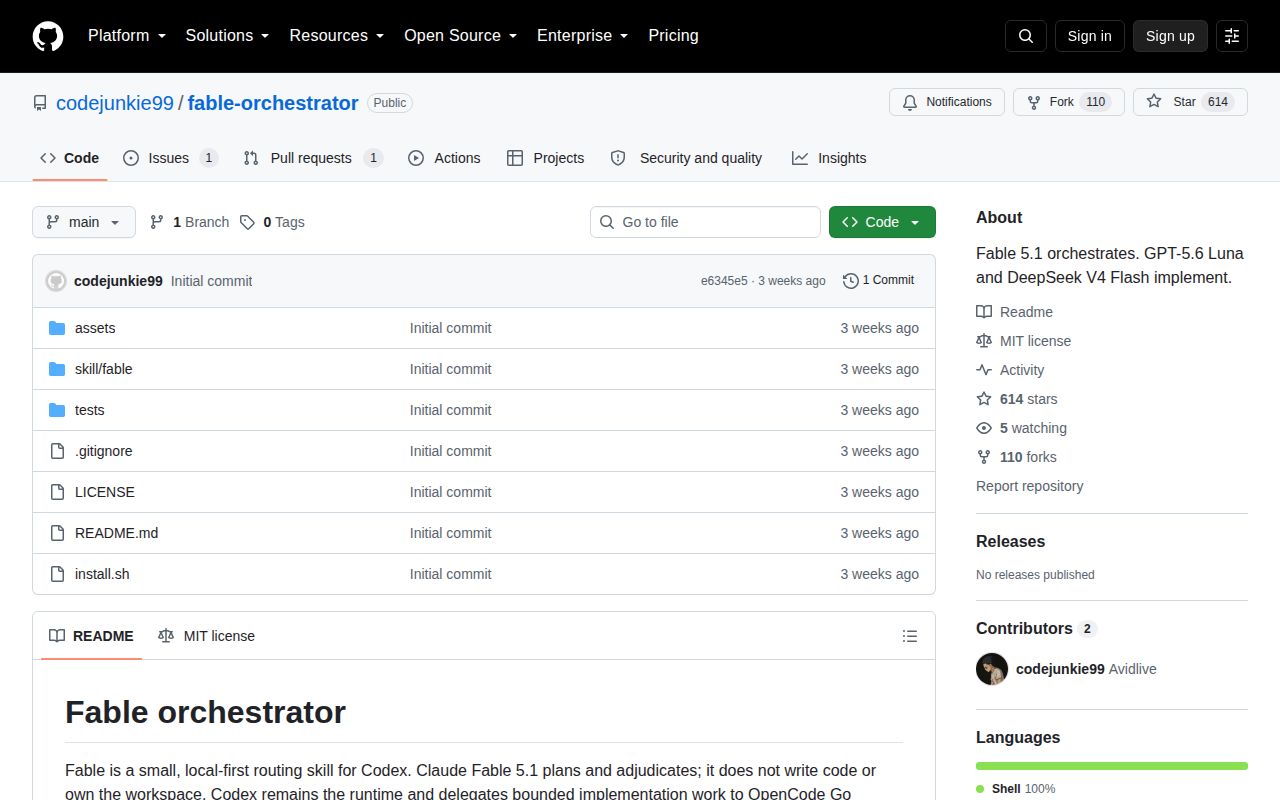
Three files turn Codex into the runtime for a fixed model split
Fable Orchestrator is smaller than its name suggests. The installable payload is SKILL.md, scripts/ask_fable.sh, and agents/openai.yaml. Claude Fable 5.1 receives a task packet and returns an execution graph. Codex validates that graph, starts workers, owns the tools and files, and checks the result. Implementation is reserved for GPT-5.6 Luna or DeepSeek V4 Flash.
The separation is the whole product. Fable plans and adjudicates without editing the repository, while Codex remains accountable for the work. The helper disables Claude tools and session persistence, and the skill caps complex flows at 3 Fable calls unless the user asks to continue. That makes the boundary readable. It also means this repository is only useful inside the exact stack named in its documentation.
Codex Router and a local Claude login are mandatory
The skill does not include an inference proxy, provider credentials, model discovery service, or dashboard. It expects Codex Router to expose callable opencode-go/ and opencode-go-responses/ agents. The user must configure the OpenCode Go key through that router. The orchestration helper separately calls the locally installed Claude Code CLI and searches local settings for a usable model candidate.
Our lab examined commit e6345e5 in a sandbox configured with 3 CPUs and 8 GB of RAM. That environment had no supported runner for the Shell-only project, and the repository offered no Dockerfile as another execution route. The absence matters because a copy script and a live multi-provider workflow pose different questions. The repository documents its checks, but this review has no lab result showing those checks passed.
What happened when we ran it
The September 28, 2026 lab record contains no install, build, or test result for commit e6345e5. Its classifier reported Shell as the language, no supported ecosystem, and no Dockerfile. There is therefore no dependency count, disk figure, audit result, build status, or test count from our sandbox. Any such number here would be invented.
The source does include tests/test_skill.sh. Reading it shows checks for Shell syntax, required routing strings, basic YAML shape, SVG safety, a dry run, an idempotent copy, and credential-shaped strings. Those are sensible checks for this package. We did not execute them under an ad hoc path after the lab declined the project, because that would replace the supplied measurement with a different run.
Model choice is policy, not automatic shopping
A user can request Luna or DeepSeek explicitly. Without that choice, the skill sends loop construction and repeated mechanical work toward DeepSeek V4 Flash, while normal implementation prefers GPT-5.6 Luna. Fable itself stays outside the implementation graph. If neither allowed route is callable, the documented behavior is to report a blocker rather than invent a model.
That rigidity can be a feature for a team testing a known model split, but it narrows the audience. The 3 installed files do not adapt the policy to a cheaper provider, an internal model, or a newly preferred coding agent. You can edit the skill, of course, though then you own the fork and its routing claims. A general agent manager is a better fit when provider choice changes often.
Shared workers still need ordinary repository discipline
The returned graph assigns responsibilities and dependencies, then Codex may start ready nodes in parallel. Workers share the workspace, so the skill tells Codex to give each code-writing agent explicit ownership and to preserve other agents' changes. It also says orchestration cannot expand approval for publishing, deployment, destructive actions, spending, or external messages.
Those rules are written instructions rather than a separate isolation layer. A 3-agent plan can still collide if file ownership is vague, and a convincing plan can still be wrong about the repository. Codex must inspect the workspace before asking Fable, validate every node against callable tools, review changed files, and run proportionate verification. The helper improves task division only when the surrounding operator follows that contract.
614 stars arrived before a first release
The repository was created on September 2, 2026, last pushed on September 4, and had 614 stars when fetched. GitHub listed 2 combined issues and pull requests and no latest release. One open issue criticizes the handling of merged pull requests followed by a force push. That complaint is unverified by our lab, but it is directly relevant to a buyer judging repository history.
Fable Orchestrator is easiest to recommend as a short policy document you can audit, not as proven infrastructure. Its MIT-licensed source is compact, and the failure behavior is explicit when a required model route is missing. The missing lab run, new repository, absent release, and external prerequisites keep it experimental. Adopt it after you can name every provider route and explain who reviews the shared-workspace result.