It is a research archive, not a packaged product
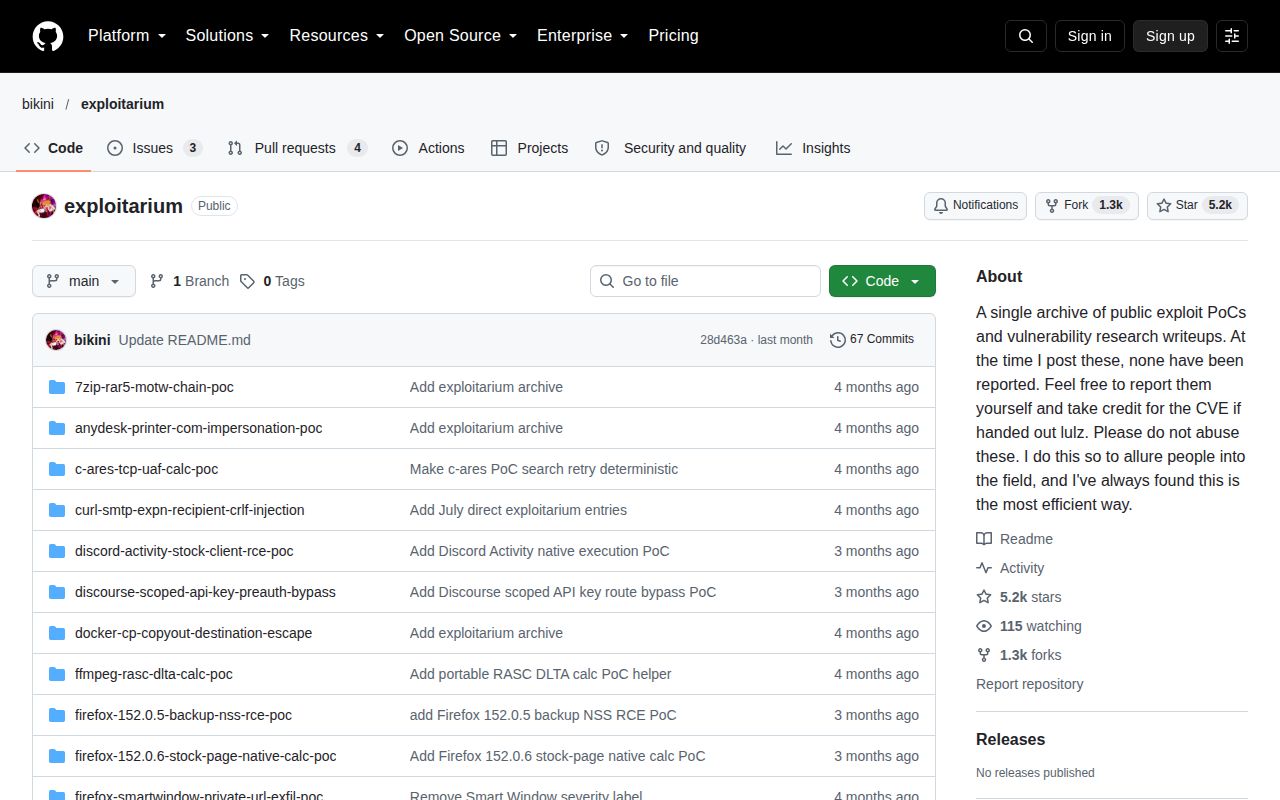
Exploitarium collects public proof-of-concept code and vulnerability writeups that previously lived across separate repositories or arrived as direct entries. Its value is concentration: instead of hunting through scattered projects, a researcher gets one index spanning desktop software, servers, libraries, browsers, developer tools, and infrastructure. With 4,384 GitHub stars, it has attracted serious attention, but the repository's own opening statement says it was incomplete when published. That warning should shape expectations more than the star count.
This is also a personal research archive with unusually candid provenance. The author says GPT-5.3 automated the fuzzing workflow under human oversight, while the proof-of-concept code was hand-typed except for AI assistance on RustDesk. The README formatting was AI-generated and reviewed for accuracy. That disclosure is useful because it separates workflow automation, documentation, and exploit implementation instead of presenting them as one indistinct process.
What happened when we ran it
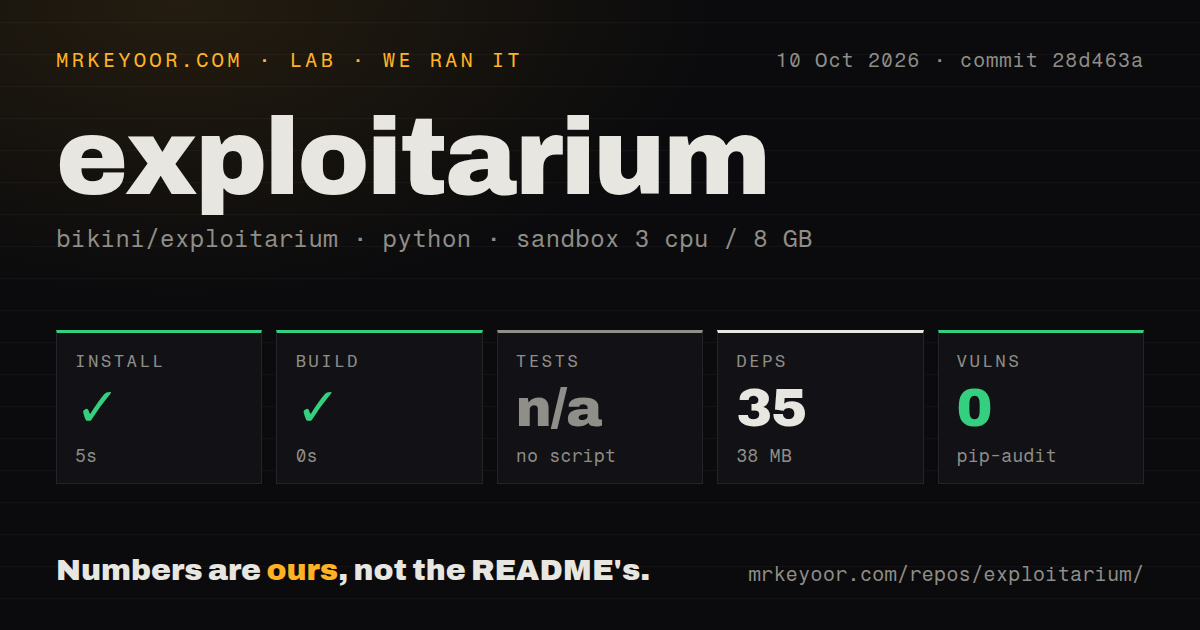
Our run used commit cdcbe77 in an unprivileged Debian container with 3 CPUs, 8 GB of RAM, no secrets, and Python 3.12. The measured project was ./anydesk-printer-com-impersonation-poc/, not every folder in the archive. Installation succeeded in 17 seconds, pulled in 35 packages, and occupied 37 MB on disk. That is a reasonable first-run result for the selected subproject, but it cannot establish that the many unrelated PoCs share the same setup experience.
The build also succeeded, taking 10 seconds. There was no test script or test target, so the test phase was skipped. That wording matters: zero executed tests is not a passing test suite, and there is no automated evidence here that the PoC behaves correctly across supported environments. A successful build tells us the selected code could be prepared in our container, nothing more.
We counted 356 files and about 17,509 lines of source in the checkout, which was 2.9 MB. A dependency audit reported 0 known vulnerabilities among the installed Python packages. The repository had 0 CI workflow files, no Dockerfile, and no tests directory. Those measurements make local inspection manageable, but they also leave reproduction discipline largely to each reader.
The strongest feature is traceable consolidation
The consolidation notes are better than a casual file dump. For 12 former standalone repositories and 96 tracked entries, the author says fresh clones were compared by relative path, Git object type, tree mode, and blob ID, with zero mismatches. Blob-level comparison is a concrete preservation check, including executable bits, and gives researchers a defensible reason to trust that copied tracked files retained their original bytes.
The coverage is broad and specific. Entries name targets such as 7-Zip, Docker, Ghidra 12.1.2, ImageMagick, libssh2, Nextcloud, OpenSSH, PostgreSQL, QEMU, Redis, RustDesk, and VLC. Direct additions dated from June 23 through July 15, 2026 show that the archive was being expanded in concentrated bursts rather than merely preserving old material. Clear folder names also make it easier to locate the likely target and vulnerability class before opening potentially dangerous code.
Missing project machinery creates real friction
The biggest practical weakness is that the repository looks like one Python project in summary data but behaves as a collection of independent experiments. Our successful 17-second install applies to the AnyDesk folder only. Other entries target C libraries, browsers, Windows components, network services, and virtualization software, so readers should expect different compilers, operating systems, vulnerable versions, and containment needs. The top-level README supplies an inventory, not a shared launcher or common environment.
There is no listed release, no CI configuration, no test directory, and no test target in our measured path. More seriously, the license is unknown. Public visibility does not automatically grant permission to copy, modify, or redistribute code, so organizations with compliance requirements should stop and resolve that question before reuse. The 7 open issues may be manageable, but the supplied data does not show response times or whether reports are being resolved.
Documentation quality is uneven by design. The index, source hashes, dates, and consolidation method are genuinely useful, while the author openly says the repository was incomplete. Individual folders preserve original README files or contain direct-entry notes, meaning instructions can vary with each target. Researchers should verify prerequisites and affected versions inside the relevant folder rather than assuming the top-level description covers all 356 files.
Activity is recent, but release health is unproven
The last push was July 15, 2026, roughly 7 weeks before our September 4 review, so calling the project abandoned would be unfair. Its 4,384 stars indicate reach, and only 7 open issues is not an alarming queue by itself. Still, stars measure attention, not maintenance quality, and the available evidence says nothing about issue replies, fixes, or contributor depth.
With 0 listed releases, there is no release cadence to evaluate and no stable version boundary for downstream users. That is less damaging for a research archive than for a library, because folders and commits can serve as references. Even so, teams need to pin commit cdcbe77 or another reviewed revision if they want repeatable internal analysis.
It belongs in an isolated research workflow
In a real security stack, Exploitarium fits after discovery and before remediation validation. A team might use an advisory or asset inventory to identify a suspected exposure, inspect one matching folder, reproduce it in a disposable lab, and then confirm a vendor patch or mitigation. It should not run on production hosts, sit in a deployment pipeline, or be imported wholesale as a 37 MB dependency set.
The right operating model is folder-by-folder review with network isolation, snapshots, disposable targets, and explicit authorization. The clean dependency-audit result of 0 known package vulnerabilities is welcome, but it does not make exploit code safe, prove the findings, or cover native tools and target applications. For experienced researchers, this is a useful and unusually transparent archive. For general development teams, established databases and maintained testing frameworks will be easier to govern.