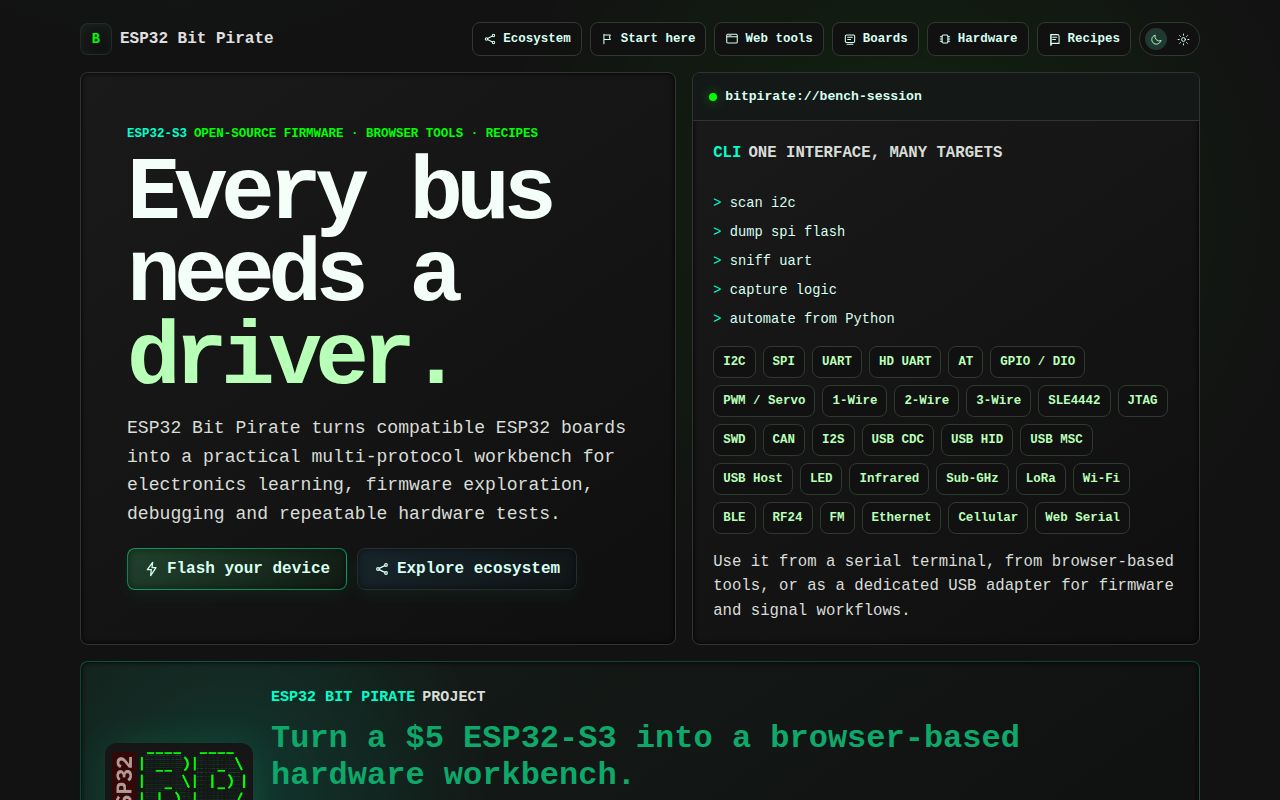
For years, the Dangerous Prototypes Bus Pirate was the go-to pocket tool for anyone needing to poke and prod at unfamiliar electronics. It was a simple, effective bridge between your computer and the I2C, SPI, and UART buses that make the world of embedded systems tick. But time moves on, and the ESP32 Bit Pirate has arrived not just as a successor, but as a complete reimagining of what a modern hardware multi-tool should be. By taking the original concept and porting it to the powerful, Wi-Fi-enabled ESP32-S3 microcontroller, this project delivers a tool that is an order of magnitude more capable than its ancestor.
The Swiss Army Knife Reborn
The core value of the ESP32 Bit Pirate is its sheer breadth of functionality packed into a tiny, affordable package. You take a common, off-the-shelf development board like an M5 Stick or a LILYGO T-Display, often costing less than $20, flash it with the Bit Pirate firmware via a simple web interface, and you instantly have a device that can replace a box full of specialized tools. It's a logic probe, a protocol sniffer, a JTAG debugger, a Wi-Fi analyzer, a Sub-GHz radio, an RFID cloner, and an infrared remote, all rolled into one.
The user experience is a standout feature. While you can still plug in via USB and use a classic serial terminal, the ability to connect to the command-line interface over Wi-Fi is a real step up. You can place the device next to your target system and interact with it wirelessly from your laptop, free from cable clutter. This, combined with the slick web-based tools the project provides, makes it exceptionally accessible.
An Arsenal of Protocols
Where the ESP32 Bit Pirate truly distinguishes itself is its jaw-droppingly long list of supported protocols. It covers all the wired classics you'd expect: I2C with device scanning and EEPROM dumping; SPI with tools for flash chips and SD cards; and UART with baudrate auto-detection. It also adds support for more niche interfaces like 1-Wire, CAN bus for automotive hacking, and even I2S for tinkering with audio.
But the wireless capabilities are the main event. The firmware uses the ESP32's native Wi-Fi and Bluetooth radios to provide sniffing, scanning, and even attack tools like Wi-Fi deauthentication. It goes further by supporting a vast array of radio modules, enabling it to operate as a Sub-GHz analyzer for key fobs and garage doors, an RFID/NFC reader and cloner, and an nRF24 transceiver. The inclusion of an infrared transmitter and receiver, complete with a universal remote function capable of emulating over 80 protocols, is the cherry on top. This isn't just a debugging tool; it's a full-fledged radio exploration platform.
The User Experience: Surprisingly Polished
Getting started is frictionless. The project's website hosts a web flasher that handles the entire installation process from your browser. There's no complex toolchain setup or command-line flashing procedure; you just select your board, click a button, and you're done in under a minute. This is how all embedded projects should be.
Once running, the CLI is intuitive, with clear modes for each protocol and helpful commands. The built-in "Pirate assistant" provides guidance, and for more complex tasks, you can use Bus Pirate-style bytecode or Python for scripting and automation. The onboard LittleFS filesystem, accessible over HTTP, makes it easy to save sniffed data, scripts, or configuration files. These thoughtful additions elevate the Bit Pirate from a simple interactive probe to a serious analysis and development tool.
Rough Edges and Limitations
For all its strengths, the ESP32 Bit Pirate is not a replacement for professional, calibrated lab equipment. It's a jack-of-all-trades, and master of none. It can't compete with the sample rates or software polish of a dedicated logic analyzer like a Saleae. While it can sniff Wi-Fi, it won't replace a specialized Wi-Fi Pineapple for serious penetration testing.
Furthermore, the project's ambition is also its potential weakness. With dozens of supported protocols and hardware configurations, it's inevitable that some features will be more mature and stable than others. The core wired protocols are likely rock-solid, but a more obscure feature on a less common board might have bugs. Finally, your experience is tied to the hardware you choose. A tiny board like the M5 AtomS3 is incredibly portable but offers few GPIO pins, limiting which protocols you can use. You need to choose your hardware carefully based on your intended use case.
Despite these minor caveats, the ESP32 Bit Pirate is a phenomenal project. It provides an incredible amount of power to hobbyists, students, and professionals at an unbeatable price point. It's the perfect first tool to buy when diving into hardware hacking and a wonderfully convenient field tool for seasoned experts. It has earned a permanent place in our toolkit.