mrkeyoor.com_
Tue 01 Sept 17:43 UTC
Dataevaluationupdated 25 Aug 2026

elasticsearch review

Elasticsearch is a distributed engine for full-text search, vector search, logs, metrics, and analytics over indexed documents. It solves the hard parts of finding relevant records quickly across data that is too large or too busy for a single database query path.

+20stars / 7d
Verdict

Our 405.6 MB Elasticsearch checkout built its native Parquet Rust subproject in 68 seconds, but that result does not validate the Java server or a production cluster. Choose Elasticsearch when search relevance, vector retrieval, and operational analytics justify a dedicated stateful system with experienced owners. For a small catalog or a team without cluster skills, Typesense, Meilisearch, or database-native search will cost less attention.

We ran it

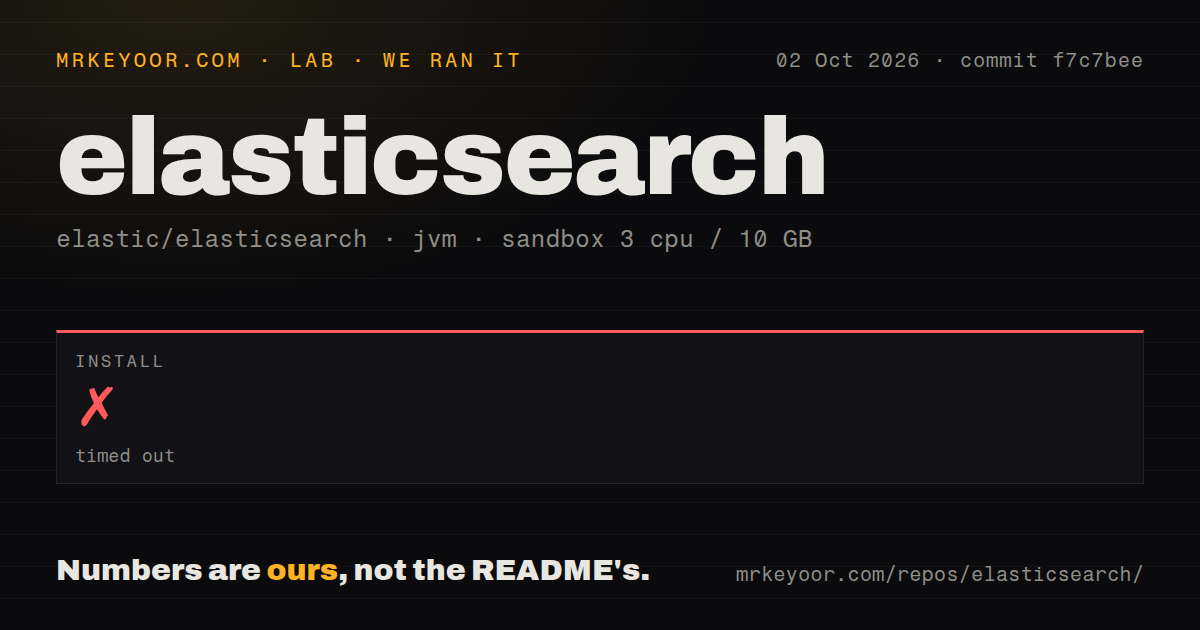
Lab card: what happened when we ran elasticsearchScreenshot of elasticsearch (www.elastic.co/products/elasticsearch)
Install✓ · 8s80 packages
Build✓ · 68s
Tests✓ · 15s0 passed · 0 failed of 0 (cargo test)
Repo38024 files~5,773,807 lines of source · 405.6 MB · 7 CI workflows · tests dir

Answers from our run

Does elasticsearch build from source?

Dependencies installed in 8 seconds (80 packages), and the build succeeded in 68 seconds. We cloned commit 776c434 into a clean Debian container with 3 CPUs and no project-specific setup.

Do elasticsearch's tests pass?

Yes: 0 of 0 passed when we ran the project's own test command (cargo test). Some failures need services or credentials a bare container does not have.

Who should not use elasticsearch?

Small applications that only need prefix search over a modest catalog: Elasticsearch brings cluster state, mappings, shards, and JVM operations that a database extension or smaller search server can avoid.

What are the alternatives to elasticsearch?

OpenSearch, Typesense, Meilisearch. Our 405.

Setup3/5Quick local script, demanding production cluster operation
Docs5/5Clear local path plus extensive product and API references
Community5/5Recent push, current release, and busy issue and PR activity
Maturity5/5Long-lived engine with production deployment choices

Discussed on

  1. hnElasticsearch is open source, again759 points
  2. hnOfficial Elasticsearch Python library no longer works with open-source forks294 points
  3. hnElasticsearch 6.0.0 GA released192 points
  4. hnElasticsearch as a Time Series Data Store126 points
  5. hnElasticsearch node crashes can cause data loss112 points

Who it’s for

Product teams that need mature full-text search with filters, ranking, and language analysis.
Operations and security teams storing logs, metrics, or event streams for interactive investigation.
AI teams that want vector and hybrid retrieval in the same system as keyword search.
Organizations willing to operate a stateful cluster or pay Elastic to operate one.

Who it’s NOT for

Small applications that only need prefix search over a modest catalog: Elasticsearch brings cluster state, mappings, shards, and JVM operations that a database extension or smaller search server can avoid.
Teams expecting every feature in the local trial to remain free: the README says the one-month trial enables all features, then reverts to the Basic license.
Operators who need the README's local command to be a production recipe: Elastic explicitly warns that the script disables HTTPS, uses Basic authentication, and binds services only to localhost.
Contributors looking for a quick source build on limited hardware: the checkout we measured contained 38,024 files and about 5.77 million source lines, while the documented distribution build uses Gradle and was outside our measured native subproject.

Setup reality

In our sandbox, the measured target was the Rust project at libs/parquet-rs/native/, not an Elasticsearch server distribution. The 405.6 MB checkout contained 38,024 files and about 5,773,807 source lines. Its install completed in 8 seconds with 80 packages, the build in 68 seconds, and cargo test finished in 15 seconds with 0 tests discovered.

The README's user path is different: Docker plus Elastic's start-local script launches Elasticsearch and Kibana, creates a password and API key, and exposes ports 9200 and 5601. That one-month trial turns into the Basic tier afterward. Production needs TLS, durable storage, memory sizing, backups, shard planning, and authentication beyond the localhost-only development setup.

Source contributors use Gradle to assemble an operating-system distribution. The repository had 7 CI workflow files and a tests directory, but no root Dockerfile in our checkout. Those signals describe a very large development tree; they do not turn the narrow Rust result into proof that the Java server or a multi-node cluster passed.

Elasticsearch earns its cost when search is a product feature

Elasticsearch is a distributed document index built for queries that ordinary relational indexes handle awkwardly: relevance-ranked text, language analysis, faceting, vectors, geospatial data, and time-based events. Applications send JSON documents through REST APIs, then query an index rather than scanning the source database. The same engine can support a customer-facing search box, retrieval for an AI application, or investigation of operational records. That range is useful, but it also means the default mental model is a service with its own data layout, not a library added to an application process.

The repository was pushed on August 25, 2026, and release v9.5.2 followed on August 20. GitHub reported 5,953 open issues and pull requests together, a large queue that matches the project's size rather than a clean defect count. Fresh pull requests covered memory estimates, shard allocation, ES|QL, OpenTelemetry logs, and indexing behavior within the same hour we checked. Elasticsearch is plainly active. Buyers should still read the release notes for their chosen line, because an active engine changes more often than a quiet embedded dependency.

The local script is a trial, not a deployment plan

Elastic's shortest start uses Docker and a downloaded start-local script. It creates a directory, launches Elasticsearch on port 9200 and Kibana on port 5601, then stores a generated password and API key in an .env file. That is enough to index a document, run a match query, and inspect results in Kibana. The README is unusually blunt about the boundary: HTTPS is disabled, Basic authentication is used, and both services are restricted to localhost.

The bundled trial exposes all Elastic features for 1 month before reverting to the free Basic tier. That detail belongs in an architecture decision, not in procurement cleanup after an application is built. Check which security, machine learning, alerting, and management functions your design depends on. A local demonstration can make the whole stack look like two ports and one command, while a real deployment also needs storage durability, memory limits, certificates, access policy, snapshots, upgrades, and a failure plan for stateful nodes.

Search quality comes with data-model decisions

Elasticsearch can automatically create an index when the first document arrives, but serious search work starts with explicit mappings and analyzers. Field types affect how values are stored and queried. Tokenization affects whether names, identifiers, and phrases match the way users expect. Shard counts affect recovery and operating overhead. Bulk ingestion must use newline-delimited JSON, including a final newline, which is a small detail that regularly distinguishes a working importer from a confusing request error.

The API covers full-text and vector search alongside logs, metrics, and application monitoring. That makes Elasticsearch attractive when a team wants hybrid retrieval without maintaining separate lexical and vector systems. It does not remove evaluation work. Relevance depends on your documents, query mix, filters, and judgment set. None of our lab numbers is a search benchmark, so this review makes no claim about query latency, indexing throughput, or cluster capacity. Test those with representative data before deciding node counts.

What happened when we ran it

Our sandbox cloned commit 776c434 into a 405.6 MB checkout containing 38,024 files and about 5,773,807 lines of source. The harness selected the Rust project under libs/parquet-rs/native/. Installation succeeded in 8 seconds and installed 80 packages. Its build succeeded in 68 seconds. The test command completed in 15 seconds, reporting 0 passed and 0 failed because no tests were discovered by that cargo invocation.

That is a clean result for the measured native component, with an important limit: we did not build the Gradle-based Elasticsearch distribution or start a server. The repository exposed 7 CI workflow files, a tests directory, and no root Dockerfile to our scanner. Treat the run as evidence that this pinned Rust subproject resolved and compiled in a fresh unprivileged container. It says nothing about a Java distribution, Kibana, security configuration, multi-node behavior, or production search performance.

Licensing needs a feature-level check

GitHub did not return one SPDX license identifier for the repository. Elastic's README describes the local trial as converting to Free and open Basic, while the repository and product have a licensing history that cannot be reduced to a generic open-source checkbox. Organizations with redistribution, managed-service, or paid-feature concerns should review Elastic's current license files and subscription matrix with counsel. OpenSearch is the clearer candidate when Apache 2.0 terms are non-negotiable.

For teams comfortable with Elastic's terms, the documentation is strong. The README separates a local experiment, REST calls, language clients, source builds, and learning resources. It also points to executable notebooks for vector, hybrid, and generative-AI use cases. Source contributors face a different path from application developers: Gradle assembles platform distributions, while product users can choose downloads, containers, or Elastic Cloud. Mixing those paths produces misleading estimates, as our narrow 68-second native build illustrates.

Pick Elasticsearch for depth, not convenience alone

Elasticsearch is the safest choice among these alternatives when sophisticated relevance, mixed query types, and a large operations ecosystem matter more than a small footprint. OpenSearch is the close architectural comparison. Typesense and Meilisearch are easier fits for focused site or product search. A relational full-text extension may be enough when data volume is modest and search is secondary.

The deciding question is ownership. Someone must understand mappings, query behavior, access control, backups, and upgrades after the first successful request to port 9200. If that responsibility already exists, Elasticsearch gives the team a deep search and analytics system with active maintenance. If nobody wants that job, the quick-start script is showing a demo, not the future operating cost.

Alternatives

ProjectWhat it isPick it when
OpenSearchA community search and analytics engine descended from Elasticsearch 7.10.2.pick this instead when Apache 2.0 licensing and the OpenSearch ecosystem are firm requirements.
Typesense gh↗A search server centered on typo-tolerant product and site search with a smaller operating surface.pick this instead when you want fast application search without Elasticsearch's wider analytics stack.
Meilisearch gh↗A developer-friendly search engine aimed at responsive search experiences and simple defaults.pick this instead when ease of integration matters more than deep query and cluster controls.

What people are saying

  1. [velocity-scout] elastic/elasticsearch

Sources

  1. Elasticsearch README
  2. Elasticsearch 9.5.2 release
  3. Elasticsearch issue and pull-request activity
  4. Elasticsearch licensing

More data reviews

turso · TrackersListCollection · dash · getcontact-cli · awesome-zhuiju-free · iggy · the whole board →