mrkeyoor.com_
Thu 10 Sept 16:48 UTC
Dev Toolsevaluationupdated 10 Sept 2026

eigenwise-toolshed review

Eigenwise Toolshed is a marketplace of six independent Claude Code plugins for repository maps, conditional rules, tracked parallel work, extra subscription models, local usage records, and guided setup. It is meant to stop each new coding session from rediscovering the project or rebuilding the same operating habits.

trackingstars / 7d
Verdict

Our Node 22 run installed Model Gateway's 6 packages in 26 seconds and used 3 MB, but 5 of 281 tests failed, so Toolshed deserves a plugin-by-plugin trial instead of blanket adoption. Codebase Mapper and Live Rules solve narrow problems with understandable files, while Sidequest and Model Gateway reach much further into work ownership and process routing. Install only the pieces whose state changes and privacy boundaries you are prepared to review.

We ran it

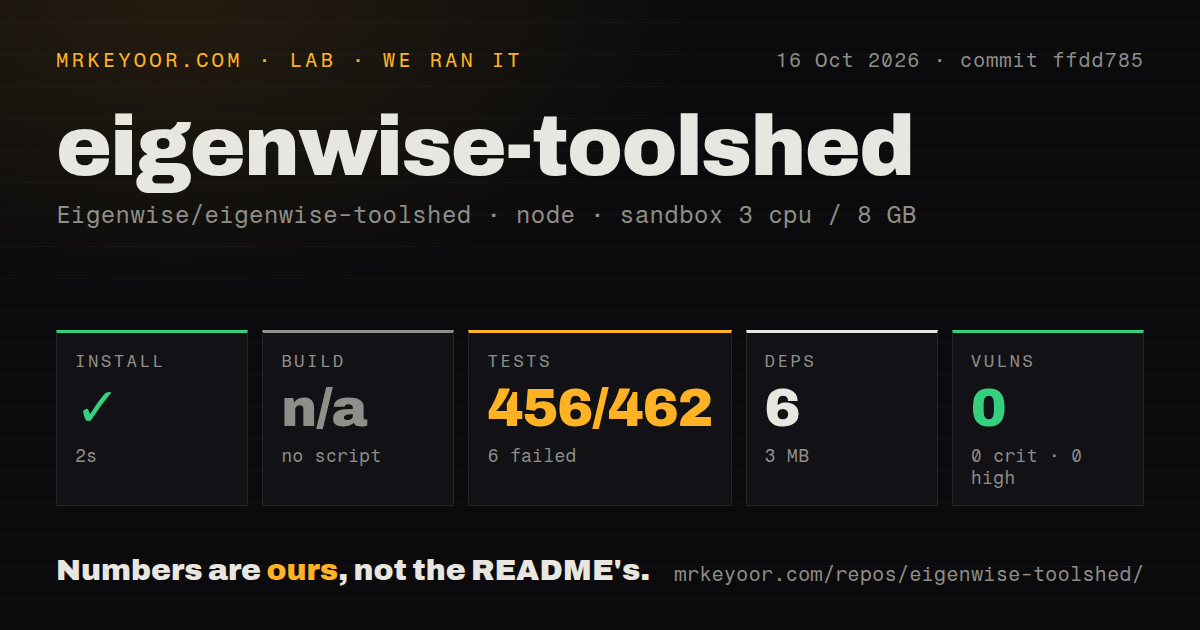
Lab card: what happened when we ran eigenwise-toolshedScreenshot of eigenwise-toolshed (eigenwise.io)
Install✓ · 26s6 packages · 3 MB
Buildn/ano build script
Tests✗ · 198s276 passed · 5 failed of 281 (node:test)
Known vulns00 critical · 0 high · 0 moderate · 0 low (npm audit)
Repo855 files~192,378 lines of source · 14.4 MB · 4 CI workflows · tests dir

Answers from our run

Does eigenwise-toolshed build from source?

Dependencies installed in 26 seconds (6 packages), and the project has no separate build step. We cloned commit c6ce202 into a clean Debian container with 3 CPUs and no project-specific setup.

Do eigenwise-toolshed's tests pass?

Not all of them: 276 of 281 passed and 5 failed when we ran the project's own test command (node:test). Some failures need services or credentials a bare container does not have.

Does eigenwise-toolshed have known vulnerabilities in its dependencies?

npm audit found none in the dependency tree at the time of our run.

Who should not use eigenwise-toolshed?

Users of coding agents other than Claude Code: the README says these plugins depend on Claude Code's marketplace, scopes, hooks, and reload commands.

What are the alternatives to eigenwise-toolshed?

Claude Code, Superpowers, Agents. Our Node 22 run installed Model Gateway's 6 packages in 26 seconds and used 3 MB, but 5 of 281 tests failed, so Toolshed deserves a plugin-by-plugin trial instead of blanket adoption.

Setup3/5Small install, but reloads, restarts, and provider wiring add work
Docs5/5Each plugin documents scope, state, recovery, and known limits
Community2/5124 stars and 5 current issues and pull requests
Maturity3/5Fast releases and deep tests coexist with open Sidequest failures

Who it’s for

Claude Code users who want project knowledge and conditional instructions stored with a repository.
Teams coordinating agent work through owned tickets, worktrees, verification, and review.
Developers who want supported ChatGPT, Codex, or Grok subscription models in Claude Code's model picker.
Operators willing to inspect local telemetry, plugin scope, settings changes, and restart boundaries.

Who it’s NOT for

Users of coding agents other than Claude Code: the README says these plugins depend on Claude Code's marketplace, scopes, hooks, and reload commands.
Privacy-sensitive teams relying on Observability's per-repository opt-in as a hard boundary: its README says events can enter the shared spool before that check.
Teams that need Sidequest remote delivery to be settled today: issue 51 reports reconciliation against a stale local branch, and issue 49 reports a dispatch call that armed a ticket but never returned.
Managed desktop users whose host forces ANTHROPIC_BASE_URL: Model Gateway says project or user settings cannot be guaranteed to override it on Windows or macOS.
Developers who expect installation to take effect in an open session: several workflows require plugin reloads, and model discovery or environment changes require a full Claude Code restart.

Setup reality

Our Node 22 sandbox installed the Model Gateway project in 26 seconds: 6 packages and 3 MB on disk. There was no build script, so that step was skipped. Tests failed after 198 seconds, with 276 passing and 5 failing out of 281. Npm audit found 0 known vulnerabilities.

Toolshed itself is installed through Claude Code's plugin marketplace. Model Gateway needs the relevant subscription login and a local proxy process; Observability can add Docker, Grafana, or a remote sink; the other plugins write local or project files according to the chosen scope.

Reloading plugins is enough for some changes. Model Gateway picker rows, settings, and environment wiring can require a new Claude Code process. The repository has 4 CI workflows and a tests directory, but no Dockerfile; the tested checkout contained 855 files, about 192,378 source lines, and occupied 14.4 MB.

Six plugins address six recurring Claude Code jobs

Toolshed packages six plugins that can be installed separately. Codebase Mapper writes a project map; Live Rules stores conditional instructions; Sidequest supplies a local work board; Model Gateway routes selected subscription models; Observability records usage metadata; Quartermaster recommends and checks the other pieces. A team can add one behavior without accepting every local service, hook, or settings edit in the repository.

Codebase Mapper and Live Rules are the easiest pair to inspect. The mapper writes under .claude/.codebase-info/ and may commit its updates unless the user prohibits commits. Live Rules keeps one Markdown file per rule under .claude/live-rules/ and generates a manifest. Both leave CLAUDE.md alone. Review those generated files because stale maps and broad rules become instructions for later sessions.

Sidequest has a local handoff model and current dispatch defects

Sidequest gives Claude a backlog with dependencies, claims, routes, verification, review, and integration. A code change hands back a candidate revision; other work can return a verified project snapshot. That is more precise than asking several agents to edit the same checkout. Its dashboard and ticket database stay local.

Issue 49 reports Sidequest 5.1.1 arming a routed ticket, then hanging until the host backgrounds the call at 120 seconds without returning the launch token. The held write lock also blocked the board. Issue 51 describes remote delivery staying pending when a candidate reached origin/develop but local develop was stale. The reports concern core dispatch and delivery paths, though they do not prove every installation fails.

Model Gateway adds subscription models through a local proxy

Model Gateway requires Claude Code 2.1.129 or newer for gateway rows in /model. It keeps Claude models on Anthropic and sends selected gateway identifiers through supported ChatGPT, Codex, or Grok subscriptions. Setup checks login, starts the gateway, edits project settings, and verifies wiring. A process-level ANTHROPIC_BASE_URL takes precedence and can make project settings ineffective.

The plugin maintains a shim supervisor, proxy discovery, recovery records, model-window aliases, and route metadata. SessionStart waits up to 12 seconds inside a 30-second hook budget, while model-picker discovery requires a full process restart. The README says route logs omit prompts, bodies, tools, credentials, and arbitrary headers. Administrators still need a retention policy for the local JSONL records.

Observability does not enforce opt-in at ingestion

Observability says hook events can reach its shared spool and ingest path before it verifies that the repository opted in. Teams handling sensitive repositories should stop there until the boundary matches the policy. Records are designed to hold identifiers and usage metadata without prompt text, response text, code, file contents, tool arguments, credentials, or environment values. That narrower record does not repair the opt-in gap.

The observer keeps a 128 MiB writable reserve below a 4 GiB database limit and normally retains 30 days. Under pressure it can remove older whole days sooner. A local dashboard usually listens on 127.0.0.1:3000; remote sinks are optional. Cost panels use API list-price equivalents, while unpriced models remain visible as token counts without a made-up dollar total.

What happened when we ran it

Our sandbox tested plugins/model-gateway/ at commit c6ce202. Npm installed 6 packages in 26 seconds and used 3 MB on disk. There was no build script or target, so the build step was skipped. Npm audit reported 0 known vulnerabilities. This covers Model Gateway's repository mechanics, not subscription login, model selection, Sidequest dispatch, or Observability services.

The test command returned exit code 1 after 198 seconds. Node reported 276 passed and 5 failed out of 281. The supplied log tail does not show the five failures; its final lines mark compatibility migration and SessionStart cases ok, including SQ-1901. We will not guess what failed. The checkout had 855 files, roughly 192,378 source lines, 4 CI workflows, a tests directory, and no Dockerfile.

Quartermaster asks before changing a workspace

Quartermaster inspects a project and bounded summaries of recent Claude Code sessions, then suggests one setup or maintenance change at a time. Its README says installs, file edits, and settings changes wait for approval. The mining script uses clipped prompts, path segments, counts, and short correction evidence instead of loading raw transcripts into model context. Its default command looks back 30 days and considers up to 40 sessions.

After approved installs and file writes, Quartermaster stops for a plugin reload or Claude Code restart before verification continues. Updates follow the recorded user, project, or local scope, even if the request starts in another project. Read the proposed targets before approving an updater run.

September 10 activity comes with five open items

GitHub recorded a push on September 10, 2026, the day release v3.541.0 was published. The repository had 124 stars and 5 open issues and pull requests when fetched. Four open reports shown by GitHub concerned Sidequest dispatch, review, or delivery. Frequent releases indicate active maintenance, but an open Claude Code process can lag installed files until plugins reload or the process restarts.

Toolshed is best treated as six separate decisions. Codebase Mapper and Live Rules leave inspectable artifacts. Sidequest owns workflow state, Model Gateway owns a local routing path, and Observability has an acknowledged privacy gap. The failed 281-test run makes a local check part of adoption. Start with one plugin and keep it only if the recovered time exceeds the extra operational work.

Alternatives

ProjectWhat it isPick it when
Claude Code gh↗The official coding agent with native hooks, skills, subagents, and plugin support.pick this alone when built-in project instructions and agents cover the job without a third-party plugin suite.
Superpowers gh↗A skills-based development workflow for planning, implementation, and review.pick this instead when disciplined coding workflows matter more than model routing, telemetry, or a ticket board.
Agents gh↗A plugin marketplace spanning Claude Code and several other coding-agent hosts.pick this instead when a large catalog and support beyond Claude Code matter more than Toolshed's integrated local workflow.

What people are saying

  1. [github-trending] Eigenwise/eigenwise-toolshed

Sources

  1. Eigenwise Toolshed README
  2. Model Gateway README
  3. Sidequest README
  4. Observability README
  5. Sidequest dispatch hang issue 49
  6. Sidequest remote delivery issue 51
  7. Eigenwise Toolshed v3.541.0 release

More dev tools reviews

unleashed-firmware · elixir · metasploit-framework · migrate · ast-grep · ai-usagebar · the whole board →