1 replay tree changes the cost of policy experiments
Dream-RSI's useful idea is smaller and more concrete than the name suggests. A coding agent explores candidate programs, an evaluator records what happened, and the resulting decisions form a tree. The method then treats that finished tree as a replay environment. Another exploration policy can choose different recorded branches, change their order, group work differently, or stop earlier without asking the coding agent and evaluator to repeat those completed attempts. The object being improved is the exploration controller, while the underlying coding agent stays unchanged.
The paper organizes that loop into 3 stages. An online policy first drives discovery and logs a structured history. Dream-RSI converts accumulated trees into a simulator pool, then generates and evaluates candidate exploration policies inside that pool. A selected policy returns to online discovery, adding more history for a later round. This division is the paper's strongest design choice because it makes branching, concurrency, and stopping explicit. Readers can judge the exploration strategy separately from whatever model proposes the actual code.
Replay cannot score a branch that history never visited
The simulator uses realized code-execution outcomes already stored in a discovery tree. That makes policy comparison cheap in the paper's terms, but it also bounds what replay can reveal. A candidate policy can traverse recorded choices in a new way; it cannot know the outcome of an action absent from the tree. The paper's loop partly addresses that boundary by redeploying improved policies online and collecting fresh trees. Still, the quality and variety of the initial history influence what the offline policy search can learn. This is experience reuse, not a general model of every possible program.
The authors evaluate the framework across 8 tasks in 3 domains: algorithm engineering, mathematical optimization, and GPU kernel engineering. The paper reports improvements or lower discovery cost in several settings and supplies detailed prompts in its appendix. Those are paper claims, not results from MrKeyoor's lab. The repository currently provides no implementation or reproduction scripts with which to check them. For a prospective adopter, the most important result is therefore unavailable: whether the published method can be rebuilt outside the authors' internal environment with the same task machinery.
What happened when we ran it
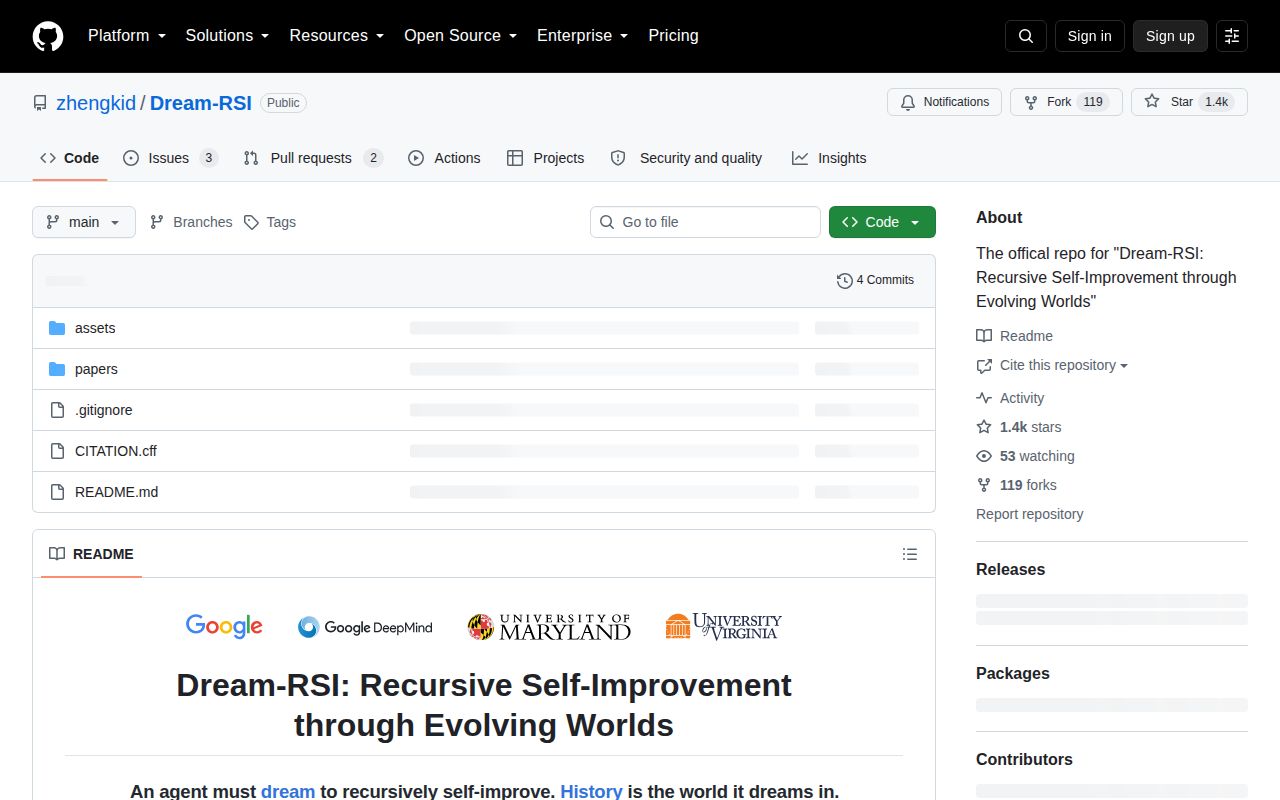
We did not run commit 4149ea9. The lab found no supported executable ecosystem and no Dockerfile, so there was no install, build, or test target to invoke in the unprivileged sandbox. That matches the README's release table, where the paper and project page are available but the discovered programs, full codebase, and reproduction scripts are marked as being prepared. Calling this a failed build would be misleading. It is a publication repository awaiting the artifacts that would turn the method into testable software.
The repository also has no detected license and no GitHub release. GitHub showed 1,350 stars, 5 open issues and pull requests, and a latest push on 2026-09-16. One open issue asks for the artifacts on Hugging Face, while a pull request proposes listing independent implementations. Another issue asks whether the fixed boundary between the base model, evaluator, and exploration policy is intended as a safety property. These are sensible questions for a young research release, but open discussion is not a substitute for runnable evidence.
The paper is readable before the code exists
The English README gives a compact account of the mechanism, links the full PDF, and distinguishes available items from work still being prepared. The paper explains the replay simulator, policy loop, task families, comparisons, and prompts. That is enough to understand or critique the idea. It is not enough to estimate deployment cost, required model credentials, storage format, evaluator interfaces, or the effort needed to plug in a new domain. Any review claiming easy setup now would be describing an imagined implementation rather than this repository.
A missing license adds another practical stop sign. GitHub reports no repository license, and the paper itself carries a copyright notice. Reading and discussing the work is straightforward; reusing repository assets or an eventual implementation needs terms that are not currently stated here. Researchers should also distinguish the README's aspiration from a commitment with a date. It says the full codebase is being prepared, but it gives no release schedule.
OpenEvolve is the runnable choice today
OpenEvolve and CodeEvolve already provide code for evolutionary program search, so they are better starting points for an experiment this week. SkyDiscover covers a wider scientific and systems-discovery workflow. AI Scientist reaches farther toward end-to-end research automation, which makes it less direct as a comparison but more suitable when paper production is part of the task. Dream-RSI remains the one to read when the question is how to improve an exploration policy from stored discovery histories. The decision can change after a code release; at 4149ea9, there is nothing here to install.