One logged-in cookie reaches both collection and account actions
DouYin Spider covers far more than downloading clips. Its Python modules read profiles, posts, comments, follower lists, recommendations, favorites, notifications, and search results. WebSocket paths listen to live-room events and private messages. The same codebase can send direct messages, publish comments, like videos, move favorites, post live chat, and send live-room likes. That range calls for more caution than a read-only downloader.
The README tells you to copy a logged-in Douyin cookie into DY_COOKIES. Its sample environment file also has 4 messaging credentials: DY_TICKET, DY_TS_SIGN, DY_CLIENT_CERT, and DY_PRIVATE_KEY. Those values can represent an active account session. A test mistake can therefore affect the account rather than merely return bad data. Use a separate account, stay within platform rules and local law, and keep write methods disabled unless the work explicitly requires them.
Python 3.7 and Node 18 are listed, but the root npm step lacks a manifest
The quick start names Python 3.7 or newer and Node.js 18 or newer, followed by pip install -r requirements.txt and npm install. The current repository tree has no root package.json. The JavaScript manifest is under newsign, a directory choice the user must discover. The README also uses a Xiaohongshu cookie example while explaining Douyin configuration, a copy error in the part where precision matters most.
A Dockerfile gives another path. It uses Python 3.10 slim, adds build tools, installs requirements.txt, copies the source, exposes port 5000, and runs main.py. Yet main.py is described as a crawler entry point, not an HTTP service with a documented port. The image can package the process, but it does not resolve which script you need for collection, live monitoring, or private-message reception. Those remain 3 separate commands.
What happened when we ran it
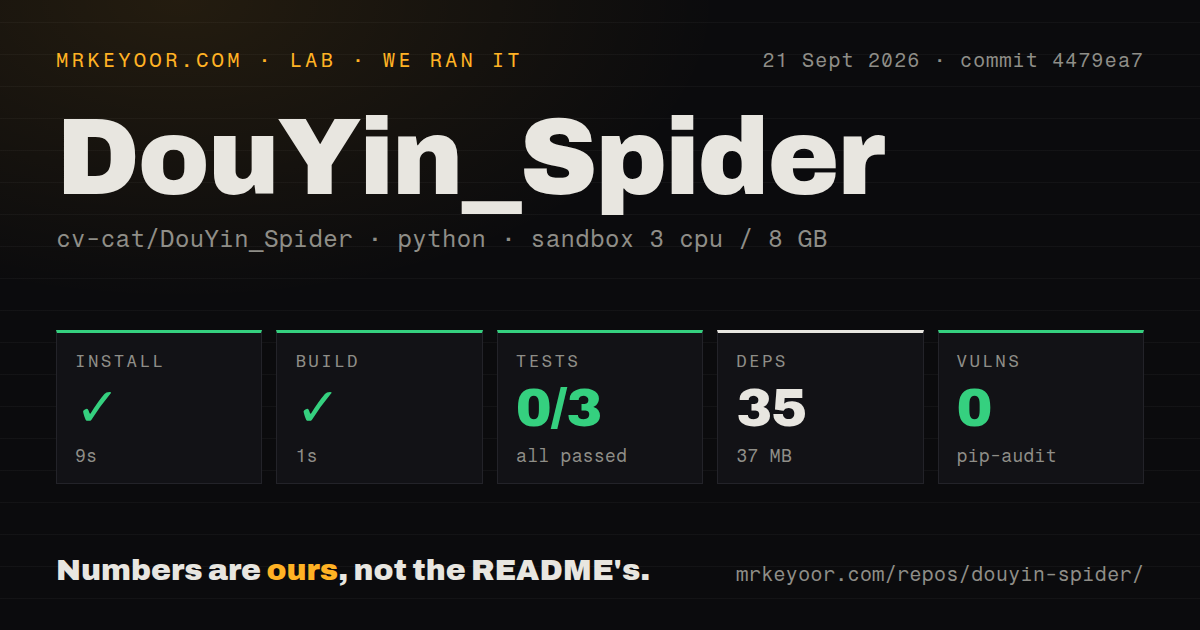
Our sandbox installed commit 4479ea7 in 9 seconds, pulling 35 packages and using 37 MB on disk. The build completed successfully in 1 second. Tests then exited with code 1 after 2 seconds. Pytest recorded 0 passed, 0 failed, and 3 collection or setup errors out of 3, so no test body ran. Pip-audit reported 0 known vulnerabilities in the installed Python environment.
All 3 errors followed the same import path. A test imported dy_apis/douyin_api.py, which imported utils/http_client.py. That module tried from curl_cffi import requests as _cffi, and Python raised ModuleNotFoundError: No module named 'curl_cffi'. The log proves the module was unavailable in our environment. It does not say why, so blaming Python 3.12, the package index, or the repository would go beyond the evidence.
The measured checkout contained 70 files, about 18,327 source lines, and 2.6 MB of repository data. It had a Dockerfile and a tests directory, but 0 CI workflow files. The 3 collected tests target live PK and ranking APIs. A clean import would still leave much of the profile, comment, download, direct-message, and account-action surface outside the measured test set.
Three collection errors expose a dependency gate before API behavior
The failed import matters because utils/http_client.py is on the path to the main API wrapper. Issue 76 describes missing runtime packages after installing requirements.txt in a fresh environment and proposes additions for login and message modules. The requirements file at measured commit 4479ea7 names curl_cffi, while our installed environment still could not import it. That mismatch needs a reproducible install check, not a guessed explanation.
A useful project gate would create a fresh environment, install the declared packages, import all 5 main entry modules named in issue 76, then collect the 3 current tests. This repository has no GitHub Actions workflow doing that in public. Until the maintainers add and pass such a check, a successful pip install is only the start of setup. The 1-second build did not catch the missing runtime import.
Sixty-eight open issues include silent data errors and account lockouts
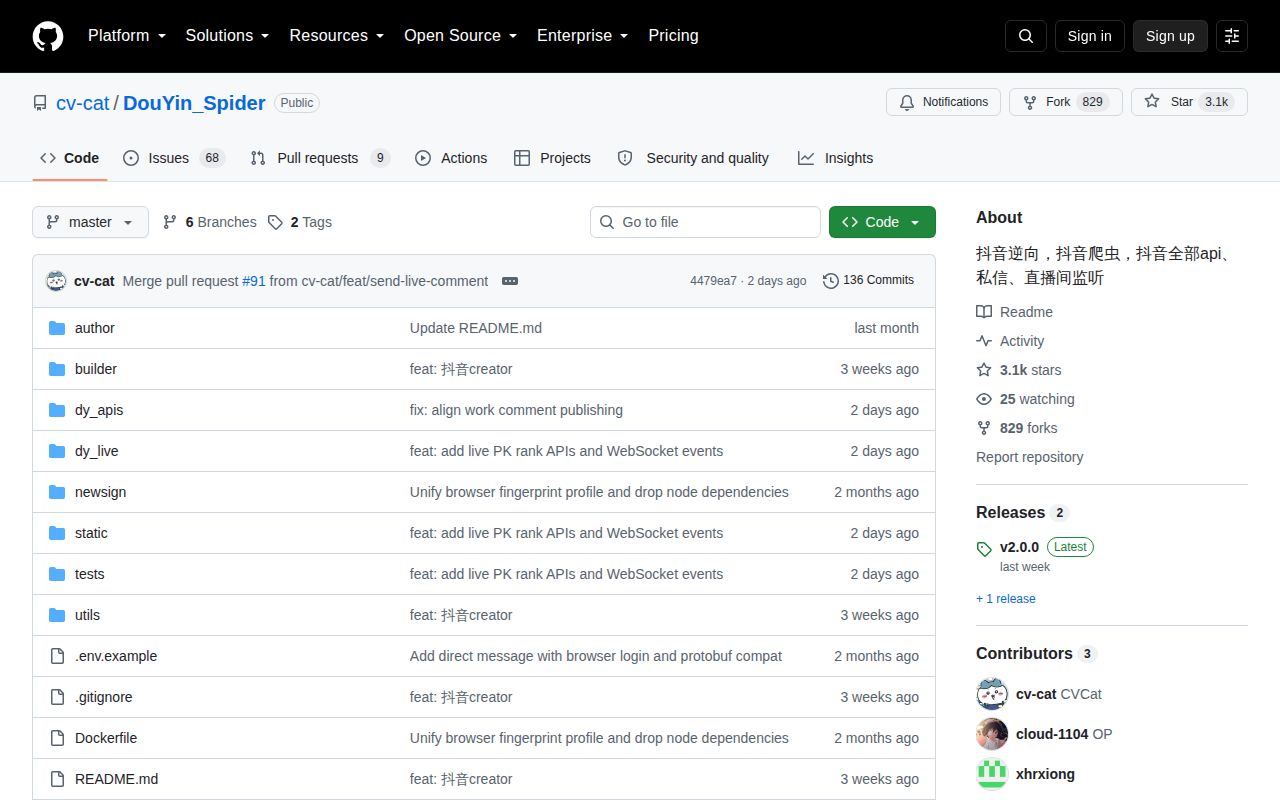
GitHub listed 3,108 stars, 829 forks, and 77 combined issues and pull requests. A separate issue-only query returned 68 open issues. The last push was September 19, 2026, six days after v2.0.0, so the project is active. Activity has not removed endpoint churn: issue 85 reports a follower request returning status 0 with an empty list, while issue 88 reports each live gift arriving twice.
Write operations carry a sharper warning. Issue 70 says like and comment calls returned HTTP 403 and forced the account to log out. Issue 75 reports a corrupt protobuf response during direct messaging followed by the browser session being removed. These are user reports, not findings from our sandbox, and they do not prove every account will be affected. They are enough to rule out casual testing on an important personal or business account.
No declared license stops the commercial evaluation
GitHub reports no license for the repository, and the tree has no LICENSE file. The README says the project is only for learning and technical research and warns against illegal or harmful use. Issue 81 is a commercial user's unanswered request for either an open-source license or explicit permission. Public source code without a license does not grant the normal rights that MIT or Apache-2.0 would spell out.
A company needs written terms before copying, modifying, distributing, or building this code into an internal service. The 35-package install and 37 MB footprint are inexpensive, but legal permission is a separate requirement. For media downloads, an MIT-licensed narrower tool is easier to assess. For a service interface, an Apache-2.0 alternative offers clearer reuse terms before technical testing starts.
The 9-second install buys a lab kit, not an unattended service
DouYin Spider can save research time because its 18,327 lines already map a large Douyin surface. The current evidence still points to a lab setting: Chinese-only documentation, session credentials, 3 test collection errors, no public CI workflow, 68 open issues, and no license. Keep account-changing calls behind an explicit switch, validate returned data instead of trusting status codes, and stop the evaluation if written permission does not cover your intended use.