Dora turns a robot into a graph of small programs
A Dora application is a YAML graph whose nodes send named outputs into other nodes' inputs. Each node can be a Rust binary, a Python script, or a program using the C or C++ API. The runtime starts those processes, connects the edges, watches their health, and can restart a failed node according to policy. That model is easy to explain to a team debugging a camera, detector, and controller on the same bench.
The implementation is substantial without being a giant checkout. Our copy held 1,237 files, about 212,023 source lines, and 13.1 MB. The workspace includes the CLI, coordinator, per-machine daemon, in-process runtime, language APIs, ROS 2 and MAVLink bridges, recording tools, telemetry, and examples. Apache Arrow is the common message representation, while Zenoh handles the data path between processes and across machines.
Version 1.0 freezes node APIs but leaves extensions flexible
The 1.0 release makes a precise promise. Its Rust, Python, C, and C++ node APIs, wire protocol, CLI commands, and dataflow YAML schema are frozen for the 1.x series. Nodes built against 1.0 are supposed to keep building and talking to later 1.x daemons. Python 3.11 is the floor for that series, and Rust users select an Arrow major through a feature flag rather than inheriting one forever.
That promise does not cover everything in the 1,237-file workspace. The operator API, Hub, ROS 2 bridge, MAVLink bridge, tensor pool, and some extension surfaces may change in a minor release. A 0.x component also cannot communicate with 1.0, so upgrading requires a full stop and coordinated replacement rather than a rolling mix of versions. The narrower promise is credible because the project spells out its edges instead of calling the entire repository stable.
What happened when we ran it
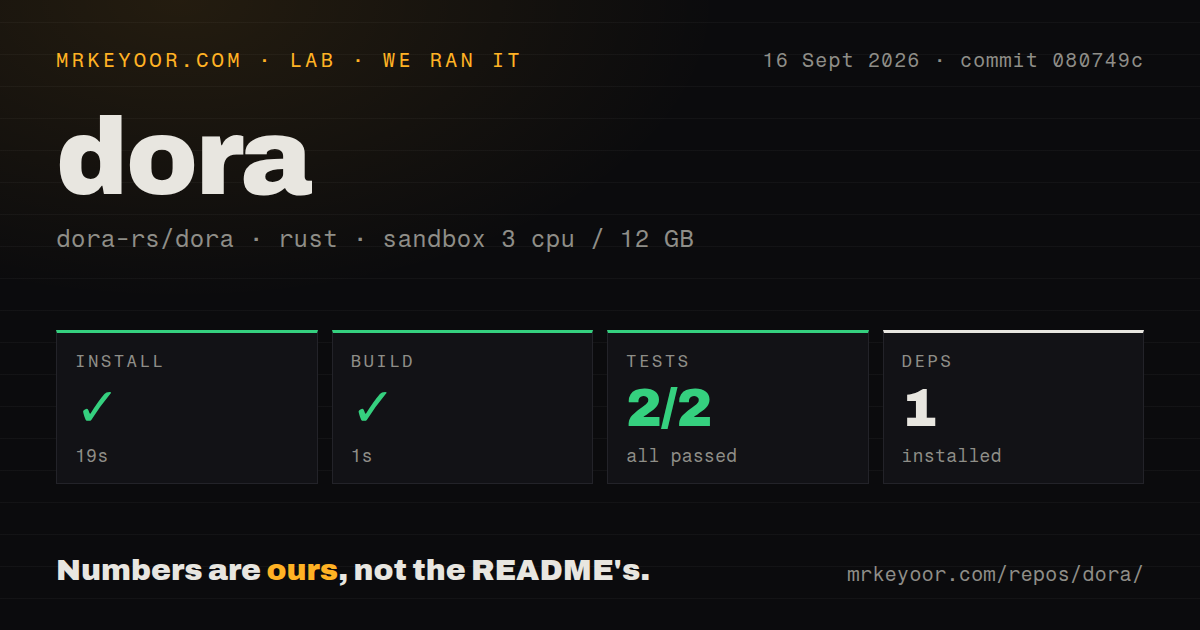
Our sandbox installed one package in 19 seconds and recorded a successful build in 1 second. The full cargo test command was a different story. It reached the 900-second limit with 2 tests passed and 0 failed out of the 2 that had completed. The command timed out, so the suite did not pass or fail as a whole. That distinction matters more than the partial green count.
The last log lines were still compiling workspace components, including the daemon, coordinator, runtime APIs, download extension, and a fault-tolerance fixture named late-dynamic-sender. This was a 3-CPU, 12 GB unprivileged Rust container. The checkout had a tests directory and 17 CI workflow files, but no Dockerfile. A contributor should budget for a large first compile and use the project's targeted CI commands before assuming a full workspace test will fit an ordinary feedback loop.
Shared memory is the attraction, while hard real time stays out of scope
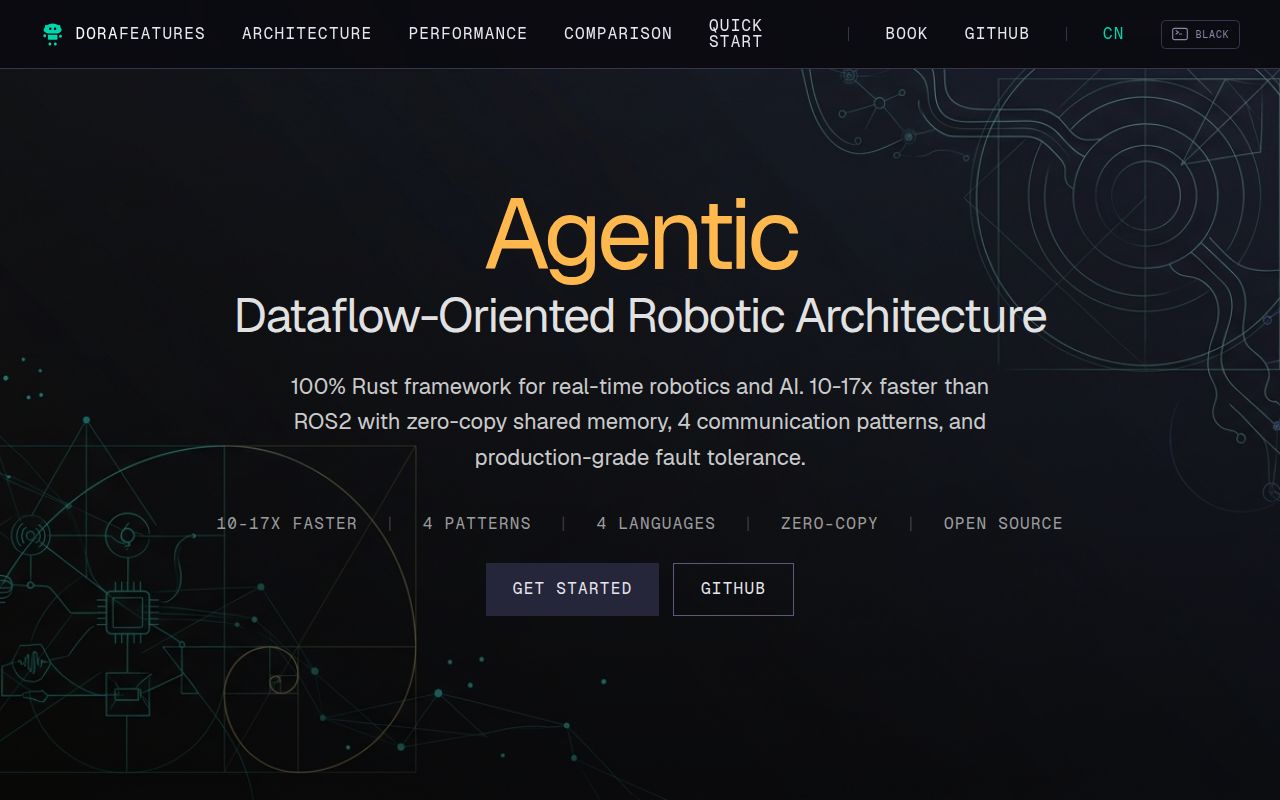
Dora sends larger same-machine messages through Zenoh shared memory and uses network transport when nodes move across machines. The project's own benchmark reports lower Python node latency than ROS 2, but our run did not reproduce that benchmark. Record/replay, topic inspection, queue policies, input timeouts, and typed ports are more immediately useful reasons to try it because they shape how failures get diagnosed and replayed.
The tuning guide is candid about limits. Dora offers memory locking, CPU affinity, and SCHED_FIFO for soft real-time work, yet the --rt profile affects the daemon's main thread and does not promote spawned nodes. Our unprivileged 12 GB container did not validate any scheduler or memory-lock behavior. A deployment needing tight control loops must test kernel configuration, capabilities, node scheduling, queue behavior, and worst-case jitter on the actual robot.
Distributed operation adds coordinator and inspection failure modes
Local dora run avoids a separate coordinator, while managed dataflows use one coordinator plus a daemon on every machine. Persistent redb state helps the coordinator remember dataflows, and daemons reconnect after interruption. Cluster commands can install systemd services and perform rolling binary upgrades. Those features move Dora beyond a local graph runner, but they also create control-plane behavior that a bench demo will never exercise.
Open issue 3509 gives a useful test case: sending a large camera output through dora topic hz reportedly wedges the coordinator connection while the dataflow keeps running. Issue 3474 reports incomplete orphan containment for local runs on Windows. With 17 CI workflows and an explicit fault-tolerance test area, the project is clearly working on these paths. Buyers should still rehearse coordinator loss, daemon reconnect, node crashes, debug subscriptions, and forced shutdown before putting motion behind the graph.
Same-day commits followed the 1.0.1 release
GitHub showed a September 16, 2026 push, 3,944 stars, and 35 combined open issues and pull requests. The issue search returned 21 open issues, including a nightly-regression tracker updated that day. Version 1.0.1 shipped on September 3 with packaging, CI, and release fixes shortly after the 1.0 announcement. That is current maintenance around a fresh compatibility promise, not years of field evidence for the new major.
The 19-second install and 1-second build make Dora cheap to inspect. The unfinished 900-second test run makes source validation expensive enough to plan. Start with one non-safety-critical graph, record representative sensor traffic, and force the coordinator, daemon, and nodes to fail separately. If recovery matches the documentation and the ROS 2 bridge covers missing drivers, Dora can earn a wider role one dataflow at a time.