A federated community still needs someone to run it
Mastodon lets people on your server follow and exchange posts with people on other ActivityPub servers. That's the useful bargain for an organization hosting its own community: you choose local rules while members keep connections beyond your website. The README describes chronological timelines, media attachments, and a web interface, so you aren't assembling the basic social experience yourself.
The decision gets harder when you become responsible for the people using it. Mastodon's own hosting guide warns that public service brings moderation and community management work. An invite-only community can be a sensible use, and the guide explicitly allows restricted registration. Either way, decide who handles reports before you invite people. A reporting interface gives that person somewhere to work.
What happened when we ran it
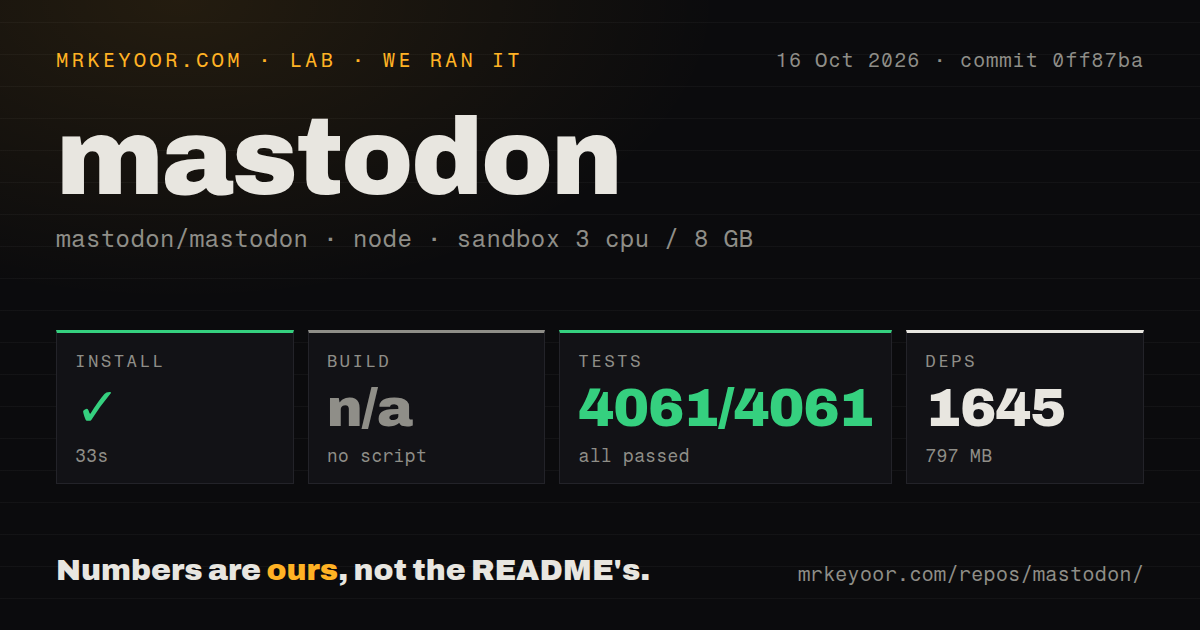
Our sandbox installed Mastodon commit 0ff87ba in 33 seconds, recorded 1,645 dependencies, and used 797 MB on disk. The October 16, 2026 run used a recorded configuration of 3 CPUs and 8 GB of RAM with image label lab-node:22. That label does not establish the actual runtime or operating-system version. Those would require the raw toolchain logs.
Vitest completed in 162 seconds: 4,061 passed, 0 failed out of 4,061. The harness found no build script or target and skipped the build step. A skipped build is still unverified. These are JavaScript-path results from the measured checkout, with no evidence here of a complete production deployment or a passing Rails suite.
The checkout contained 10,122 files, about 312,459 source lines, and occupied 88.5 MB. Our scan found 22 CI workflow files, a Dockerfile, a compose file, a tests directory, and monorepo workspaces. The installed footprint describes the measured dependency step. It cannot size a server's database or uploaded media, and the passing suite doesn't establish federation behavior under real traffic.
Rails, Redis and PostgreSQL remain outside a Yarn result
The README assigns web pages and REST endpoints to Ruby on Rails, storage to PostgreSQL, caching and queued work to Redis and Sidekiq, and streaming to Node.js. React and Redux handle the interactive interface. Someone comfortable contributing to the client may still need help operating the rest. Our successful dependency step gives that contributor useful evidence without answering whether their eventual server is ready.
The README includes Docker and compose deployment configurations, plus a link to standalone installation guidance. Containers are a useful packaging choice for that service stack. They don't decide how you will recover PostgreSQL data or investigate queued work in Sidekiq. The release notes explicitly ask administrators to back up the database before upgrading. Rehearse that recovery on the deployment you intend to keep.
The hosting guide also calls for a domain, an always-connected server, and email delivery for confirmation links and notifications. Optional object storage moves uploaded files away from the server's local disk. Budget those services separately. Keeping accounts accessible depends on more than whether the web page loads after an update.
The current README and v4.7.3 require different runtimes
The live README lists Ruby 4.0 and Node.js 24+, while the v4.7.3 release notes list Ruby 3.3 or newer and Node 22 or newer. Both name PostgreSQL 14+ and Redis 7.0+. This is a practical documentation trap: the development branch and the stable release do not describe the same requirements. Follow the requirements attached to your chosen code revision.
Release v4.7.3 was published on October 1, 2026. Its upgrade notes call for a database backup and warn that skipping releases can mean extra migration steps. That is enough reason to read the intervening notes before changing versions. Our October 16 commit run does not independently validate this release's upgrade path, even though both belong to the same project.
Moderation controls are a reason to choose Mastodon
Mastodon's README names locked accounts, phrase filtering, muting, blocking, and a reporting and moderation system. These are useful starting points for a community that wants its rules enforced locally. The work includes deciding which reports deserve action and how members can appeal. If nobody owns those decisions, postponing your own server is the sensible choice.
The README also documents OAuth2 plus REST and streaming APIs. That makes Mastodon relevant to teams building clients or integrations, not just people who like its web interface. Choose it when those interfaces and federation match the product you need. We have no request-latency or capacity measurements to tell you how much infrastructure that product will require.
October repository activity supports a trial, not a support promise
GitHub recorded a push on October 23, 2026. The October 1 release notes also link fixes for registration errors and account-deletion behavior to their issue and pull-request discussions. Those dated changes support calling development active. It doesn't measure response time for your bug. The combined open count includes pull requests, and neither that queue nor the star count is a reliability result.
Misskey is another federated social platform worth comparing if you are choosing a community's software. Pixelfed focuses on photo sharing. Pick Pixelfed when photography is the main activity; compare Misskey directly when another general social platform might suit your members. Neither received a sandbox comparison here.
Our documentation rating uses this scale: 1 means essential instructions are absent, 2 means major gaps, 3 means a usable route with omissions, 4 means detailed guidance with a caveat, and 5 means no material documentation gap found in the inspected route. Mastodon earns 4 because its hosting and release guidance is detailed, but readers must reconcile branch and release requirements. Setup, support quality, and production reliability remain unassessed. Start with a closed trial and verify email, a remote follow, and recovery before accepting public sign-ups.