Version 2.0.2 is a full overlay editor, not a bare key strip
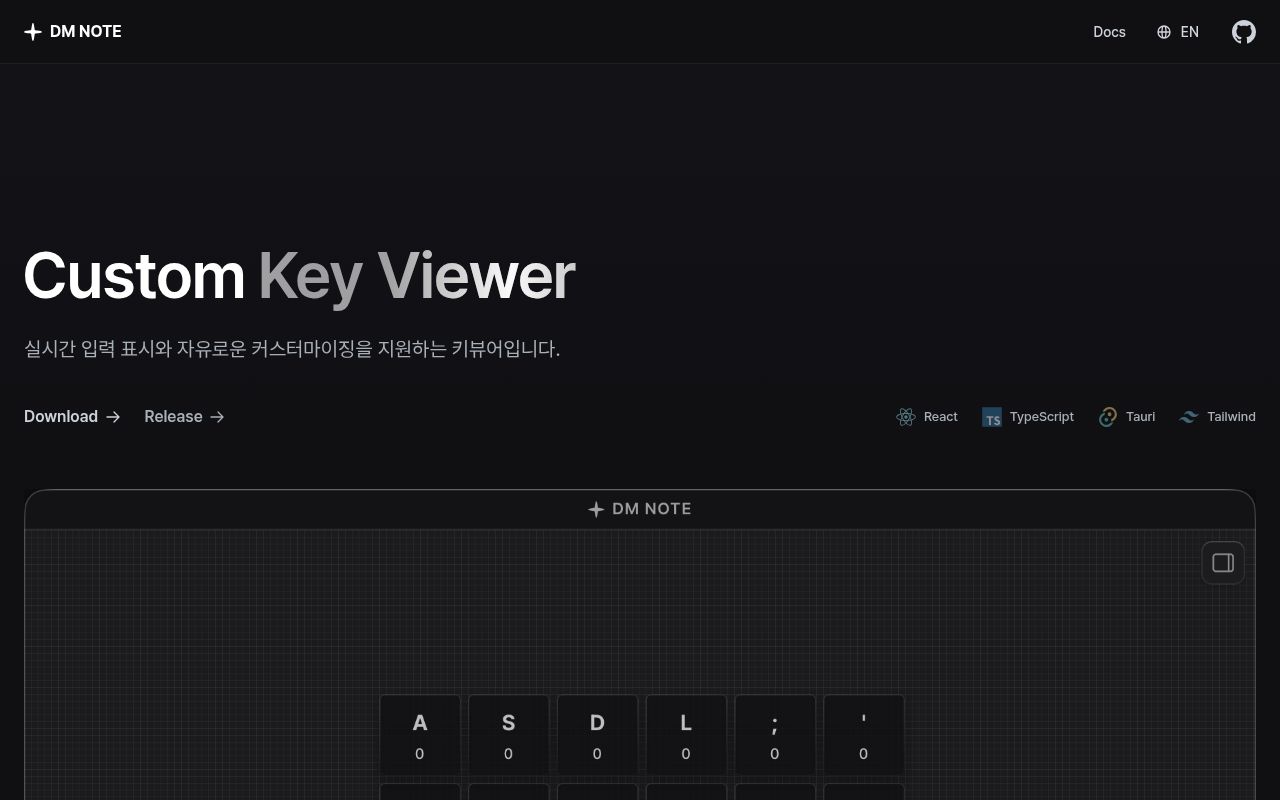
DM Note v2.0.2 can show live key presses, note effects, counters, key sounds, and a KPS graph. A grid editor controls the layout, while each key can carry its own image and styling. The overlay can stay above ordinary windows, lock its position, and resize from a chosen anchor. Those details make it better suited to a finished stream scene than a utility that only flashes a row of keyboard labels.
OBS mode is the feature that changes the practical recommendation. DM Note can run on the gaming PC and expose the overlay as a browser source to a separate streaming or recording machine. The README recommends this path when the player does not need to see the overlay locally, because it puts less load on game frame rates than the regular overlay. That split also keeps the broadcast composition away from the game display.
A 53-second build passed, while one of 4,678 tests failed
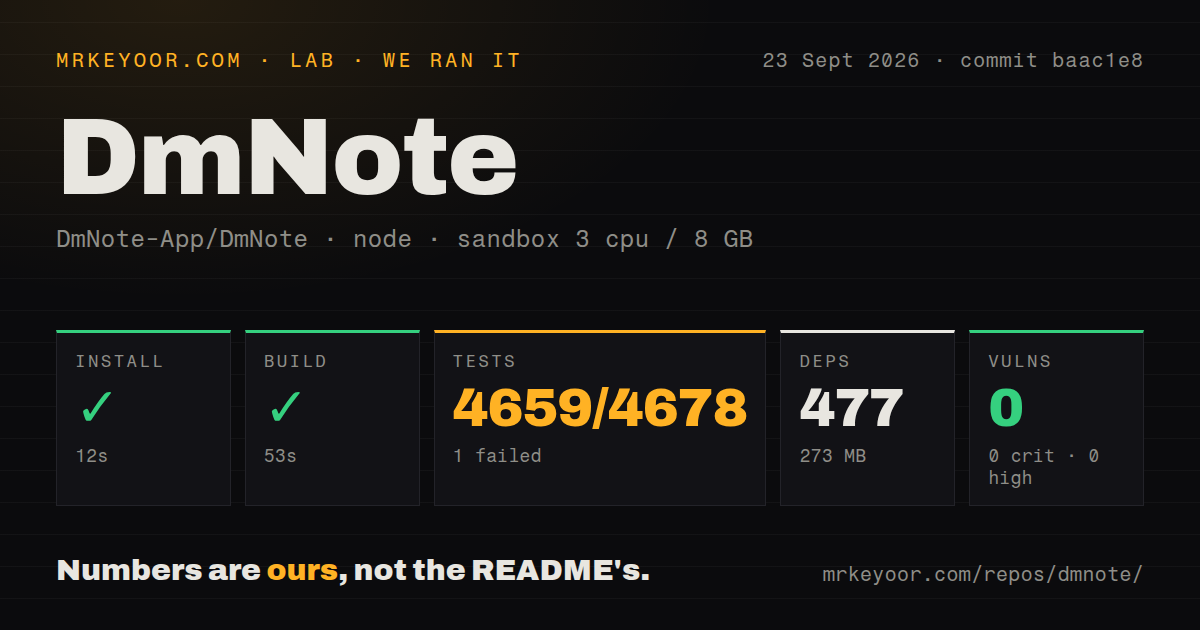
Our clean Debian sandbox installed 477 npm packages in 12 seconds and occupied 273 MB. The web build completed successfully in 53 seconds. Vitest then ran for 221 seconds and reported 4,659 passed, 1 failed, and 18 skipped out of 4,678 tests. That is a deep suite for an interface-heavy desktop project, but one red test still means the run failed.
The log excerpt supplied by our lab ends with totals and a list of skipped performance cases. It does not include the failed test's name, assertion, or stack trace. We cannot honestly label the failure cosmetic or platform-specific from that evidence. Npm audit reported 0 known vulnerabilities, and the repository contains 10 CI workflow files plus a tests directory. Those signals support a serious maintenance process without erasing the failed case.
What happened when we ran it
We ran commit baac1e8 in an unprivileged container with 3 CPUs and 8 GB of RAM. The 150.4 MB checkout held 1,693 files and roughly 392,281 lines of source. Installation took 12 seconds for 477 packages, and the finished dependency tree used 273 MB. The successful 53-second build is useful evidence that the React and Vite side can be packaged in a fresh environment.
The test command ended with exit code 1 after 221 seconds. Vitest counted 459 test files: 440 passed, 1 failed, and 18 skipped. Across those files, 4,659 tests passed, 1 failed, and 18 were skipped. Several skipped names in the log are performance cases for tab switching, grid controls, and plugin input. We only know they were skipped; the measurement does not say those interactions are fast or slow.
Windows 10/11 and macOS are the supported desktop targets
The packaged app targets Windows 10/11 and macOS. On Windows, DM Note uses the Raw Input API. The standard ASIO development and build commands also need LLVM or Clang for binding generation, although the repository includes the ASIO SDK and documents no-ASIO commands for contributors. End users downloading a release do not have to assemble that toolchain.
Mac users must grant Accessibility and Input Monitoring permissions, then restart the app. The guide explains how to reset those permissions after upgrading from versions at or below 1.6.1, while version 2.0.0 and later use signing and notarization. Linux is outside the main support promise, and the README points to northernorca/DmNote. This platform boundary is clear enough that Linux users should start with the fork instead of hoping the Tauri app happens to work.
Five interface languages do not remove the plugin trust boundary
The main README is Korean, with maintained English and Chinese documentation. DM Note itself lists 5 interface languages. Styling can stay inside the visual editor, move into custom CSS, or extend further through plugins and presets. The plugin API covers custom elements, settings, statistics, and newer tab-order data. For streamers with a visual identity, that range is the main reason to choose DM Note over a fixed keyboard skin.
Plugins also execute inside a tool that observes global input. The README explicitly warns against loading an untrusted plugin. That is the right warning, though users still have to decide whom they trust and how they inspect third-party code. The project says it has no analytics or telemetry; network access is used for GitHub release checks, updates, user-selected remote assets, and the local or LAN OBS bridge when enabled.
August releases and a September push show active maintenance
Release 2.0.2 was published on August 30, 2026, after two other 2.0 releases in the same period. Its notes cover tab reordering, window restoration, multi-display scaling, animation fixes, and web-font editing. GitHub recorded the last push on September 17, 2026, with 1,662 stars and 5 open issues and pull requests. A mouse-wheel mapping request received a maintainer reply on September 22, so current activity is visible in both code and issue discussion.
DM Note earns a recommendation for Windows and macOS streamers who will use its editor, OBS bridge, or plugin surface. The 53-second build and 4,659 passing tests show far more engineering depth than the simple download instructions suggest. Keep the single failed test in view, use borderless window mode when a game covers the overlay, and treat every unofficial plugin as code with access to an input-capture application.