A 91,260-line editor keeps the timeline in source code
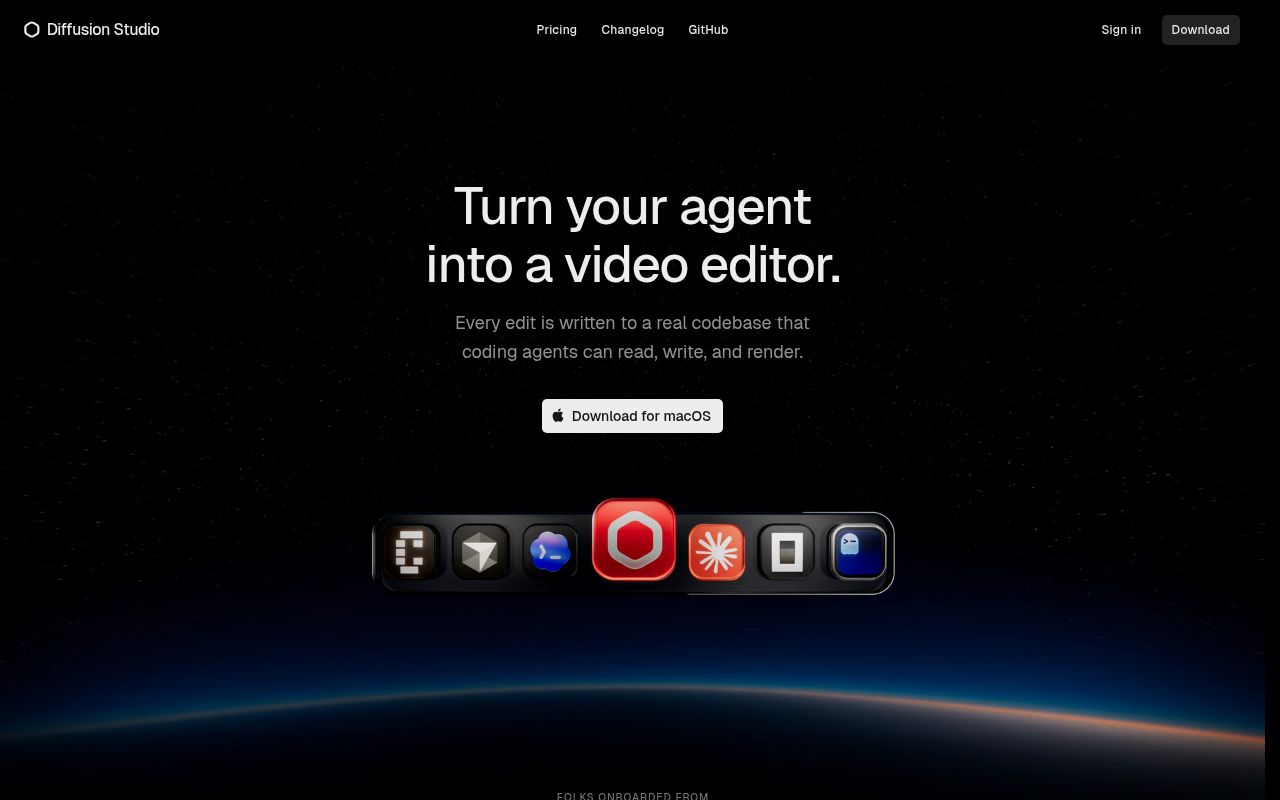
Diffusion Studio stores a composition as SolidJS-flavored JSX rather than an opaque editor project. Its 1,079-file monorepo separates the web interface, Electron shell, CLI, runtime, reconciler, asset system, and encoder. A project has a stage containing scenes, with familiar elements for video, text, and shapes. Generated images, video, and speech can also appear as declared assets. This makes an edit reviewable in a diff and gives an agent a concrete document to change.
The visual editor writes back to that same source. Each mounted element carries an ID, so dragging a rectangle, trimming a clip, or changing text updates the element that created it. Release v0.205.2 fixed a revealing failure in that contract: canvas changes could previously skip JSX expressions and snap back after reopening or exporting. The fix matters because two-way editing is the product's reason to exist. If source and canvas disagree, the agent and human are editing different cuts.
Version v0.205.2 gives agents tools to inspect the footage
The v0.205.2 README documents frame grabs, filmstrips, waveforms, timed transcription, media probing, and multimodal listening. Those commands address a basic problem with agent editing: a text model cannot judge a cut from filenames alone. dapi capture renders selected moments, while dapi check looks for gaps, invisible nodes, and failed sources. Each command has an MCP counterpart and returns structured JSON for scripts or coding agents.
That interface reaches beyond cutting. The documented examples cover captions, motion graphics, social clips, color changes, generated media, scene search, and timestamped questions. Headless use is available, yet the desktop editor remains the place where a person can pick up the result. This pairing is more useful than an agent that emits a final video with no editable timeline. It also creates a larger surface to verify, because transcription, generation, local media access, JSX compilation, playback, and export can fail independently.
What happened when we ran it
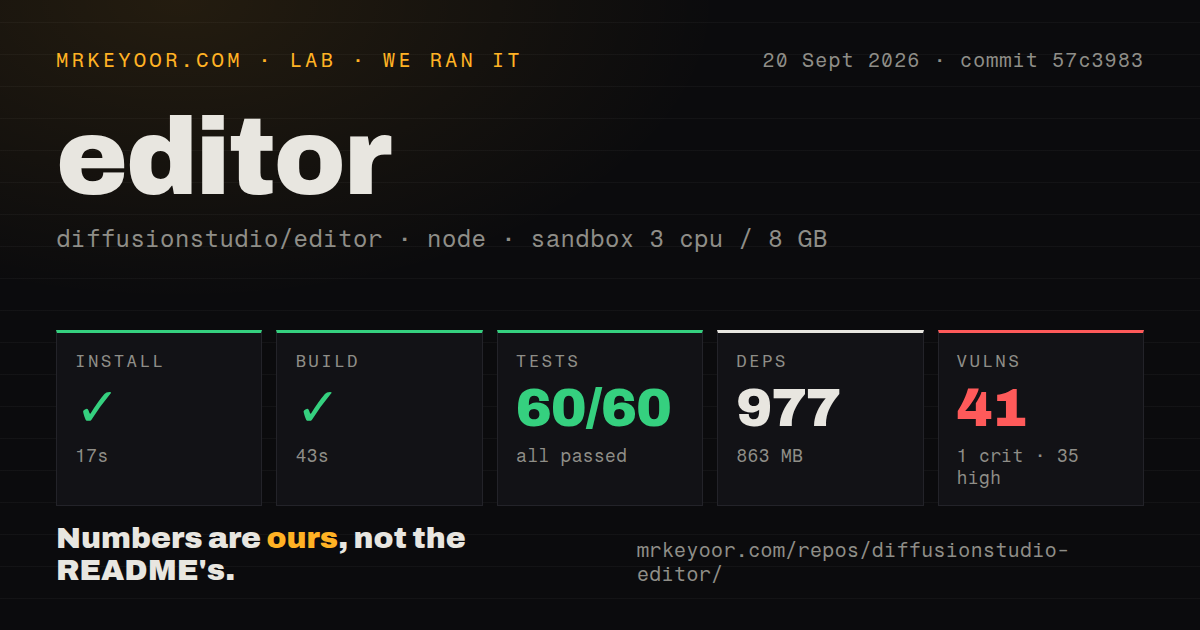
Our sandbox installed 977 npm packages in 17 seconds, taking 863 MB on disk. The build succeeded in 43 seconds. The checkout at commit 57c3983 contained about 91,260 source lines across 1,079 files, so the quick build hides a substantial workspace rather than a small wrapper around a hosted API.
All 60 Vitest tests passed in 9 seconds. The test command exited cleanly even though the repository has no top-level tests directory, which is consistent with tests living inside workspaces. Npm audit separately reported 41 known vulnerabilities: 1 critical, 35 high, 2 moderate, and 3 low. Our run did not establish exploitability, but those counts call for dependency review before the editor handles private footage or joins a release workstation.
The 2 release downloads support Apple Silicon only
Release v0.205.2, published September 18, provides a DMG and ZIP for macOS arm64. There is no Windows or Linux asset in that release. Open issues 50 and 40 ask for those platforms, while several pull requests work through packaging and IPC problems. A Windows report also says a handled dapi error can abort with a fatal status instead of the documented exit code 1. Cross-platform code exists, but the packaged product is narrower.
Development requires Node 20 or newer and a copied environment file. The example points to hosted Supabase, Umami, and Diffusion Studio API endpoints. Issue 39 asks for custom model gateways and bring-your-own-key support, which means teams with internal generation services should not assume that path exists now. The core editor is MPL-2.0, while the desktop brand assets are excluded from that license. Forks that redistribute the application need to separate code rights from brand rights.
The 41 advisories are joined by export correctness reports
A clean test result does not cover every media path. Issue 65 reports audio clips losing between 10 and 1,000 ms at the tail during export, depending on format and run. Issue 24 reports an intermittent export where three quarters of the canvas freezes while capture frames remain correct. Issue 55 describes timeline items moving before 0 seconds. These are specific editing and delivery failures, not cosmetic requests, and they justify watching the exported file from start to finish.
Activity is strong enough that these reports should not be confused with abandonment. GitHub recorded a push on September 20, two days after v0.205.2, and listed 32 combined issues and pull requests. That release fixed canvas write-back, caption placement, navigation, and chat behavior. Fast movement is encouraging for contributors, though it also means an editor used for client work should pin a known version and test its own codecs, frame rates, audio cuts, and agent commands before upgrading.
Use it when editable JSX matters more than broad platform support
The 863 MB install buys a rare workflow: footage inspection, agent commands, a programmable composition, and a visual editor all working on one source. That is a sensible trade for an Apple Silicon team already using coding agents and willing to inspect exports. Remotion is a better fit for established React rendering pipelines, Motion Canvas for programmed animation, and OpenShot for manual editing across common desktop systems.
Diffusion Studio is young, active, and pointed at a real editing problem. The passing 60-test run makes it credible enough to evaluate, while 41 advisories and open export defects keep it off unattended delivery machines. Use the agent to get to a cut faster. Keep a person responsible for the file that leaves the building.