DeepTutor is a learning system, not a PDF chat box
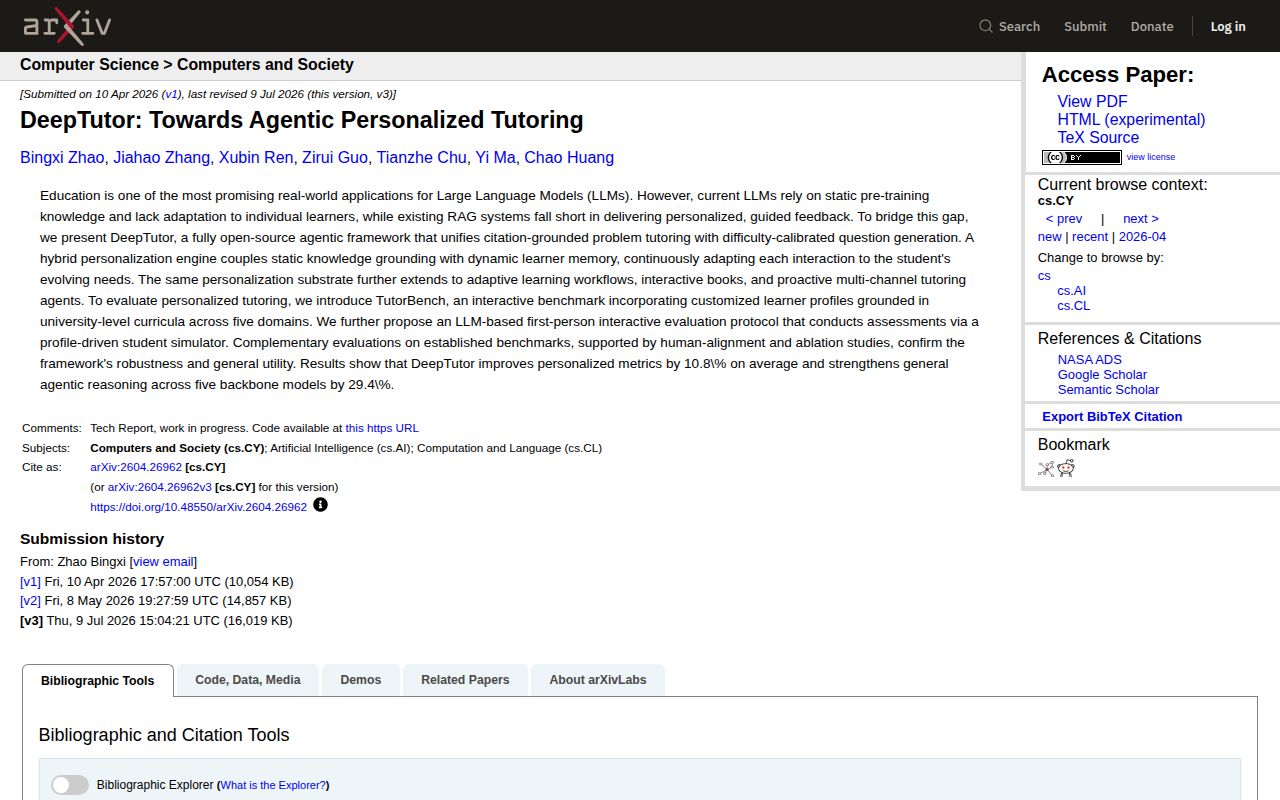
DeepTutor combines several jobs that normally live in separate applications. Chat can use documents, saved memory, skills, web search, MCP services, and external coding agents. A learner can turn the same material into a quiz, a guided mastery path, a notebook entry, a cited research report, or a generated book. Persistent Partners add their own personality, memory, library, and messaging connections.
That breadth is the reason to consider it and the first reason to hesitate. Our checkout had 2,215 files and about 403,711 lines of source. The repository includes a Python backend, a Next.js frontend, multiple retrieval engines, document parsers, model-provider catalogs, account isolation, a CLI, and channel adapters. If your goal is one conversation over a handful of PDFs, much of this system becomes maintenance rather than benefit.
The education features are concrete. Immersive Reading keeps a source beside the conversation and cites claims to pages. Mastery paths gate progress through questions, while the question bank saves the user's answer, a reference answer, and an explanation. Generated books contain editable blocks and track visits, bookmarks, quiz attempts, and weak chapters. This is closer to a personal study environment than a themed chatbot.
What happened when we ran it
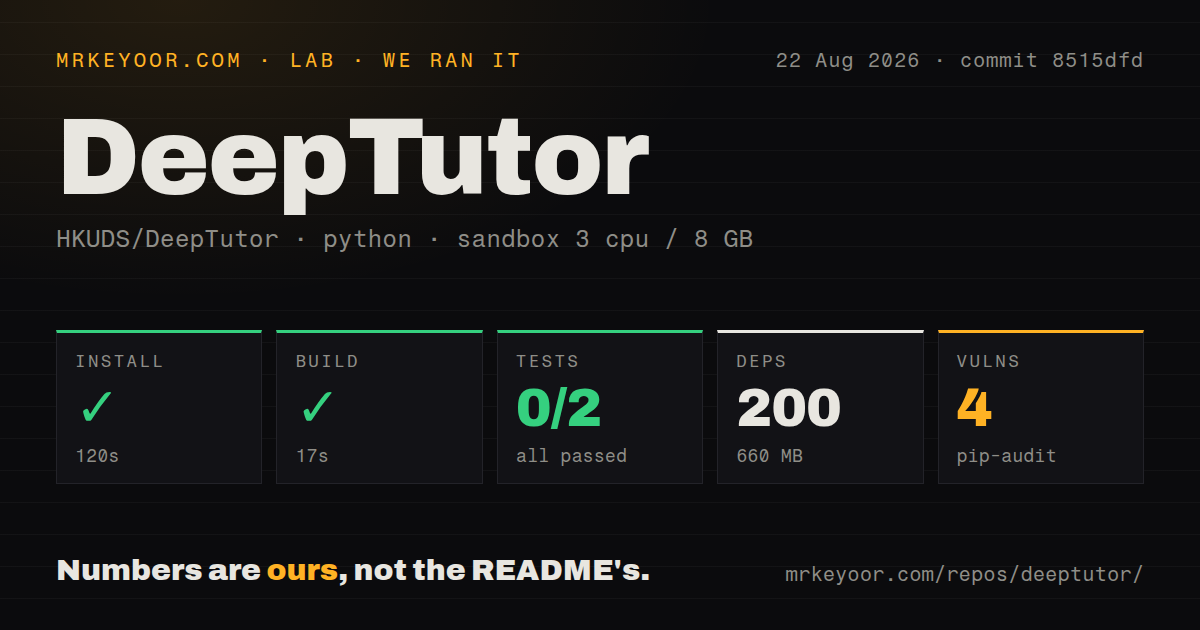
Our install at commit 8515dfd finished in 120 seconds, adding 200 packages and 660 MB on disk. The build succeeded in 17 seconds. Pytest then exited with code 4 after 42 seconds: 0 tests passed, 0 failed, and 2 collection/setup errors prevented the suite from starting.
The first error was explicit: main.yaml was not found under /work/repo/data/user/settings. The second test module could not import pytest_asyncio because that package was absent. The log does not establish why either prerequisite was missing, so we will not assign a cause. It does show that the dependency and workspace state in our fresh Debian run were insufficient for the checked-out tests.
Pip-audit reported 4 known vulnerabilities. The repository has 4 CI workflow files, a Dockerfile, a Compose file, and a tests directory. Those are healthy engineering signals, but they do not cancel a collection failure. A team evaluating this commit should reproduce the initialized settings, install the intended test extras, rerun the full suite, and review each advisory before approving an environment.
The normal start path creates state before serving
For a local installation, the README recommends Python 3.11 through 3.13 and Node.js 22 LTS. The shortest application flow installs the package, runs deeptutor init, and then runs deeptutor start. Initialization writes the settings files, asks for ports and a model profile, and can configure embeddings. The default frontend is port 3782 and the backend is port 8001.
Docker is simpler to contain. Only port 3782 needs publishing for the usual single-container topology because Next.js proxies API and WebSocket traffic internally. A data volume holds settings, provider keys, logs, workspace files, memory, and knowledge bases. That volume needs backups because it contains both user work and the configuration required to interpret it.
Models remain your responsibility. DeepTutor supports hosted APIs, OpenAI-compatible servers, local engines, and an experimental Codex OAuth route tied to each user's ChatGPT plan. Knowledge bases may also require an embedding model and a parser. Tika is remote-only, Docling can be local or remote, and some optional extras need system packages such as LaTeX or FFmpeg.
Generated code is enabled for office tools
DeepTutor's office skills can ask a model to write Python for DOCX, PDF, PPTX, or XLSX work. On local and single-container installs, a restricted subprocess runs that code, and the README says the sandbox backend is active by default. A split deployment can send execution to a runner sidecar instead. This is useful, but it changes the threat model.
For personal experiments, the container itself provides a boundary from the host. Multi-user or internet-facing deployments need more: disable the feature when unnecessary, restrict grants, isolate the runner, and assume uploaded documents can influence generated instructions. DeepTutor has an import safety gate for community skills, yet a reviewed skill can still direct powerful tools. Administrators decide which users receive models, knowledge bases, skills, MCP access, CLI apps, and code execution.
Authentication also deserves deliberate setup. The first registered user becomes administrator and owns shared provider credentials and grants. Later users get separate workspaces and redacted settings. That is a sensible model, provided registration is controlled during first boot and the administrator account is backed by TLS and a strong credential.
Retrieval choice brings tuning work
A knowledge base can use LlamaIndex, PageIndex, GraphRAG, LightRAG, a remote LightRAG server, FAISS-backed paths, or linked external systems. DeepTutor can preserve older index versions during rebuilds and remove one failed document without deleting the whole collection. Those are useful operating details for a growing library.
Choice does not guarantee good retrieval. Each engine has different dependencies, indexing costs, citation behavior, and failure modes. Test with the documents and questions that matter, inspect citations, and keep source files recoverable. A generated answer that sounds pedagogically confident can still be wrong, especially when the selected parser lost a table or the embedding profile changed.
Active releases mean frequent upgrade decisions
Release v1.5.17 was published on 2026-08-24, and the repository was pushed on 2026-08-25. GitHub listed 91 open issues and PRs, with current work on EPUB reading, persisted quizzes, web-source syncing, and model settings. The queue is active rather than stale, but the pace means a deployment owner must choose when to absorb changes.
DeepTutor is worth testing if its study workflows match how you learn or teach. Start with one model, one parser, and one knowledge base, then verify the 574-test suite in your chosen install path. A school or company should wait for that local evidence, resolve the 4 audit findings, and define who may run code before inviting ordinary users.