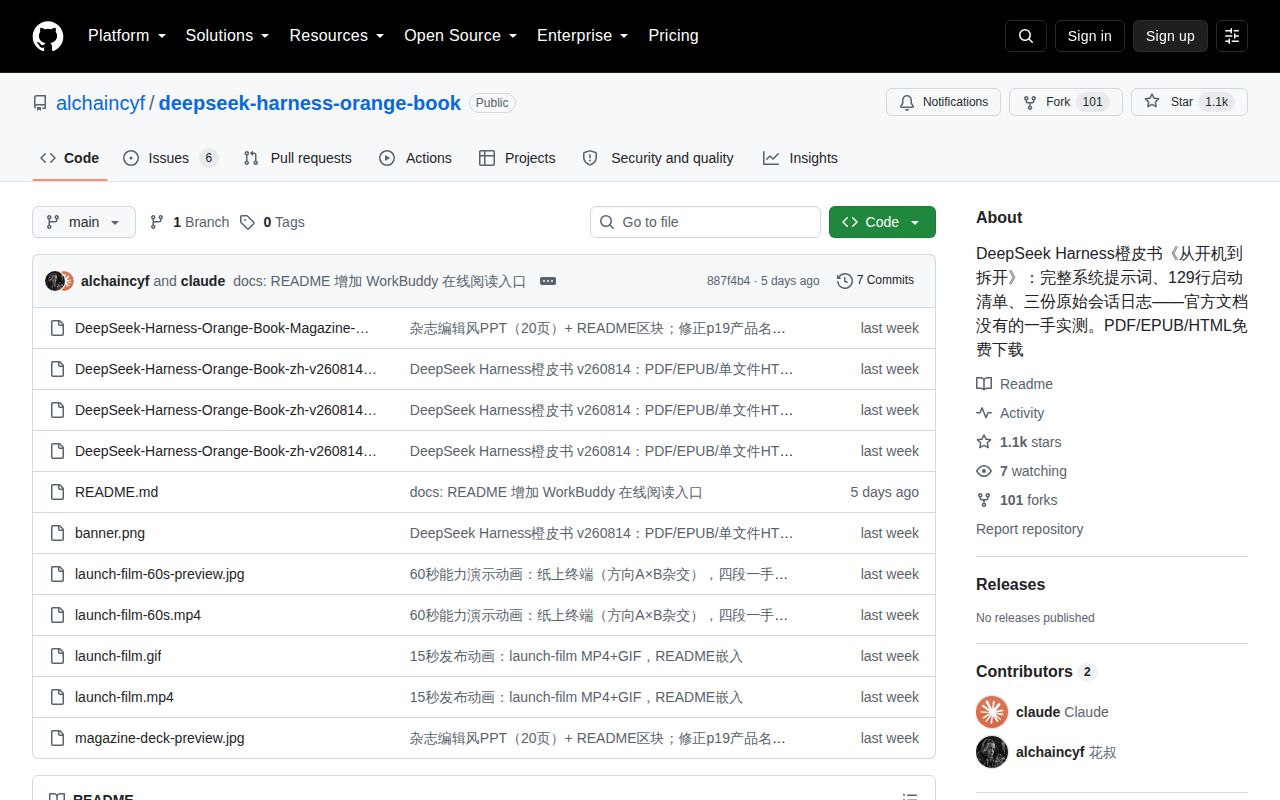
What this repository actually is
DeepSeek Harness Orange Book is not another agent framework, wrapper, or installer. It is a Chinese book about the experience of taking DeepSeek Harness from first boot through hands-on use and then examining how it is built. That distinction matters. You come here to decide whether the underlying tool deserves access to your computer and budget, not to add a dependency to an application.
The timing explains both the repository's appeal and its central limitation. The author says the work was produced within 24 hours of Harness being open-sourced on August 13, 2026. It captures the product at the moment when official material was understandably focused on architecture and launch messaging. The book asks more practical questions: What happens immediately after installation? Which files can it touch? When does it request approval? Which capabilities are installed, and which merely exist elsewhere in the ecosystem?
There is only a brief English summary. The full book, supporting explanations, and much of the presentation are Chinese, so English-only readers will not get the main value without translation.
The evidence is the reason to read it
The strongest part of this project is its insistence on showing work. The repository advertises the complete system prompt, a 129-line default boot manifest exported from a named command, and three unedited session logs covering standard, PTC, and creation modes. Those are much more useful for evaluating an agent than a feature checklist. They let a careful reader inspect what the model was told, what tools were loaded, and which events occurred during real tasks.
The creation-mode account is especially concrete. It follows a 19-step process in which the agent creates a count_chinese tool and the tool list grows from 32 entries to 33. The PTC section records five user turns coordinating 15 operations, then calls out a counterintuitive nine percent increase in fixed overhead. This is not a general performance benchmark, and the README does not pretend it is. It is a traceable case study with enough detail to challenge simplistic claims about fewer turns always costing less.
The book also separates 35 npm extensions from the installed dependency closure. That is an excellent practical distinction: availability in a repository or registry does not mean a fresh installation includes the feature. Similar care appears in the architecture material, which covers skills, MCP, plugins, conflict resolution between editing tools, 683 Agent Notes, and four incident reviews. A recurring section about rejected designs adds useful context about why an expected feature may be absent.
Presentation is unusually generous. Readers can choose a 13 MB PDF, a 5.4 MB EPUB tuned for WeChat Reading, a 4.9 MB self-contained HTML file, hosted per-chapter pages, or a 20-slide magazine-style deck. There are also short launch and capability videos. This variety makes the project easy to sample, share internally, or read offline.
Where the rough edges are
Freshness is a double-edged sword. A first-day teardown can expose details before later documentation smooths them over, but system prompts, default manifests, package counts, permission behavior, and costs can all change rapidly. The author explicitly warns readers to prefer output from their own machines when reproducing tests. Treat every number as a dated observation, not a standing promise from DeepSeek.
The repository metadata lists no release, while the document itself uses a dated version label, v260814. That is adequate for a book snapshot, but it gives readers no established cadence for corrections or updates. The supplied dataset also calls the repository license unknown, while the README declares the book under CC BY-NC-SA 4.0 and separately describes Harness as MIT licensed. Users must keep those subjects separate: the book's noncommercial share-alike terms do not describe the software's license.
The author's non-programmer perspective is valuable for usability questions, but it is still one person's machine, workflow, and first-day sample. There is no evidence here of repeated testing across operating systems, long-running production workloads, teams, or multiple versions. The claim that sessions are unedited improves auditability, yet readers still need the underlying official repository and local reproduction for high-stakes security or cost decisions.
Project health and community signal
At 1,063 stars, the guide has attracted substantial attention for a repository only days old. A community snapshot recorded 859 stars at creation, suggesting quick early interest, although stars measure curiosity more reliably than sustained maintenance. Six open issues is a manageable queue, but the data does not show response times, closure quality, or outside contributor depth.
The last push was August 17, two days before this review date, so the project is active. No listed formal release is not evidence of abandonment, particularly for a publication distributed as files. Still, there has not been enough time to judge update discipline, issue handling, or whether later Harness changes will be incorporated. Community health is promising but unproven.
Where it fits in a real stack
Place this repository in evaluation and onboarding, before production tooling. A technical lead can use the slide deck for orientation, assign relevant chapters to operators, and then compare the included logs and manifest against fresh local output. Security reviewers should use its permission questions as a checklist, not as an approval. Finance owners can use the cost example to identify what to measure, not to forecast their own bill.
For direct use, pair the book with the actual Harness source and current official output. Choose DeepSeek Harness Desktop if a graphical interface is the main need, or Awesome DeepSeek Harness if discovery across plugins and multilingual resources matters more. Readers evaluating Codex should use the sibling Codex Orange Book. As a launch-window field report, this repository is unusually specific and honest. As permanent documentation, it cannot yet earn the same trust.