Typed output still needs a correct decision
DeepOpen asks you to define the allowed answers before a model sees a ticket or document. Its choice primitive selects a label, score returns an ordinal rating, and noul supplies a probability for a true-or-false question. The README's support-ticket example asks for a department and urgency alongside refund and cancellation signals. That could replace a text-generation step followed by a parser in a routing application.
The attraction needs a firm boundary. Our checkout was 93 files and about 6,011 source lines, but neither that code nor a fixed answer format establishes correct judgments. A classifier can choose the wrong department while producing perfectly valid output. The README calls the approach hallucination-free because it generates no free text. For a buyer, that means fewer parsing problems, not permission to trust every decision.
What happened when we ran it
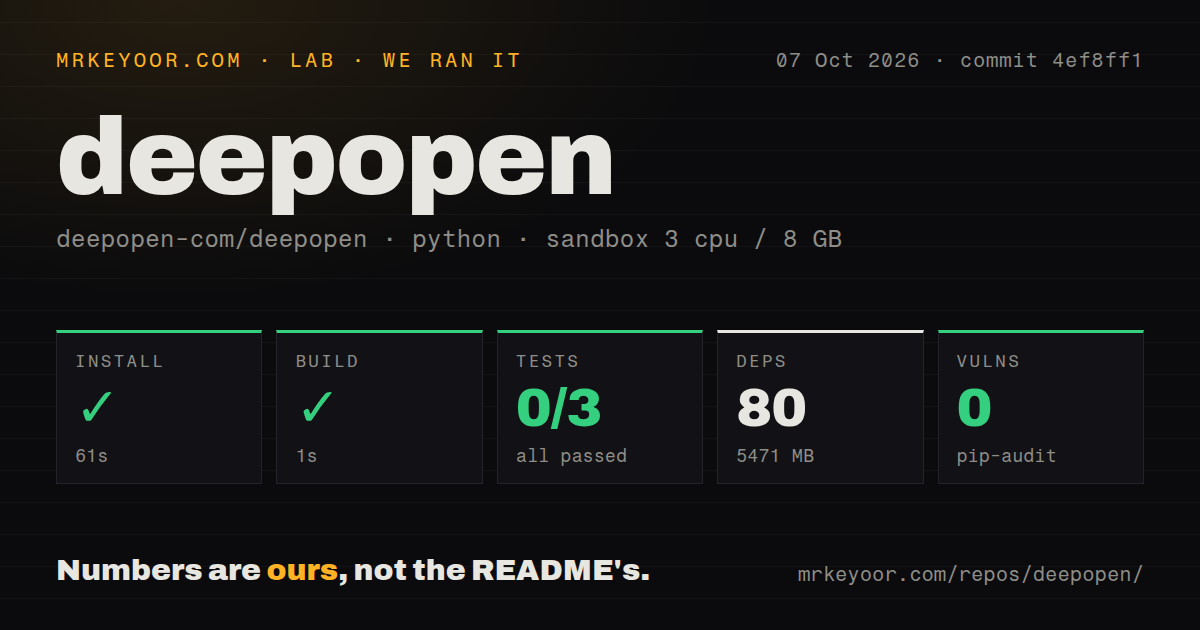
Our sandbox installed DeepOpen commit 4ef8ff1 in 61 seconds, adding 80 packages and occupying 5,471 MB. The build succeeded in 1 second. We ran it on October 7, 2026, using Python 3.12 in a fresh, unprivileged Debian container with 3 CPUs, 8 GB of RAM, and no secrets. Pip-audit reported 0 known vulnerabilities in that environment.
Pytest failed with exit code 1 after 2 seconds. The harness records 0 passed, 0 failed, and 3 collection/setup errors. The log names tests/test_criteria.py, tests/test_local_e2e.py, and tests/test_router.py, with a collection summary of 3 errors in 0.07 seconds. The router file tries to import helpers from laya.lang and raises ModuleNotFoundError: No module named 'laya'.
That is an import failure before useful validation can begin. Our 1-second build does not offset it, and zero failed assertions doesn't mean the code passed: collection stopped before tests could run. The excerpt establishes that laya was unavailable on the failing import path. It doesn't establish working inference, routing accuracy, or how a renamed import would affect the rest of the suite.
The installed environment is much larger than the checkout
The 3.3 MB repository expanded to a 5,471 MB installed environment in our run. That is a material cost for a project whose introduction concentrates on inexpensive local decisions. Local hosting removes a per-call vendor dependency, but you still provision disk, model assets, memory, and any acceleration hardware. The sandbox measured repository setup, not model response times or language coverage.
The README's router instructions distinguish lazy loading from preloading checkpoints, and expose controls for resident models and unloading them. Alternating languages can require different checkpoints. Keeping them resident trades memory for avoiding repeated loads. Decide which languages the service must handle and which models you can keep warm before assuming a simple Python object is the whole operating plan.
The README admits that domain tuning changes the result
DeepOpen's English documentation says the base checkpoints perform near chance on its typed-decisions benchmark and recommends treating the project as a base to specialize. It supplies a fine-tuning notebook and discusses fitting calibration temperatures. That is useful candor amid the more enthusiastic opening claims. The support-ticket snippet shows the API shape, but it doesn't establish that your refund policy or urgency rubric works without training data.
Our run's 80 packages and 61-second install paid only the setup cost we measured. Useful adoption also requires representative examples, labels, and a decision about acceptable errors. For ticket triage, compare incorrect billing assignments with incorrect technical assignments separately. For a guardrail, measure missed attacks as well as rejected harmless prompts. None of those task outcomes appears in our lab block, so this review makes no accuracy claim.
Language routing has an unresolved report
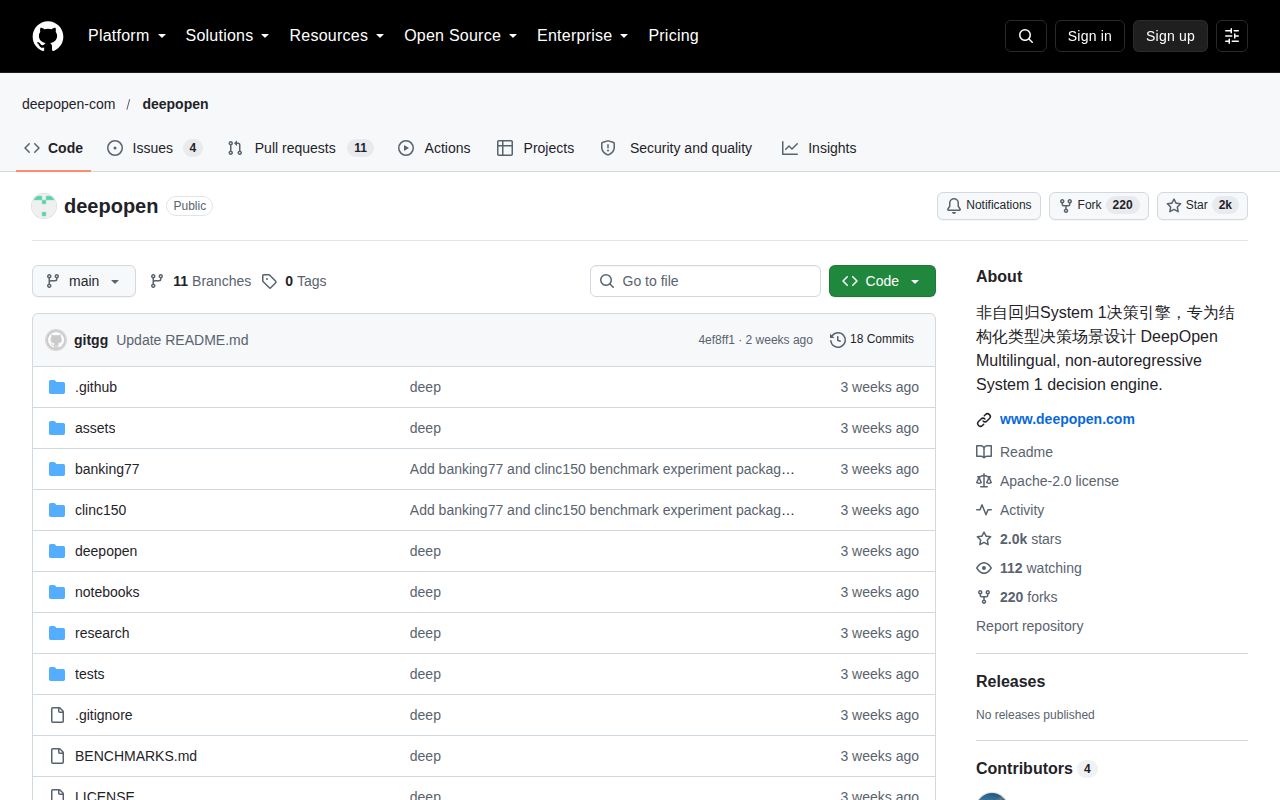
Open issue 6 reports Romanian, Polish, and Latvian text going to the English checkpoint and describes old laya imports in the tests. That report concerns this repository's language router and naming, rather than an unrelated similarly named component. Its missing-module complaint matches the kind of collection failure shown in our log, although the reporter examined a different commit.
Open pull request 7 proposes a routing correction and changes imports in the router test file. It remains a proposal, and our 3 collection/setup errors don't tell us whether its patch fixes our measured checkout. If multilingual routing is the reason you're considering DeepOpen, require representative text from your actual languages before adopting it. Confidence scores cannot compensate for a checkpoint that doesn't understand the input.
Chinese-heavy documentation includes an English technical section
The README combines a short English introduction, a long Chinese whitepaper, and detailed English API guidance. English readers can find routing, memory, decision primitives, and limitations, but must move past duplicated introductions and inconsistent presentation. With a 93-file checkout, the documentation is still harder to navigate than the repository size suggests. The English limitations section is the most useful part for an adoption decision.
GitHub records a last push of September 28, 2026, with 2,049 stars and 15 open issues and PRs. Recent activity includes dependency-update proposals and October issue discussion, while the latest-release endpoint returns no release. Those facts don't establish abandonment. Our scan found 3 CI workflow files and a tests directory, but no Dockerfile. The unresolved import and routing reports carry more weight than the star count.
A conventional classifier may be the better starting point
SetFit suits a developer with labeled text and a classification task. Scikit-learn is worth considering for a conventional baseline, while Transformers gives you direct control over an encoder and classification head. None is a drop-in replacement for DeepOpen's question schema. I'd start with DeepOpen only if that schema and local multilingual checkpoint routing justify repairing the collection failure before evaluating the decisions.