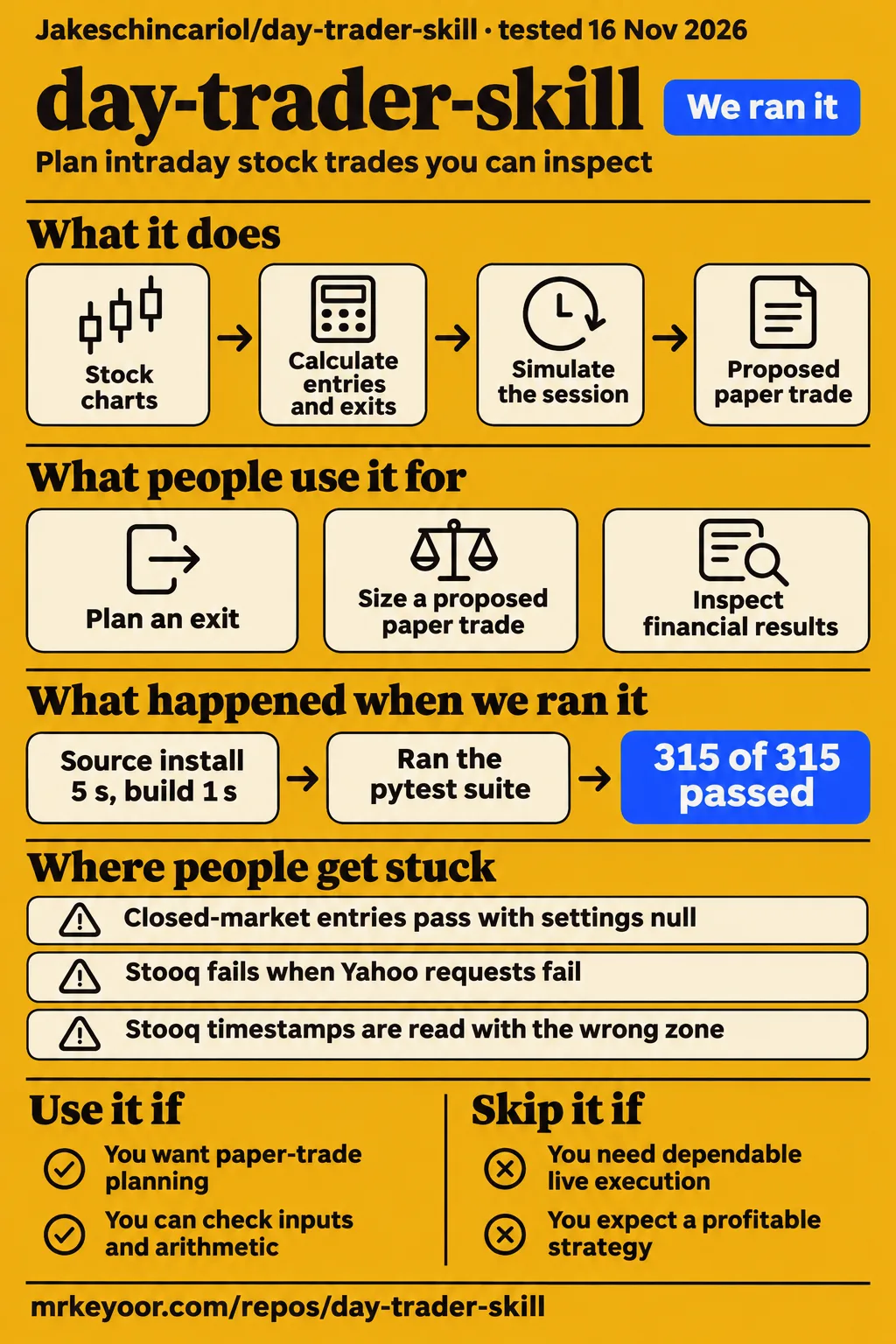
Short answer: use it for paper-trade planning
Our sandbox passed all 315 tests at commit 3d0f4ef, while Ordalin's separate DUOL replay selected a trade that would have stopped out. Use day-trader-skill if you want to inspect how an agent builds an intraday stock-trading plan. Skip it if you need dependable live execution or expect a simulation to demonstrate a profitable strategy. Those are different standards, and this pack currently clears the first one much more convincingly. Ordalin's replay is particularly useful because it follows the decision through to the losing outcome.
The attraction is concrete: eleven Claude skills share files containing the proposed entry, stop, target, position size and risk checks. You can examine that chain instead of accepting a conversational recommendation on trust. My recommendation is to keep the broker disconnected while learning it. The most useful first result is a plan you can explain and independently check, rather than an order you can approve quickly.
What people use day-trader-skill for
Ordalin completed a session replay without connecting a broker, and the author's examples show both intraday planning and earnings research. These are the strongest documented uses because they identify an actual task and its output.
| Who used it | What they did | What came out |
|---|---|---|
| Ordalin, replaying November 4 | Scanned stocks, chose DUOL, planned an exit, simulated the session and sized a proposed paper trade | The selected trade would have hit its stop at 15:10; no order was placed. Replay |
| The project author, in the README | Walked through an opening-range breakout on TSLA on October 19 | The simulation's verdict was close to a coin flip. A $5,000 account and $50 loss limit produced an eight-share proposal. Worked example |
| The project author, in trader-analyst's recorded examples | Read TSLA and AAPL results and investigated Coca-Cola's filings | The Coca-Cola example read the newer 10-Q directly because SEC company facts lagged behind it. Analyst examples |
| Argusic's verification agent | Exercised the scanner and Time Machine with offline fixtures on a fresh CPU machine | Both tools produced fixture-based CLI output. Recorded verification |
The TSLA example is worth reading as an explanation of the arithmetic. A proposed stop determines the loss per share, and the budget tool divides the dollar loss allowance by that amount. That makes a position size inspectable. The example's simulated odds also give the agent something less flattering than a confident buy recommendation to discuss. Its value here is the worked reasoning, rather than a reported realized return.
What happened when we ran it
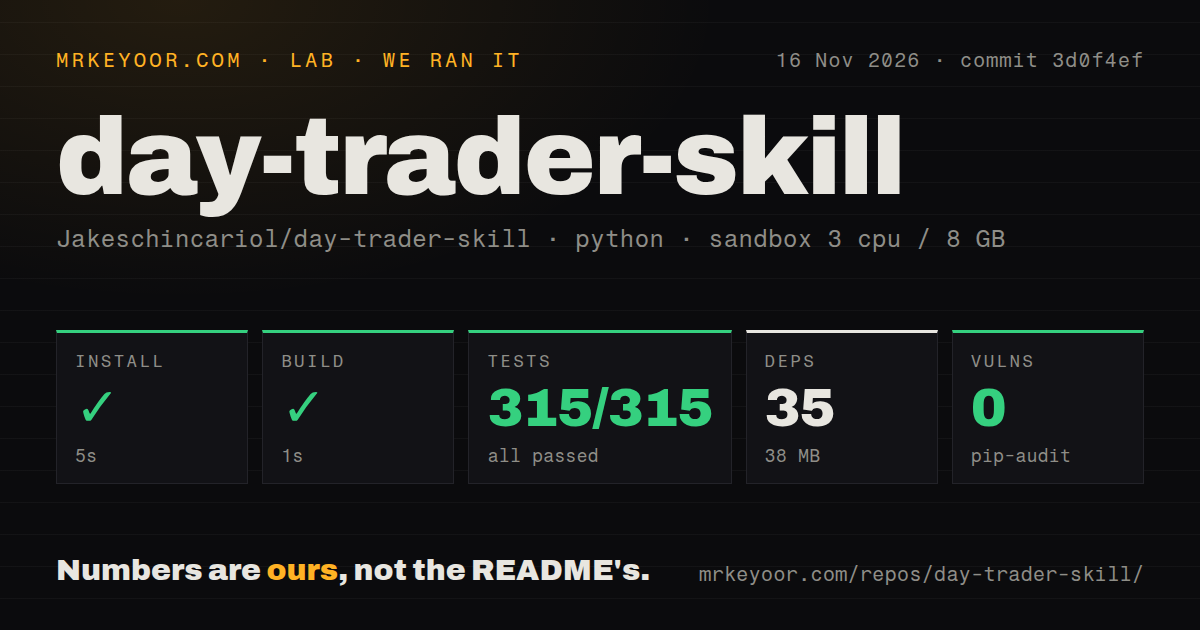
Our November 16 sandbox run installed day-trader-skill in 5 seconds, built it in 1 second and passed 315 tests in 25 seconds. The checkout was commit 3d0f4ef. These are our repository-harness results, separate from the agent replays described elsewhere on this page.
| Recorded check | Our result |
|---|---|
| Install | Succeeded in 5 seconds |
| Dependency inventory | 35 dependencies recorded, 38 MB on disk |
| Build | Succeeded in 1 second |
| Tests | Pytest: 315 passed, 0 failed of 315, in a 25-second step |
| Dependency audit | pip-audit: 0 known vulnerabilities |
| Checkout | 85 files, approximately 13,163 source lines, 1.1 MB |
| Repository signals | Tests directory present; 0 CI workflow files; no Dockerfile |
The recorded sandbox configuration was 3 CPUs, 8 GB RAM and image ghcr.io/astral-sh/uv:python3.12-bookworm. That is an image label, not a runtime-version observation. The actual Python and operating-system versions require the raw toolchain logs. The dependency inventory also describes our harness environment. It should not be turned into an instruction that users must install 35 packages: the README describes the tools as standard-library Python.
A separate hands-on deployment attempt failed its safety step because none of compose.yaml, compose.yml, docker-compose.yaml or docker-compose.yml existed. The harness called this an unsafe repo under its Compose-required rule. That label describes the harness requirement, not a discovered security defect in these Python tools.
The hands-on run metadata says it was deployed with its own Docker Compose, which conflicts with the failed safety step. We count that attempt as blocked, with no completed deployment task demonstrated. Its teardown record says cleanup succeeded. Passing repository checks and a blocked deployment attempt can coexist here because they exercised different paths.
Where people get stuck: market hours and quote fallbacks
Issue #16 reports that closed-market entries pass when both entry-window settings are null. The reporter names the early return in window_check: turning off the optional window also skips the market-closed check. The supplied thread is open and contains a request for an unconditional block, without an implemented repair. Issue #16.
The quote problem is more involved. The author of issue #3 reports that Stooq's quote URL returns HTTP 404, while other Stooq paths return a JavaScript browser check rather than CSV. The same reporter encountered Yahoo HTTP 429 responses on both chart hosts, recovering after a few minutes. That is precisely when a usable fallback would matter. An alert workflow that appears fine while Yahoo responds can therefore have a very different failure path during rate limiting. Issue #3.
| Reported problem | Practical response | Resolution in the supplied record |
|---|---|---|
| Closed-market entries pass with entry-window settings disabled | Independently reject closed-market entries rather than treating PASS as sufficient | Issue #16 remains open |
| Stooq cannot supply usable CSV to the standard-library client | Treat a failed Yahoo request as missing price evidence | Issue #3 proposes StockAnalysis through PR #4; no merge is shown |
| Stooq lacks previous close, so percentage alerts fall back to session open | Check which reference price the percentage calculation uses | The proposed replacement supplies previous close; the record shows a proposal |
| Stooq timestamps are read with the wrong zone | Require an explicit timestamp zone before accepting quote freshness | A commenter requests this from replacement sources; no completed fix is shown |
| Installation and command discovery confuse users | Distinguish plugin namespaced commands from copied-folder commands | Issues #76 and #77 request clearer steps and availability checks |
The timestamp report deserves attention beyond alerts. A commenter in #3 says a Warsaw-local quote was parsed as UTC and appeared two hours in the future. The risk checker then used the plan entry instead. In that reported reproduction, a calculated loss above the configured limit became a PASS. This is a community report, not a defect we reproduced, but it directly contradicts treating the risk manager as an unconditional enforcement boundary.
The documentation requests are also specific. The authors of #76 and #77 ask for prerequisites, copyable instructions and a way to check that skills are available. Both records are open. Existing README commands answer part of that request, but an installation command and a successful installation check are separate pieces of documentation.
The DUOL replay shows why a warning needs a human decision
Ordalin's agent took the DUOL setup after its breakout had already triggered, despite the entry tool's warning. The agent finished the planning workflow, but the stock later reached the stop and never approached the target. No broker was connected. That makes this a useful test of agent judgment without pretending it was an executed trade or a measurement from our sandbox. Replay details.
A late entry changes the price paid and the distance to the planned exit. The warning therefore belongs in the decision, not merely in the transcript. If you reproduce this workflow, ask the agent to explain the plan using the actual proposed entry and inspect the resulting files yourself. A completed sequence of tool calls can still end in a trade you should decline.
The Time Machine samples the stock's recent historical bars. Ordalin reports that its ordinary-session sample missed the magnitude of DUOL's actual move that day. The README itself warns that future headlines, halts and earnings can produce events absent from the sample. Repeating a simulation many times makes its calculations repeatable; it doesn't expand the historical evidence beyond the bars used to construct it.
Full execution needs a shell and working market-data access
The README requires Python 3.8 or newer for the tools, and SEC requests need your name and email in sec_user_agent or SEC_USER_AGENT. The basic data scripts use public endpoints. Brokerage execution is a separate connection with its own account and approval settings. These distinctions matter when a tutorial calls the pack free or says it works in a chat window. README requirements.
| Environment or route | What the evidence supports | What to check before relying on it |
|---|---|---|
| Claude Code plugin | Explicit marketplace and plugin commands; Ordalin used the plugin route | Commands have the /day-trader-skill: prefix |
| Copied skill folders | README supports global or project-local skill folders | Plain /trader-scanner names differ from plugin names |
| Single instruction file pasted into chat | README describes a chat mode without Python tools | Reading instructions does not run the data scripts |
| Claude app or API upload | QAI flags argument-hint as an upload-format problem in trader-broker |
QAI's result is a format check, not an agent execution test |
| Network-enabled browser execution | The setup video describes code execution and network-access settings | A visible skill toggle alone doesn't demonstrate successful market-data retrieval |
In the supplied Windows/Mac setup video, the presenter tells viewers to enable code execution and file creation, then allow market-data network access. The transcript distinguishes a browser route described as available on the free plan from a local Claude Code route described as requiring Pro. Those are the presenter's instructions, rather than our platform-support measurements. Setup video.
QAI's trader-broker entry reports that app/API upload packaging rejects the argument-hint field and suggests deleting it or moving custom data under metadata. It also says its Claude Code format check passes. This explains why working Claude Code installation cannot be used as proof that every upload route accepts the same files. QAI format check.
Safety depends on broker permissions as well as risk checks
The README defaults to paper trading and tells users to keep brokerage tools set to Needs approval. Only the broker skill can lead to an order, after a risk check and an explicit yes for the exact ticket. That is the documented workflow to preserve while experimenting. Keep credentials in environment variables as the project instructs, and inspect the ticket at the broker boundary. Approval and paper defaults.
The clean pip-audit result in our run answers a dependency-advisory question. The closed-market and quote reports concern application behavior. You need both kinds of evidence to assess a trading tool, and a clean advisory scan cannot compensate for a price or timestamp used incorrectly in a risk calculation. I would start with a disconnected broker, recorded inputs and a proposed order that can be independently recalculated.
day-trader-skill vs trader-skill and broader trading packs
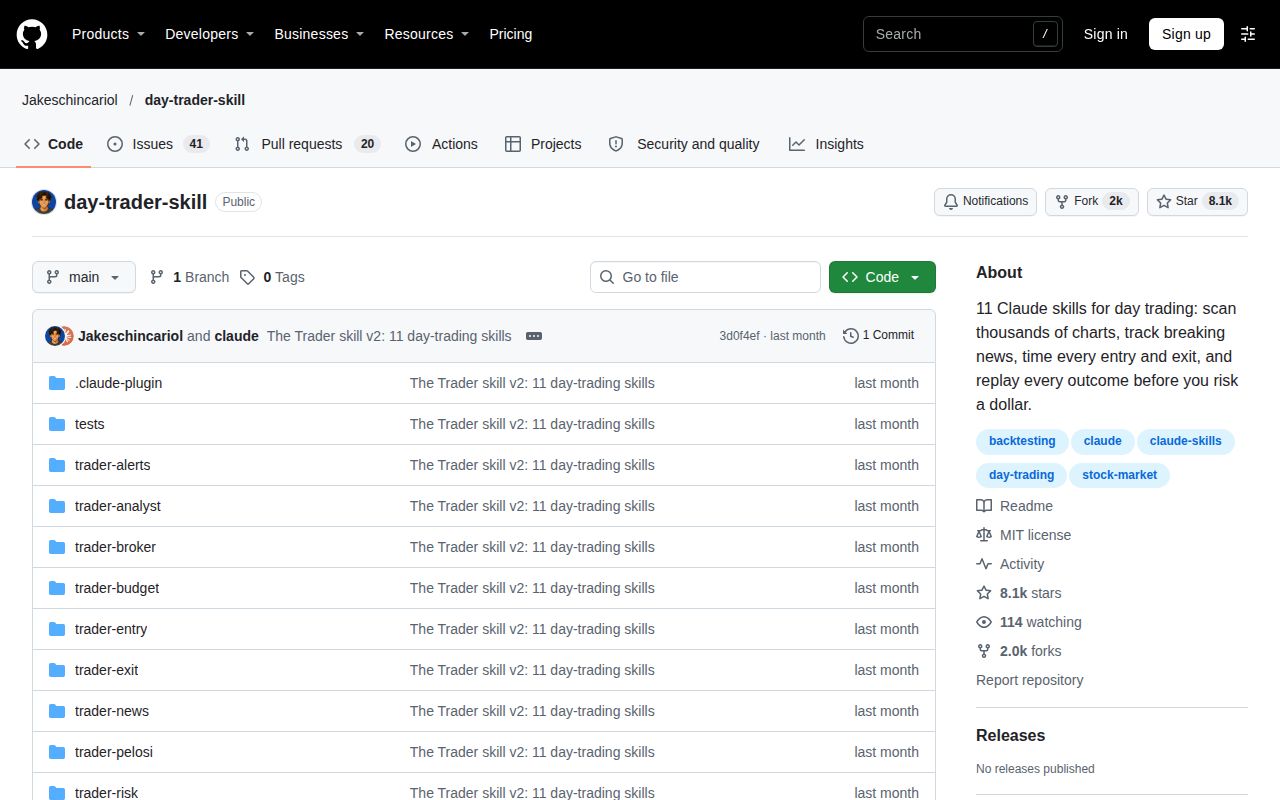
Choose the original trader-skill for portfolio workflows such as 13F copying, tax lots and rebalancing; choose day-trader-skill for intraday entry and exit planning. That division comes from the project's own README and is more useful than comparing the packs by popularity. The broader alternatives below also target different jobs. These are workflow comparisons, rather than measured trading-performance rankings.
| Project | Reason to consider it | Decision against day-trader-skill |
|---|---|---|
| Jakeschincariol/trader-skill | 13F copying, screening, tax lots and portfolio rebalancing | Pick it when maintaining a portfolio is the job, rather than timing an intraday setup |
| tradermonty/claude-trading-skills | A broader process toolkit for market review, trade planning and journaling | Pick it for investing and swing-trading workflows; its current README lists different API profiles by workflow |
| staskh/trading_skills | Options analysis, Greeks, risk reports and scanners | Pick it when options analysis is central to the task |
Moneyflock's comparison identifies the broader research pack and options-focused alternative. The original trader-skill README and tradermonty's current README support their different workflow emphasis. API access should be checked per selected workflow rather than reduced to a blanket free-versus-paid label.
What the other reviews get wrong
SkillsLLM's claim that the repository lacks a SKILL.md file is contradicted by the supplied trader-analyst source and the README's folder list. The distinction affects installation advice: this is a collection of separate skills, with separate instruction files. SkillsLLM comparison, trader-analyst source.
Moneyflock's phrase about data-free day trading confuses free access with an absence of data. Yahoo Finance, Nasdaq Trader and SEC EDGAR are external dependencies of the workflow. AINovaTools also omits agent usage when it calls a brokerage account the only optional cost. Ordalin recorded a $0.68 model bill for its replay. That is evidence of a possible running cost, not a fixed price for each trade. Moneyflock, AINovaTools, Ordalin.
Heatdrop calls the TSLA example's stop-price loss the worst case. The README says stops can fill past their specified prices, so that amount is conditional on the fill. Similarly, the README's claim about replaying every possible outcome overstates a sample of recent bars. The observed DUOL replay is a practical reason to read the fine print before trusting the headline. Heatdrop, README.
Cult of Claude says there is no exact installation command to give, although the README supplies plugin commands and a folder-copy route. Promotional promises of perfect entries also outrun Ordalin's late-entry result. The risk manager's description as stopping anything over the limits needs to be read alongside issues #3 and #16, rather than repeated as a guarantee. Cult of Claude, promotional video.
Questions people ask
Install day-trader-skill through the README's Claude Code marketplace commands, then check for namespaced commands such as /day-trader-skill:trader-scanner. A copied-folder installation uses plain skill names instead. Installation instructions.
How do I install day-trader-skill and verify that its commands are available?
The README gives these two Claude Code commands:
/plugin marketplace add Jakeschincariol/day-trader-skill
/plugin install day-trader-skill@day-trader-skill
Then look for /day-trader-skill:trader-scanner. For a first functional check, request a scan without placing orders and inspect whether it returns data or a retrieval error. The setup video recommends checking the installed skills and running a scanner, while issues #76 and #77 request clearer post-install checks. README, setup video.
Does day-trader-skill work with Indian stocks and the Nifty 50?
The Indian-market video's presenter reports that converting ticker dots to hyphens breaks Reliance's Yahoo symbol. The presenter also describes changing New York market timing and US holidays to Indian-market settings. Supporting Nifty 50 needs symbol handling, the correct universe and the appropriate market clock together. Treat that video as an adaptation account, rather than evidence of upstream Indian-market support. Indian-market setup video.
Can I use day-trader-skill on Windows or Mac with Claude's free plan?
The setup video's presenter describes Windows and Mac routes and says the browser method works on the free plan. The same transcript describes the local Claude Code route as requiring Pro. The README separately offers pasted instructions without Python tools. Keep those routes separate when assessing what you can actually run. Setup video, README.
Which code-execution and network settings are needed to fetch market data?
The setup video instructs viewers to enable code execution and file creation and permit network access to market-data sources. The README's scripts need to reach Yahoo Finance, Nasdaq Trader and SEC endpoints for their respective jobs. SEC tools additionally need an identifying User-Agent. A chat that can read SKILL.md still needs a way to execute Python and reach those services. Setup video, README.
Can day-trader-skill place trades on its own?
The documented workflow requires your explicit approval for the exact order and a connected brokerage tool. Paper trading is the default, and the README recommends a separate connector approval prompt. A planning run can finish without a broker, as Ordalin demonstrated. README, replay.
Is day-trader-skill free, and what does running it cost?
The code is MIT licensed and its data tools read free public sources. Agent usage can cost money: Ordalin's replay recorded $0.68 at API prices. That single replay is an example bill, not a monthly budget or a reliable per-run estimate. Connecting a broker introduces another service to assess separately. README, replay cost.
Is its market data real-time?
The scanner and entry timer use minute bars from an unofficial Yahoo endpoint, rather than every tick. The README says it can lag, change or rate-limit requests and tells users to check consequential prices against their broker. That makes this a poor fit for decisions requiring a guaranteed fresh execution feed. Data fine print.
How is day-trader-skill different from the original trader-skill?
The original pack handles portfolio work including 13F copying, screening, tax lots and rebalancing. This sequel concentrates on intraday scans, entry timing, exit plans and session simulations. Choose by the task you intend to repeat, rather than assuming the sequel replaces the original portfolio tools. README distinction.
Does day-trader-skill run successfully on a clean machine?
Our sandbox completed installation, build and the full recorded test suite at commit 3d0f4ef. Argusic also records fixture-based scanner and Time Machine operation on a fresh machine. Its direct test_repo.py invocation failed because a helper was outside PYTHONPATH; the documented unittest-discovery route worked around it. Argusic's recorded error and workaround.
Does day-trader-skill need a GPU?
Argusic exercised the offline tools on a CPU machine without a GPU. These Python data and calculation tools do not require a local GPU to start. That finding concerns the scripts, rather than the hardware or service used to run the agent model. CPU run.
Why do risk checks pass entries when the market is closed?
Issue #16 reports an early return when both entry-window limits are null, bypassing the closed-market check. The thread requests an unconditional market-closed block and is open in the supplied record. Keep that report in mind before interpreting a PASS as permission to trade. Issue #16.
What happens to price alerts when Yahoo rate-limits requests and the Stooq fallback fails?
Issue #3 reports that the fallback cannot return usable CSV, leaving that recovery path unavailable when Yahoo requests fail. It also identifies missing previous-close data and a timestamp-zone problem affecting downstream calculations. The proposed replacement is described in PR #4, with no merge shown in the supplied thread. Issue #3.
What we have not tested yet
Our run establishes repository setup and test results, not profitability, broker execution or sustained live-feed reliability. We did not reproduce the risk-check reports, execute a paper order, assess slippage, compare strategies or measure multiweek returns. Ordalin's losing replay is one recorded session, not a return distribution. Argusic's fixture output does not fill those gaps.
We have not tested Windows, macOS, free-plan browser execution, app/API uploads or an Indian-market fork. The supplied video extracts lack a dependable channel identity, so attribution here is to the named setup video and its presenter. The Indian-market extract describes changes but does not verify a completed adaptation. The X search and Bilibili search results do not supply a relevant, completed day-trader-skill task that could strengthen the decision.
At larger scan sizes, Ordalin says the replay fetched the full universe but confirmed only the 200 most traded candidates. It identifies --max-confirm 0 as the way to check all candidates; we have no runtime measurement for that mode. The latest-release endpoint returned 404, while GitHub's last-push date was October 20, 2026 and the supplied November issue records remain active. Those observations do not establish abandonment, support response times or a repair schedule. We have not run a security review beyond the recorded dependency audit. Keep the first evaluation disconnected from a broker until you can account for the entry price, quote timestamp and risk decision yourself.