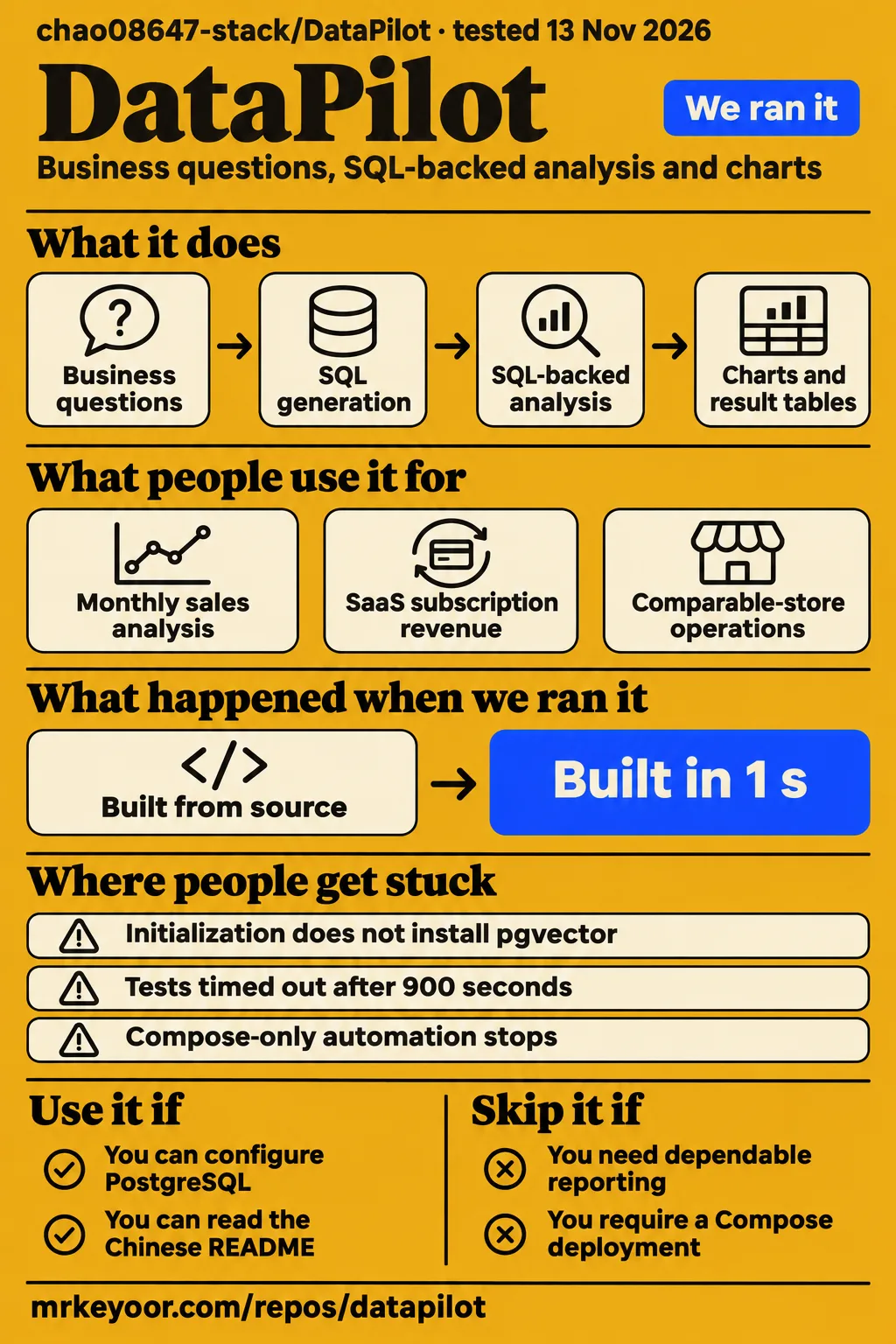
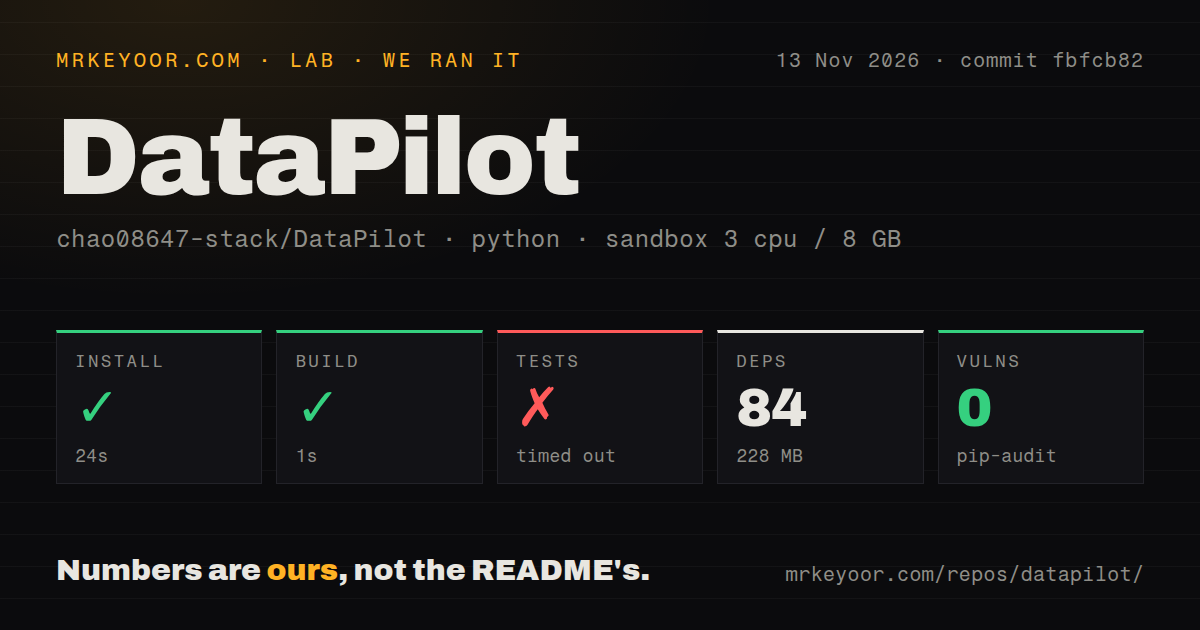
Our DataPilot backend installed in 24 seconds and built in 1 second; tests hit the 900-second limit. This review concerns chao08647-stack/DataPilot at measured commit fbfcb82. Its README describes business definitions guiding SQL generation, clarification pauses and retained query evidence. Developers prepared to configure PostgreSQL and model services should evaluate it; teams needing dependable reporting immediately or a supplied Compose deployment should choose another evaluation candidate. Begin with disposable data and a question whose answer you already know.
What you can do with DataPilot
The README describes DataPilot as a LangGraph workbench for business questions, database queries, analysis and charts. A supervisor coordinates discovery, SQL, analysis and visualization agents through structured outputs. The intended reader here is a developer who can inspect those stages and compare their outputs with an existing report. The supplied main README is Chinese, so reading or translating its business explanations is part of that evaluation. DataPilot README
Semantic models define metric formulas, fact granularity, time fields and relationships. For a profit question, compare the model's treatment of orders, order items, refunds and expenses with your accounting report. The README's quarterly example describes aligning those granularities before decomposing changes. That gives an evaluator a concrete question to ask while reading: do the model's relationships preserve the totals that the business expects?
The documented clarification workflow uses LangGraph interrupt to pause a task and resume it after the user supplies missing information. The README also describes retaining SQL, result tables and execution events alongside chart output. A useful evaluation sequence follows those artifacts: inspect the interpretation of the question, read the query, reconcile its results, then assess the explanation. This is a proposed evaluation method based on the documented workflow.
What people use DataPilot for
The maintainer demonstrates ecommerce analysis, SaaS subscription revenue and comparable-store operations. Monthly sales involve orders and contribution profit; subscription analysis bridges recurring revenue across months; store analysis uses trading days, traffic and conversion. These examples supply business questions with different definitions to reconcile. The table identifies them as maintainer examples and links to the README that presents them. DataPilot business examples
| Who presents the example | Task shown in the README | What to examine in your own evaluation |
|---|---|---|
| Project maintainer | Monthly sales, orders, average order value and contribution profit | Whether formulas match your accounting definitions |
| Project maintainer | Quarterly profit changes by channel, category, discounts, refunds and expenses | Whether joins preserve order and item granularity |
| Project maintainer | SaaS monthly recurring revenue with expansion, contraction, churn and recovery | Whether adjacent months reconcile under your subscription rules |
| Project maintainer | Comparable-store results using trading days, traffic, conversion and basket value | Whether the store population matches your operating report |
Choose a closed reporting period with an agreed answer for the first task. Preserve the expected total and the intermediate figures used to calculate it, then compare them with the generated SQL and result tables. A disagreement can then be traced to a metric definition, relationship, filter or calculation. An unfamiliar trend gives the evaluator fewer settled facts against which to assess an explanation.
What happened when we ran it
Our November 13, 2026 run at commit fbfcb82 installed the backend in 24 seconds, built it in 1 second and timed out during tests after 900 seconds. The Python project was under backend/. The recorded sandbox configuration allocated 3 CPUs and 8 GB RAM and named image ghcr.io/astral-sh/uv:python3.12-bookworm. These are source-harness results, recorded separately from the hands-on runner's Compose check.
| Recorded check | Our result | Practical reading |
|---|---|---|
| Install | Succeeded in 24 seconds | The dependency step completed |
| Dependency inventory | 84 dependencies, 228 MB on disk | The recorded installed footprint |
| Build | Succeeded in 1 second | The harness build step completed |
| Tests | Timed out in 900 seconds | The command ended at its time cap |
| pip-audit | 0 known vulnerabilities; 83 packages scanned, one skipped | The reported audit result and package coverage |
| Repository signals | 1 CI workflow file, a tests directory, no Dockerfile | File observations from the harness |
The test tail reached 92%, then printed further dots before termination. Earlier lines contain skipped-test markers. It also includes a pytest-asyncio warning about the future default event-loop scope for asynchronous fixtures and recommends setting that scope explicitly. The warning and timeout are separate findings. A useful development follow-up is a run that records active test names and preserves complete output, rather than selecting a package fix from this tail.
The checkout contained 176 files, approximately 17,785 source lines and 3.6 MB of content. The harness recorded 927 seconds overall. Checkout size describes the code-reading task, while the 228 MB dependency footprint describes the installed environment. Keeping those figures separate from elapsed time prevents three different measurements from becoming a single estimate of the application's operating requirements.
The hands-on safety step failed because none of compose.yaml, compose.yml, docker-compose.yaml or docker-compose.yml existed. Its message calls this an "unsafe repo" because its rule requires a Compose file. That wording records the runner's acceptance rule. The README provides a native startup route, so the failure identifies a mismatch between that route and the runner.
The generic hands-on entry says the project deployed with its own Docker Compose, with every port bound to 127.0.0.1. The specific safety step instead records that the accepted files were absent. We therefore use the failed safety step as the deployment outcome and retain the generic entry as a conflicting record. Cleanup records "teardown: ok".
Where people get stuck
The documented startup requires Python 3.12.x, Node.js 22 and PostgreSQL with matching pgvector extension files already installed. The README says its initialization script does not install pgvector. Commands target native Windows/PowerShell execution from the project root. Prepare those prerequisites before initializing the database, configure the model service, then start the backend and frontend in separate terminals. DataPilot startup instructions
| Symptom or decision | Evidence | Useful next action |
|---|---|---|
| Application database prerequisites | README requires matching pgvector files before initialization | Prepare the extension for the selected PostgreSQL installation |
| Model connection configuration | README lists an OpenAI-compatible endpoint, key and model | Configure the selected provider before requesting analysis |
| Embedding service unavailable | README documents full-text retrieval fallback | Read the retrieval method recorded in execution events |
| Test command reaches its cap | Our command timed out after 900 seconds | Capture active test names and complete output |
| Compose-only automation stops | The hands-on safety step found no accepted Compose filename | Follow the documented native route for the next evaluation |
The native helper creates a separate cluster under .runtime/postgres, uses port 15432 and database insight_agents, and saves connection credentials under .runtime. The backend reads this configuration through the local-postgres option. These details help distinguish the application database from business-data connections and the separately running frontend. The README also says existing business-data files are reused according to the generator's rules.
Security and persistent memory
The README describes AST validation and read-only SQL execution controls, with application state and memory stored in separate PostgreSQL storage. It instructs users to keep model keys in local configuration, outside the frontend and Git. Those are specific controls and configuration instructions to inspect before connecting data. Use a disposable copy and a database account restricted to the access needed for the evaluation. DataPilot data controls
The memory design separates workflow checkpoints, conversation context and longer-term experience. According to the README, retrieval filters experience by business domain, version and dialect, then looks up the original record. A repaired query becomes runtime experience after the repair works and the task ultimately succeeds. Inspect both the immediate answer and the information retained for future tasks, including whether that information belongs in the organization's memory store.
Documentation and repository activity
The supplied Chinese README gives a Windows/PowerShell setup path with prerequisites, model settings, startup commands and development checks. Documentation receives 3/5 under this review's rubric: 1 means instructions are absent, 3 means a concrete setup path exists with substantial reader prerequisites, and 5 requires corroborated guidance across the reviewed paths. This assesses the supplied instructions for an English-speaking developer who must also prepare PostgreSQL and model services.
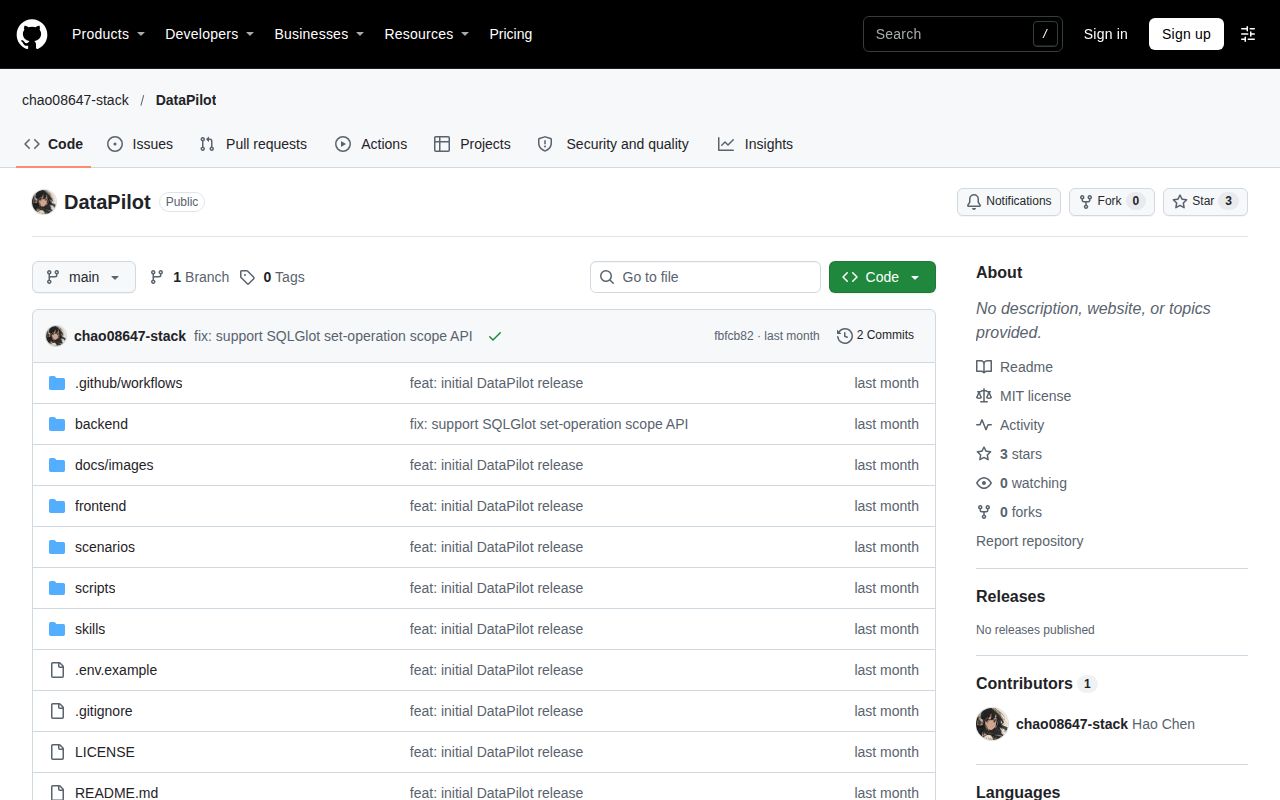
GitHub metadata observed on November 14, 2026 recorded 3 stars, 0 forks, zero currently open issues and pull requests, and a last push on October 3, 2026. These figures describe attention and current repository activity. The setup, community and maturity cards carry N/A, with their assessment boundaries collected in the final section. The measured timeout and documented prerequisites are more directly useful when planning the next evaluation. DataPilot repository metadata
DataPilot vs alternatives
Metabase documents questions over data, a SQL editor and interactive dashboards; AltimateAI DataPilot CLI documents checks for SQL and dbt projects. Those purposes help separate two possible requirements: presenting reports to a team and checking a data project's practices. The target DataPilot README describes a third workflow, agent-led business analysis with semantic models and retained SQL evidence. Choose an evaluation candidate according to the task.
| Candidate | Documented purpose | Choose it when |
|---|---|---|
| chao08647-stack/DataPilot | Agent-led business analysis with semantic models, SQL evidence and charts | You want to inspect that workflow and manage its database and model configuration |
| Metabase, metabase/metabase | Questions over data, a SQL editor and interactive dashboards | Your requirement is a team reporting and dashboard interface |
| DataPilot CLI, AltimateAI/datapilot-cli | SQL and dbt project-practice checks with Git and CI/CD integration | Your requirement is data-project health checks |
| DATAPILOT forensic products | Mobile-device evidence acquisition and analysis | Your requirement concerns digital forensics |
Metabase's README documents interactive dashboards with filters, auto-refresh and custom click behavior. AltimateAI's README describes local checks and integration with Git and CI/CD to enforce project standards. These documented purposes explain their inclusion in the comparison and give readers a next source to inspect. The comparison assigns no performance advantage over the measured DataPilot checkout. Metabase README, AltimateAI DataPilot CLI record
What the other reviews cover
Forensic Focus's supplied review concerns Susteen's Data Pilot 10 and acquiring mobile-device evidence in the field. The vendor homepage calls its category "Mobile Forensic Evidence Acquisition and Analysis". Those records explain the forensic results in the supplied research. They concern a different product from this SQL analytics repository, so their acquisition findings belong to the device they identify. Forensic Focus review, forensic vendor category
The DP10 update page directs owners to save a file to an external drive and use Settings > Admin > Offline Update. For the analytics workbench, the relevant instructions are the target repository's native startup steps. Matching the owner and task keeps an installer or product review attached to the software or hardware it actually describes. DP10 update instructions
FAQ
chao08647-stack/DataPilot is the SQL analytics workbench reviewed here; AltimateAI DataPilot CLI and DATAPILOT forensic products are separate entities. The questions below come from the supplied synthesis and search intents. Answers use the target README for the workbench's documented behavior and the named research records for product identity. The recorded suggestions identify questions in this pack, without supplying search-volume figures. Recorded search suggestions
Which DataPilot project or company do these search results refer to?
The supplied results include the analytics repository, AltimateAI's SQL and dbt CLI, and DATAPILOT forensic products. Match both owner and purpose when selecting documentation or an installer. For this review, chao08647-stack/DataPilot is the entity attached to the measured commit fbfcb82 and the supplied business-analysis README. The alternative CLI's stated purpose is project-practice checks. Target README, CLI record
Does chao08647-stack/DataPilot require a login?
The supplied README does not establish whether authentication is required; we have not tested authentication enforcement. It documents a local workbench at 127.0.0.1:5174 and backend health endpoint at 127.0.0.1:8010/api/v1/health. Its startup sequence covers dependencies, model settings, database initialization and the two processes. Follow those steps for local evaluation; the final section collects the shared-access assessment boundary. DataPilot local startup
What AI capabilities does chao08647-stack/DataPilot provide?
The README describes discovery, SQL, analysis and visualization agents coordinated by a supervisor. It also describes clarification pauses, task recovery and retrieval of successful SQL repair experience. Model configuration uses an OpenAI-compatible language-model service, with optional embeddings and full-text fallback. These stages give an evaluator specific outputs and transitions to inspect against a business question with an agreed answer. DataPilot workflow and model settings
Where can I download chao08647-stack/DataPilot?
The source is on GitHub under chao08647-stack/DataPilot, and its README documents native Windows/PowerShell startup. That route installs backend and frontend dependencies, configures model connections, initializes PostgreSQL and starts the processes separately. Keep the project-root requirement in mind when following its commands, because the documented paths refer to files and directories within that checkout. DataPilot source and startup
What does chao08647-stack/DataPilot cost to run?
The README identifies the code as MIT licensed and states that creating an analysis calls the LLM. Generating business data, starting services and reading history do not call the model. Optional installation of domain memory can call the embedding service when configured. These triggers identify activities to track when estimating expense with a selected provider and hosting arrangement. DataPilot license and model-call behavior
Is chao08647-stack/DataPilot connected to OceanBase?
The README names PostgreSQL and DuckDB as its connectors, while OceanBase appears in the supplied search suggestions. Use the documented connector list when planning an evaluation: business domains bind data sources, semantic models organize metrics and relationships, and application state resides in PostgreSQL. The supplied suggestion is a reader question rather than an integration specification. DataPilot connector description
Do DataPilot 10 versus Cellebrite comparisons apply to chao08647-stack/DataPilot?
The supplied Data Pilot 10 review concerns mobile-device evidence acquisition, so it addresses a different purchasing decision. This repository's assessment instead rests on its documented SQL workflow and the measured source steps. Use the owner-qualified repository name to select the relevant setup instructions and review evidence, then compare candidate tools according to the business-analysis task you need to complete. Forensic Focus review record, analytics README
What we have not tested yet
Our records contain no completed business-analysis session, independently checked answer set or deployment screenshot. The conflicting generic Compose entry supplies no reliable deployment-success evidence beyond the failed safety step. Cross-table accounting accuracy, clarification and recovery, repeated SQL repairs, English questions, interface localization and charts from our own dataset remain outside this evaluation. The maintainer examples are demonstrations; supplied community records concern other DataPilot entities.
The image label supplies no actual runtime or operating-system version, and the build record supplies no separate frontend outcome. The suite ended without a final summary or identified active test, leaving its completed-test count and timeout cause unknown. Native startup completion, working-set memory, query latency, provider usage, operating cost, concurrent sessions and memory-store growth also lack measurements. The allocated 8 GB describes sandbox configuration.
Shared-access controls, tenancy, secret handling, SQL-policy bypass resistance, backup and restore, and production permissions remain outside the evaluation. The audit's zero finding concerns known dependency advisories across its recorded coverage. Historical issue responses, release availability, support responsiveness and operational reliability lack supplied evidence for judgment. No existing review pages were supplied for duplicate inspection. The next useful result is a completed native deployment with reconciled totals, SQL and intermediate results preserved.