DataFusion is a query-engine kit, not a finished database
Apache DataFusion supplies the machinery developers normally have to assemble before a data product can answer SQL: parsing and planning, logical and physical optimization, and a columnar execution engine over Apache Arrow. The README describes streaming, multithreaded, vectorized execution and partitioned data sources. It also emphasizes customization, so teams can add data sources, query languages, functions, and operators instead of accepting one fixed database interface.
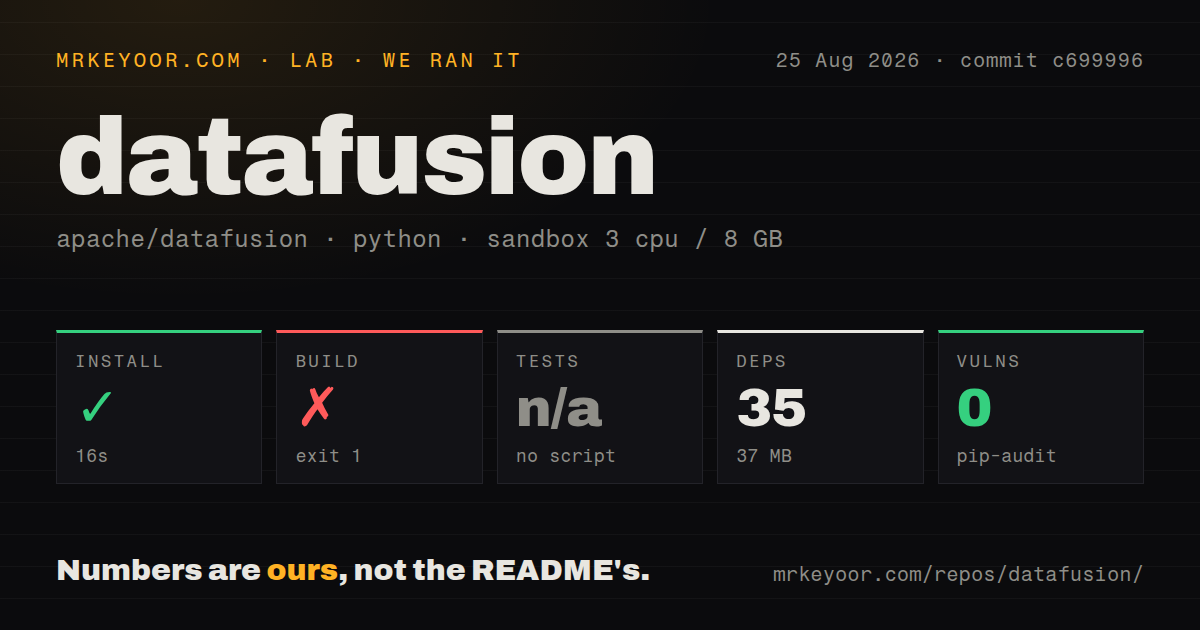
commit c699996 was large enough to demand planning before contribution. Our checkout held 5,181 files, about 952,983 lines of source, and occupied 879.3 MB. GitHub identifies Rust as the primary language. The repository exposed 14 CI workflow files but no root Dockerfile or tests directory in our scan. Those signals fit a substantial engine workspace, even though the lab's automatic path identified and attempted a Python build.
Rust is the main route, while Python lives elsewhere
The README calls DataFusion an extensible Rust query engine and links directly to Cargo documentation, Rust examples, and the Rust DataFrame API. Python and Java users are sent to separate binding repositories. Spark acceleration lives in DataFusion Comet, and distributed execution across a cluster lives in Ballista. That separation is useful: adopting this crate does not automatically deliver every language binding or deployment topology carrying the DataFusion name.
Out of the box, the engine reads CSV, Parquet, JSON, and Avro and exposes SQL plus DataFrame APIs. The crate's default features include 10 named groups covering nested expressions, compression, cryptography, dates, encoding, Parquet, SQL, regular expressions, Unicode, SQL unparsing, and recursion protection. Optional flags add Avro, backtraces, Parquet encryption, and Serde support. Teams sensitive to compile time or binary size should inspect which defaults their product needs.
What happened when we ran it
Our harness used a Python 3.12 Bookworm environment for commit c699996. Installation succeeded in 16 seconds, adding 35 packages and using 37 MB on disk. The build then failed with exit code 1 after 4 seconds. The supplied measurement did not include the failing log tail, so it would be speculation to name a missing compiler, dependency, command, or source defect.
No test script or target was detected, so the harness skipped tests. Pip-audit reported 0 known vulnerabilities in the Python packages it installed. These results do not say that DataFusion's Rust tests are absent or failing; they say our automatic run did not reach them. A valid adoption check should start from the project's documented Cargo instructions and record that separate build and test evidence rather than reinterpret this mismatched path as success.
Arrow data is the common contract for extension
DataFusion uses Apache Arrow as its in-memory representation, which is the main architectural commitment an embedding system accepts. Custom sources and operators exchange columnar batches through that model. The README also describes a full planner and execution engine, letting a product begin above the storage and query mechanics instead of implementing them from scratch. That is appealing for domain databases, but it ties extension code to DataFusion and Arrow APIs that the team must track.
The project states that public methods evolve as the engine improves. Its policy generally deprecates methods before removal, which is better than silent breakage but weaker than a permanent API freeze. With nearly 953,000 measured source lines and many default features, upgrades deserve compile checks against product-specific planners, expressions, and data-source adapters. A passing upstream release alone cannot exercise a private operator or query language.
Same-day issue work matters more than a missing GitHub release
GitHub showed 9,200 stars, 2,099 combined open issues and pull requests, and a last push on August 26, 2026. The current activity list included same-day fixes for struct casts, percentile precision, pruning, arithmetic negation, FFI planning, and hash-join memory. Two open issues about reserved names and narrowing casts were also updated that day. The combined count includes pull requests and should not be described as a bug total.
The GitHub latest-release endpoint returned no release object. That is not evidence that DataFusion is abandoned, because repository and issue activity were current on August 26 and the README links to the crate distribution. The project also points contributors to a 2026 Q3-Q4 roadmap discussion. Consumers should follow the crate and Apache release channels they actually install rather than use GitHub's missing latest-release record as a health proxy.
Pick DataFusion when customization justifies engine ownership
DataFusion makes sense when a team needs a query engine inside its own system and intends to control planning, functions, storage, or execution. The Apache-2.0 license, Arrow model, SQL support, and documented extension surface form a credible base. Python users should start with the separate binding, while cluster users should evaluate Ballista or another distributed engine.
Our failed 4-second build prevents a clean setup recommendation from this lab run. It also exposes an automation mismatch worth correcting in any evaluation: the upstream project is Rust, yet our harness installed Python packages. Before adoption, run the Cargo path on the intended toolchain, select crate features deliberately, execute relevant upstream tests, and add product queries that exercise private extensions. Without that evidence, the repository's scope and activity are promising facts, not proof that it fits a specific system.