This tool automates privileged exploitation
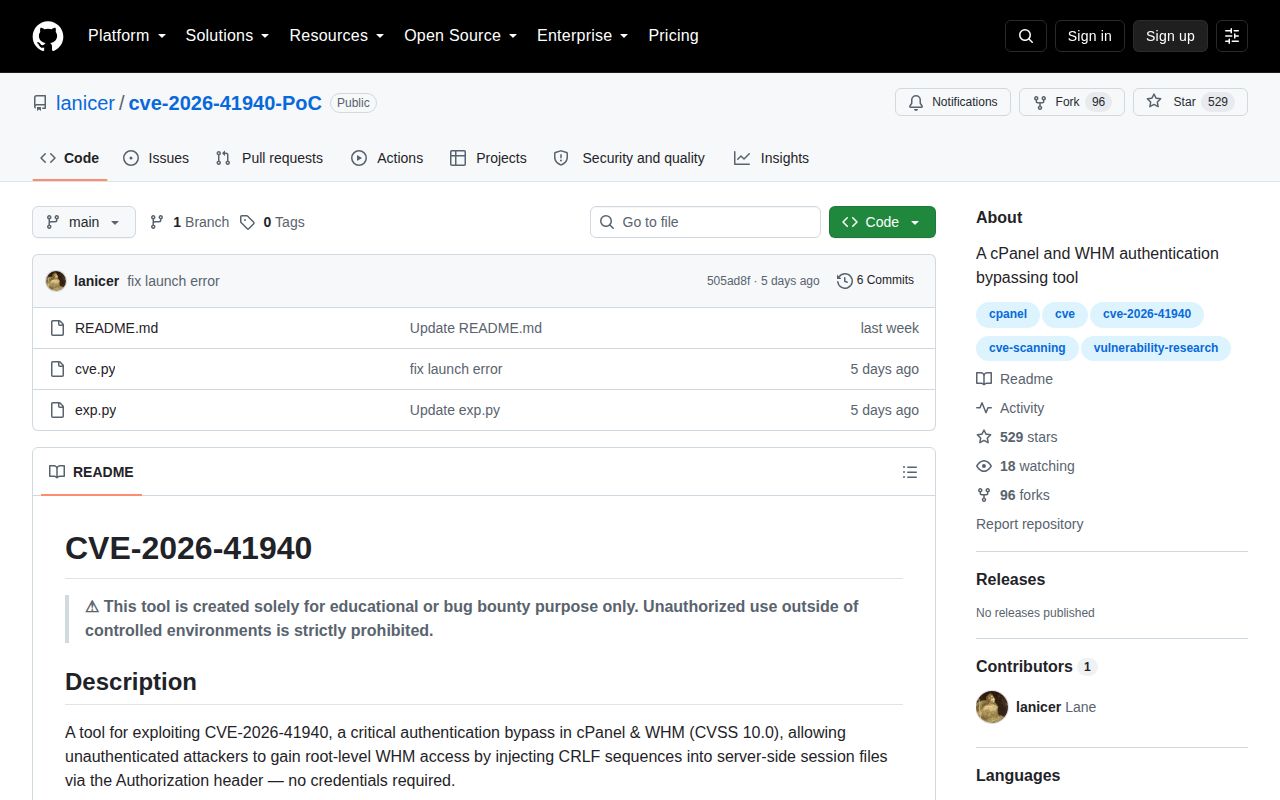
The repository packages CVE-2026-41940 into a Python command-line program aimed at cPanel and WHM endpoints. Its README describes an authentication bypass in session handling and supplies single-target, list, and pipeline modes. Successful access can lead to server information, account listings, operating-system command execution, password changes, and account creation. Those capabilities make it useful for reproducing the vulnerability in a controlled lab. They also make it a poor first choice for an administrator who only wants to know whether a production server has been patched.
The disclaimer limits use to education or bug-bounty work, yet a disclaimer does not establish authorization. The documented examples include batches of targets and discovery sources, while the shell exposes actions that can alter a host. A competent tester should define the written scope, isolate outputs, set conservative concurrency, and use a disposable system. An operator investigating a real server should begin with cPanel's update and detection instructions, then preserve evidence before running code that might change state.
What happened when we ran it
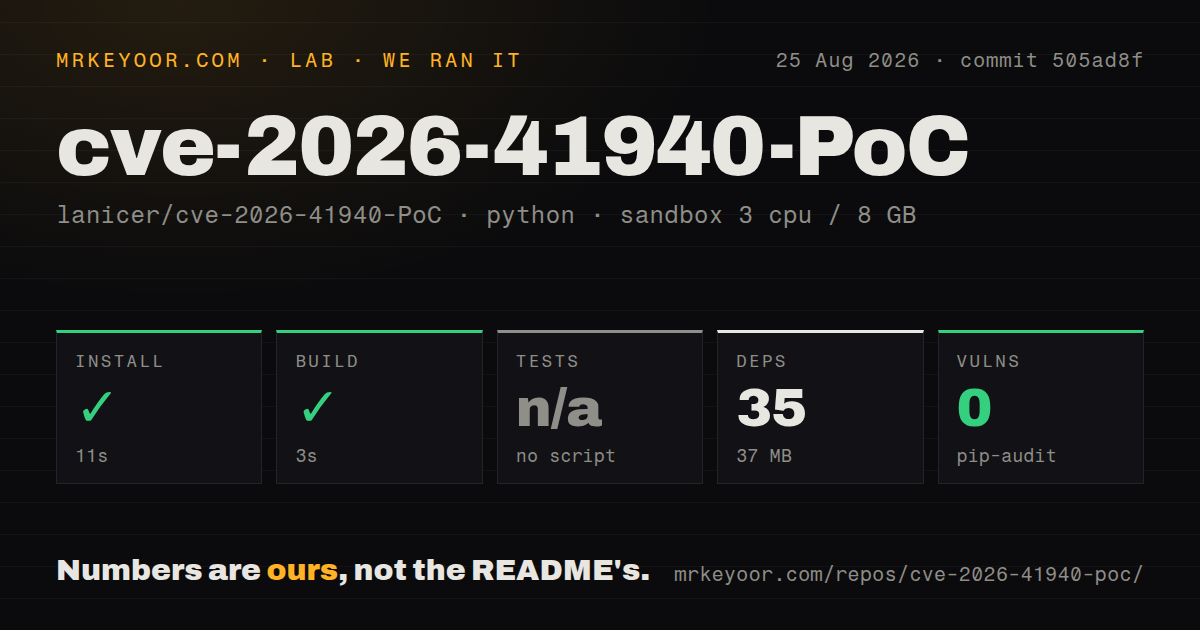
Our sandbox cloned commit 505ad8f, a repository containing 3 files and about 343 source lines. Python dependency installation succeeded in 11 seconds, pulling 35 packages and occupying 37 MB. The lab build step then completed in 3 seconds. That is a low setup cost for a security research utility, and it broadly supports the README's claim that the program can be launched directly with Python. We supplied no secrets and did not point it at a live target.
No test script or target was present, so our harness skipped testing. The repository also had no tests directory, CI workflow, or Dockerfile. Pip-audit found 0 known vulnerabilities in the dependency set installed during our run, which is useful but narrow: it says nothing about whether the exploit detects versions correctly, handles failures safely, or reports false positives. Those behaviors need fixtures or a controlled cPanel matrix, and the project publishes neither.
The README's 6-branch table is incomplete
The affected-version section lists patch thresholds for 11.110, 11.118, 11.126, 11.132, 11.134, and 11.136. cPanel's official live advisory names patched builds for those branches and also covers 11.86, 11.94, 11.102, 11.124, and 11.130, plus a separate legacy update path. That mismatch matters because administrators may read a short table as a complete exposure matrix. Use the vendor notice for patch decisions, especially on older installations or pinned update tiers.
The official response is direct: update to a patched build, verify the installed version, and restart the cPanel service. It also warns that disabled updates and pinned configurations require manual attention. None of those operational checks needs a third-party exploit. A PoC becomes relevant after a defender has built a disposable reproduction or when an authorized tester needs to prove impact. It should not replace inventory, version confirmation, log review, or the vendor's current mitigation guidance.
Three files leave little room for assurance
Small code can be easy to audit, and roughly 343 lines are short enough for a reviewer to read before execution. The tradeoff is missing project machinery. There is no declared license, no tagged release, no issue history, and no automated verification. GitHub showed the repository was created on August 19, 2026 and last pushed on August 20. That one-day public history provides too little evidence to judge how the tool responds to cPanel changes or whether its current output is stable.
No license is more than a paperwork nuisance. Public source can be viewed, but absence of a license does not grant broad permission to copy, modify, or redistribute it. Security teams that archive tools, patch them for internal use, or bundle them into assessment images should involve whoever owns their software policy. A mature scanner also needs consistent result formats, safe defaults, failure cases, and regression tests. This repository documents JSON output and rate controls, yet the lab found no test target to verify them.
Defenders should choose the vendor route first
For a cPanel owner, the decision is straightforward: use the official advisory, update, verify the build, restart the service, and investigate signs of misuse through an incident-response process. A broader scanner such as OpenVAS can fit routine vulnerability management, while Nuclei's template ecosystem is better suited to peer-reviewed, repeatable checks if a suitable template has been validated. Neither alternative grants permission to scan systems outside your control.
Researchers may still find this PoC convenient because our 11-second install and 3-second build put little friction between code review and a lab trial. Read all 3 files first, remove or disable actions you do not need, and capture traffic against a disposable instance. Do not treat a successful run as the only proof of vulnerability, or a failed run as proof of safety. With no tests and an incomplete version table, every result needs confirmation against the cPanel advisory and the actual installed build.