CrowdSec v1.8.1 needs a separate enforcement component
CrowdSec v1.8.1 reads defined log sources, normalizes events, evaluates behavior against scenarios, and stores alerts and decisions in a Local API. Remediation components, still called bouncers in parts of the tooling, fetch those decisions and enforce them through a firewall, reverse proxy, cloud edge, or application. The split is the central buying fact. The engine can detect a brute-force pattern while traffic keeps flowing if no suitable remediator is installed and connected.
The documented defaults bind the API to port 8080/tcp and Prometheus metrics to 6060/tcp on loopback. Hub collections package parsers, scenarios, and enrichers for particular services. Since version 1.7.0, setup can detect running services and choose likely collections and acquisition files. Operators still need to verify that expected sources appear and that their lines are being parsed.
What happened when we ran it
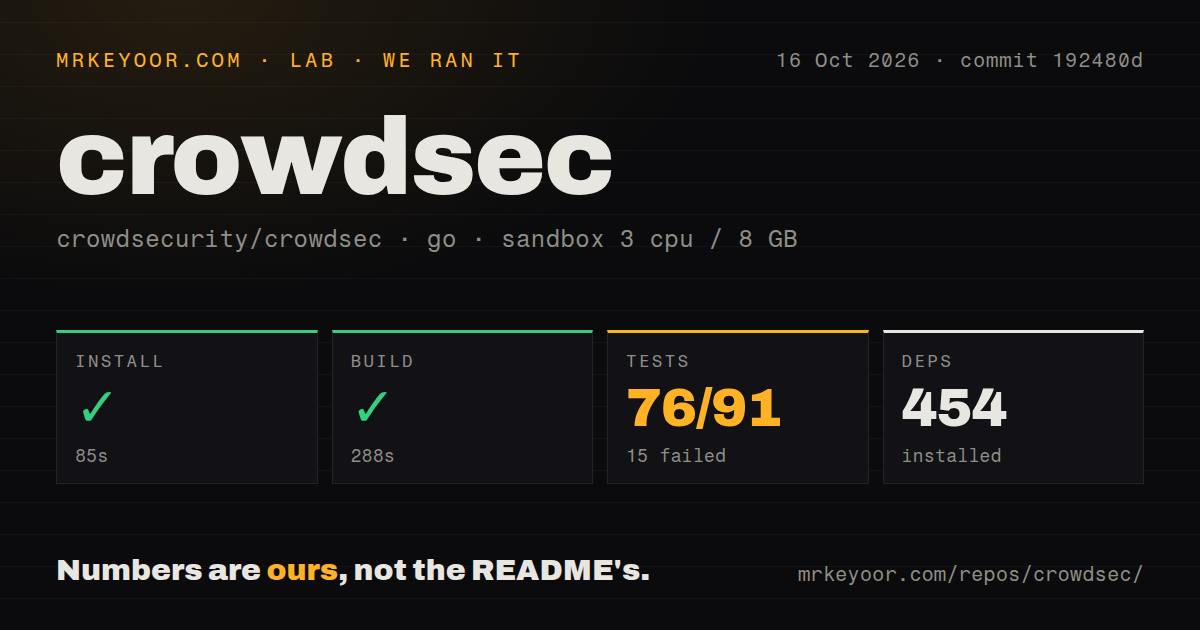
Our sandbox installed 459 Go packages in 72 seconds at commit 909b515, then completed the build in 250 seconds. The test command ran for 478 seconds and exited 1: 66 packages passed and 18 failed out of 84. The fresh Debian container had 3 CPUs, 8 GB of RAM, no secrets, and the golang:1.24-bookworm image. Source compilation worked, but the complete test gate did not.
The supplied log tail shows several packages passing, followed by TestFailWithoutExprDebug failing in pkg/exprhelpers and the suite ending with FAIL. It has no assertion message and does not identify the causes of the other 17 failures. The checkout contained 2,293 files, roughly 196,781 source lines, and 14.9 MB. We counted 19 CI workflow files and a tests directory, with no Dockerfile.
Log acquisition and a bouncer make blocking real
In v1.8.1, package installation is only the first part of a working defense. CrowdSec needs access to service logs, a parser that understands them, and scenarios that turn repeated behavior into decisions. Acquisition metrics show lines read, parsed, unparsed, and whitelisted for each source. An empty or incomplete table is a configuration problem even when the daemon is healthy.
Enforcement adds another process and credential. A manually installed remediation component needs an API key generated by cscli; packaged installers may create it when the component shares a machine with the Local API. CrowdSec's health check separately verifies detection, network connectivity, and remediation. That is useful guidance for custom proxy paths, container log mounts, and distributed installations.
Free blocklists trade wider coverage for eligible signal sharing
The v1.8 docs say regular free contributors receive a Community Blocklist of 15,000 malicious IPs, while free non-contributors receive a Lite list capped at 3,000. Paying users receive the Premium list without contributing. Lists are tailored to scenarios on each engine. Custom or modified scenarios still work locally, but their signals do not count toward contribution because the central service cannot verify them against an official Hub hash.
Unless an operator opts out, the Central API receives the scenario name, its hash and version, the decision timestamp, machine ID, and offending IP with location data when available. Console metrics include deployed engine and remediator names and versions. Organizations with strict data policies should review that exchange and decide whether the smaller Lite list or a paid plan changes the value.
AppSec v1.8 has live edge cases around CSP and large uploads
AppSec in v1.8 forwards an HTTP request from a supported server or proxy to the Security Engine. In-band rules can return a ban or challenge for the current request; asynchronous rules can create later decisions from repeated behavior. Rule files alone do nothing. The docs also require an AppSec acquisition source, a restart, and a remediator that forwards requests to the same listening address.
Two open reports deserve a preproduction test. Issue 4646 describes bot detection on v1.8.0 failing to load when a front Nginx server already sends a strict Content-Security-Policy; its workaround changes the proxy path. Issue 4636 describes uploads above 1 GB failing with a Lua memory error in an NPMPlus and Immich setup on v1.7.8, even after body inspection was disabled for that route. Each report names a specific topology rather than proving a general failure.
One Local API can coordinate several hosts from v1.6.4
Since v1.6.4, remediation components on different machines can share one API key. Log processors register with a central Local API, which applies profiles and exchanges data with the Central API. The guide supports password credentials or TLS authentication and warns that a processor can submit alerts capable of locking out users. Exposing port 8080 beyond loopback therefore calls for tight network ranges and protected credentials.
Log processors do not share events with each other. If a load balancer spreads one attack across several servers, each processor sees only its portion and may take longer to reach a scenario threshold. CrowdSec recommends central logging with one processor for that case. Installing a processor everywhere does not make its local event windows combine automatically.
September 2026 activity is high, and so is issue volume
GitHub showed 14,741 stars, 221 open issues, and 72 open pull requests when we fetched CrowdSec on September 3, 2026. The repository was pushed that day. Version 1.8.0 shipped on August 31, followed by v1.8.1 on September 3 with a fix for a Brave Browser bot-detection false positive. The 293-item combined queue makes it sensible to search for an exact proxy, database, and remediator before rollout.
CrowdSec suits operators who need shared intelligence and more deployment choices than Fail2Ban provides. The successful source build and current release cadence are encouraging; our 18 failing package tests prevent an unconditional recommendation for commit 909b515. Trial the actual log sources and enforcement path, inspect Central API policy, and run the documented health checks. Suricata is the packet-level choice, while Wazuh covers endpoint functions CrowdSec does not claim.